
Renesis Insights

Renesis Team
Why Fund Managers Are Using Renesis to Report on Enzyme Vault Positions
How crypto funds track and report DeFi vault positions: Enzyme vault accounting, receipt tokens, and clean LP reporting from one ledger.
The Reporting Gap in Vault Investing
When crypto funds invest through vaults, the vault does a good job of managing the investment itself. It records how much has been deposited, what assets are held inside the vault, and how much each vault share is worth. In other words, from the vault's perspective, the pricing and accounting layer is already taken care of. But this is only one part of what a professional investment fund needs. A fund manager doesn't just need to know that they own a certain number of vault shares.
They also need to understand how that investment fits into the entire fund. For example, if the fund owns Bitcoin on an exchange, Ethereum staking positions, several DeFi investments, and a vault position with a protocol like Enzyme, all of those investments need to be combined into one overall portfolio. The manager needs to know questions like: How much is this vault investment worth today? How much has it contributed to the fund's total NAV (Net Asset Value)? How much profit has it generated? What percentage of the fund does it represent?
This information is also important for people outside the fund. LPs, who are the investors in the fund, expect professional reports that clearly show how their money is performing. Auditors need detailed records to verify that the fund's financial statements are accurate. A fund's internal risk team also needs consistent data to measure exposure, monitor performance, and make informed investment decisions. So, simply having onchain data or a vault share balance is not enough for any of these purposes.
Vault protocols like Enzyme provide the tokenization and accounting layer for a fund, not the custody or execution layer. An Enzyme Vault is a smart contract that issues Vault Shares representing an investor's claim on the vault, not a container that holds the underlying positions itself. When an investor deposits, funds land in the Vault contract. From there, the Vault Owner withdraws them into a separate Management Wallet, custodied through whatever solution or platform they use, a multisig like Safe, a custodian like Fireblocks, an exchange like Kraken, and that's where the strategy is actually run.
The Vault Owner or Manager then values that portfolio and reports it into Enzyme's Administration App, which calculates the NAV and updates the Vault Share price accordingly. So the Vault Share doesn't hold the underlying positions directly, it prices them, based on the valuation the manager reports. The missing piece here is reporting: taking that NAV data, and the data from every other venue a fund uses, and turning it into something investors, auditors, and fund managers can easily understand and use, all in one place.
This is where Renesis.fi comes in. Renesis is built to run, report on, and analyze a fund's entire portfolio across centralized exchanges, custody platforms, and a wide range of vault protocols, with Enzyme as one example of the vault infrastructure it supports. Instead of requiring fund managers to manually pull data out of each venue into spreadsheets every month, Renesis automatically reads the position data, calculates each investment's contribution to the overall fund, measures its performance, and generates professional reports. Those reports can then be shared with LPs, used during audits, or incorporated into the fund's internal risk management process.
The Problem With Vault Positions on a Spreadsheet
A vault position on a protocol like Enzyme isn't the underlying assets sitting inside the vault contract. It's a Vault Share, an ERC-20 token, priced against the NAV that the Vault Owner or Manager reports based on the assets they actually manage through their custody solution of choice. That NAV, denominated in whatever accounting currency the vault owner has set, is genuinely useful data. But a fund holding that position still has to answer a harder question: what does this position mean for my fund's NAV, in my base currency, next to my CEX balances and my other DeFi positions, on the day my LPs expect a report?
Manually, that means pulling the vault's share price, converting it, matching it against a cost basis, and reconciling it by hand every reporting period, for every venue the fund uses. It works until a fund holds positions across more than one vault protocol, or until a vault's accounting currency doesn't match the fund's base currency, or until an LP asks a question that requires drilling into when a position was entered and what it's returned since. At that point the spreadsheet stops holding up.
How Renesis Shows Vault Positions in the PMS
Renesis treats a vault position the same way it treats every other position in the book: as a live line item in the portfolio, not a static entry that gets refreshed at month-end. That applies whether the position sits on a centralized exchange or is represented by a Vault Share on a protocol like Enzyme.
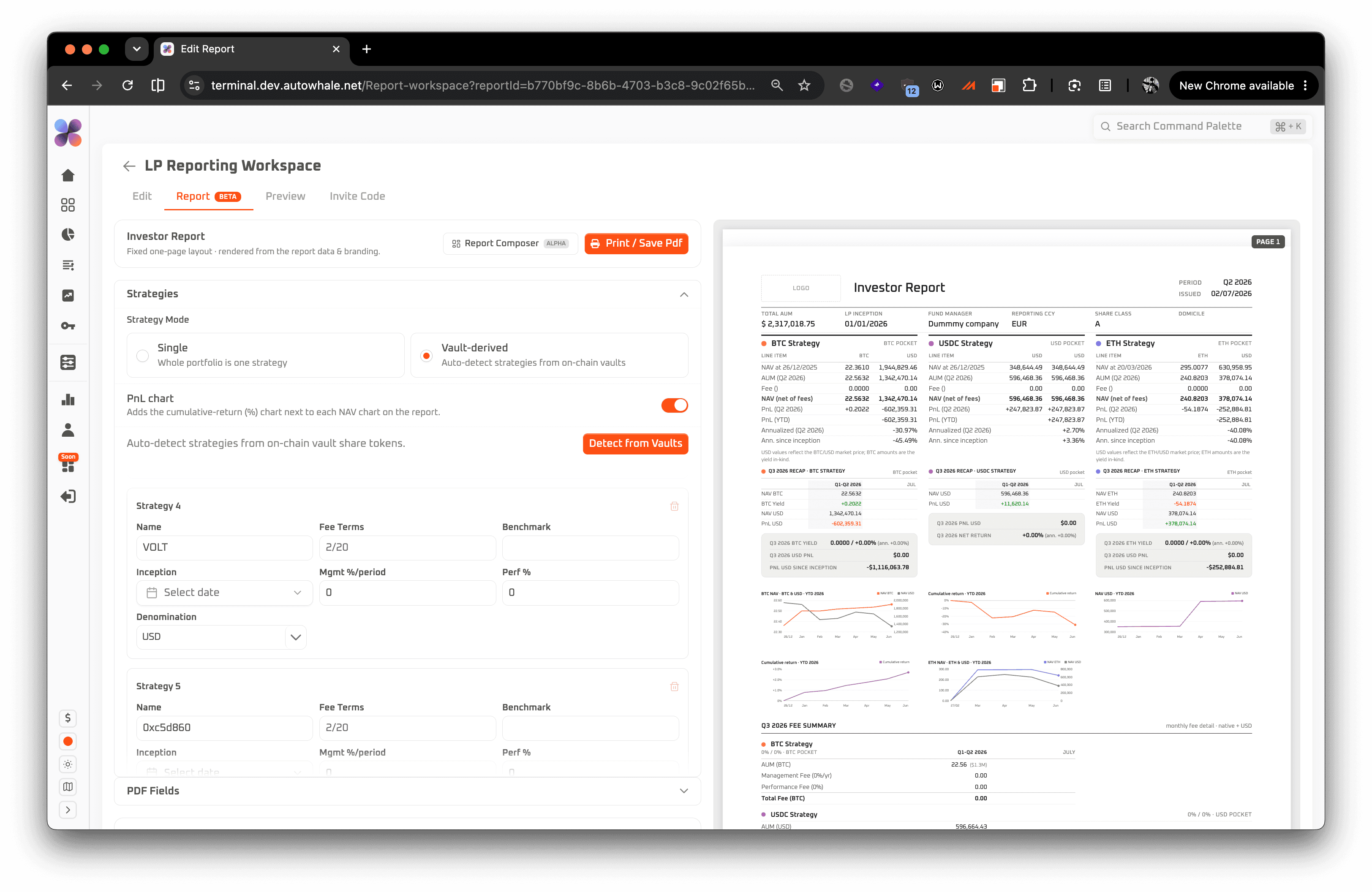
Inside the LP Reporting Workspace, a fund can set Strategy Mode to Vault-derived, then hit Detect from Vaults to auto-detect strategies directly from on-chain vault share tokens, across the range of vault protocols Renesis supports. An Enzyme Vault Share is one example of this kind of token, so it gets picked up and mapped into its own strategy line, priced off the vault's reported NAV, without a manager manually re-entering the position, its fee terms, or its inception date.
Once detected, each vault strategy carries the same structured fields as any other position in the book: name, fee terms, benchmark, inception date, management and performance percentages, and denomination currency. That's the same data model whether the position sits on a CEX, in a perp, or is represented by a Vault Share on a protocol like Enzyme.
From Position to Investor Report
The harder problem isn't seeing the position. It's turning every position a fund holds, across every venue, into something a fund can hand to an LP.
Renesis generates a one-page Investor Report straight from the same live data feeding the portfolio, no separate export or manual rebuild required. The report opens with fund-level context, Total AUM, LP inception date, fund manager, reporting currency, share class, and the reporting period, then breaks out a dedicated block per strategy, whether that strategy sits on a CEX or is represented by a Vault Share on a protocol like Enzyme.
For a vault strategy like an Enzyme position, that block shows:
NAV at period start and current AUM, in both the vault's native asset and USD
NAV net of fees, alongside the fee actually charged
PnL for the period and year-to-date, plus annualized return and annualized return since inception
A NAV chart and a cumulative return chart, so an LP can see the shape of the return, not just the number
A fee summary further down the report: AUM, management fee, performance fee, and total fee, broken out by strategy
Because it's rendered directly from the report data and the fund's branding, a manager gets a clean, print-ready PDF with one click, Print / Save PDF, covering every position in the fund, across exchanges, custody platforms, and vault protocols alike, rather than a spreadsheet reformatted the night before an LP call.
Why This Matters More Than It Looks Like It Should
Curated vault infrastructure like Enzyme has made it straightforward for fund managers to wrap a strategy into a tokenized, investor-ready Vault Share, one of a growing number of ways funds now structure and distribute their capital. What hasn't kept pace is reporting on those positions alongside everything else the fund holds across custody platforms and exchanges. That gap is usually where funds lose credibility with LPs, not on the strategy itself. A manager who can't produce a clean, consolidated report on demand looks like a manager running a spreadsheet operation, regardless of how the underlying positions performed.
Renesis exists to remove that gap: real-time NAV, protocol-level attribution, and reporting that treats every position in the fund the same way, whether it's on a centralized exchange, with a custody platform, or represented by a Vault Share on a protocol like Enzyme, live, reconciled, and ready to show an LP without a weekend of manual work first.
*Renesis is a unified portfolio management and execution platform for liquid crypto funds under $150M, with real-time NAV and protocol-level tracking across 90+ integrations spanning CeFi and DeFi, including vault platforms like Enzyme.*
Still not sure if Renesis is right for you?
Ask ChatGPT, Claude or Perplexity what they have to talk about us. Click below to ask your favorite AI about us:
" height="40px" id="b6zcrI2Wj" width="40.000000141897665px"/></svg>)
" height="40px" id="q3tXZs9hp" width="40px"/></svg>)
" height="40px" id="zrymccGxZ" width="35px"/></svg>)
Continue reading
Renesis Insights
Portfolio Valuation: How Investment Portfolios Are Actually Valued
What portfolio valuation is, who performs it, the fair value hierarchy across asset classes from listed equities to private equity and digital assets, and how valuation is becoming continuous
Renesis Insights
The Best Staking Platforms in 2026: An Institutional Guide
The best staking platforms in 2026 for funds, treasuries and DAOs: institutional providers, custodial routes and liquid staking compared on custody, slashing, reporting and accounting, not headline APY.
DeFi Research
NAV Attestation: How Vault and DeFi Fund NAVs Get Verified
What NAV attestation means for crypto vaults and DeFi funds: real-time on-chain attestation, administrator and auditor attestation, and how it differs from proof of reserves.
DeFi Research
Pendle Position Tracker: How Funds Track and Value PT, YT and Looped Positions
A Pendle position tracker built for funds: how PT, YT, looped and nested positions should be tracked and valued, and the edge cases that silently break NAV.
See how Renesis brings continuous valuation to digital asset portfolios.
Built by builders.
For builders.
We're a DeFi-native team shipping fast. No enterprise sales cycles, no bloated pricing. Start free, talk to us when you're ready.
Sep 8, 2026
Renesis Insights
Thomas Pratter
Portfolio Valuation: How Investment Portfolios Are Actually Valued
What portfolio valuation is, who performs it, the fair value hierarchy across asset classes from listed equities to private equity and digital assets, and how valuation is becoming continuous
Sep 8, 2026
Renesis Insights
Thomas Pratter
Portfolio Valuation: How Investment Portfolios Are Actually Valued
What portfolio valuation is, who performs it, the fair value hierarchy across asset classes from listed equities to private equity and digital assets, and how valuation is becoming continuous
The Reporting Gap in Vault Investing
When crypto funds invest through vaults, the vault does a good job of managing the investment itself. It records how much has been deposited, what assets are held inside the vault, and how much each vault share is worth. In other words, from the vault's perspective, the pricing and accounting layer is already taken care of. But this is only one part of what a professional investment fund needs. A fund manager doesn't just need to know that they own a certain number of vault shares.
They also need to understand how that investment fits into the entire fund. For example, if the fund owns Bitcoin on an exchange, Ethereum staking positions, several DeFi investments, and a vault position with a protocol like Enzyme, all of those investments need to be combined into one overall portfolio. The manager needs to know questions like: How much is this vault investment worth today? How much has it contributed to the fund's total NAV (Net Asset Value)? How much profit has it generated? What percentage of the fund does it represent?
This information is also important for people outside the fund. LPs, who are the investors in the fund, expect professional reports that clearly show how their money is performing. Auditors need detailed records to verify that the fund's financial statements are accurate. A fund's internal risk team also needs consistent data to measure exposure, monitor performance, and make informed investment decisions. So, simply having onchain data or a vault share balance is not enough for any of these purposes.
Vault protocols like Enzyme provide the tokenization and accounting layer for a fund, not the custody or execution layer. An Enzyme Vault is a smart contract that issues Vault Shares representing an investor's claim on the vault, not a container that holds the underlying positions itself. When an investor deposits, funds land in the Vault contract. From there, the Vault Owner withdraws them into a separate Management Wallet, custodied through whatever solution or platform they use, a multisig like Safe, a custodian like Fireblocks, an exchange like Kraken, and that's where the strategy is actually run.
The Vault Owner or Manager then values that portfolio and reports it into Enzyme's Administration App, which calculates the NAV and updates the Vault Share price accordingly. So the Vault Share doesn't hold the underlying positions directly, it prices them, based on the valuation the manager reports. The missing piece here is reporting: taking that NAV data, and the data from every other venue a fund uses, and turning it into something investors, auditors, and fund managers can easily understand and use, all in one place.
This is where Renesis.fi comes in. Renesis is built to run, report on, and analyze a fund's entire portfolio across centralized exchanges, custody platforms, and a wide range of vault protocols, with Enzyme as one example of the vault infrastructure it supports. Instead of requiring fund managers to manually pull data out of each venue into spreadsheets every month, Renesis automatically reads the position data, calculates each investment's contribution to the overall fund, measures its performance, and generates professional reports. Those reports can then be shared with LPs, used during audits, or incorporated into the fund's internal risk management process.
The Problem With Vault Positions on a Spreadsheet
A vault position on a protocol like Enzyme isn't the underlying assets sitting inside the vault contract. It's a Vault Share, an ERC-20 token, priced against the NAV that the Vault Owner or Manager reports based on the assets they actually manage through their custody solution of choice. That NAV, denominated in whatever accounting currency the vault owner has set, is genuinely useful data. But a fund holding that position still has to answer a harder question: what does this position mean for my fund's NAV, in my base currency, next to my CEX balances and my other DeFi positions, on the day my LPs expect a report?
Manually, that means pulling the vault's share price, converting it, matching it against a cost basis, and reconciling it by hand every reporting period, for every venue the fund uses. It works until a fund holds positions across more than one vault protocol, or until a vault's accounting currency doesn't match the fund's base currency, or until an LP asks a question that requires drilling into when a position was entered and what it's returned since. At that point the spreadsheet stops holding up.
How Renesis Shows Vault Positions in the PMS
Renesis treats a vault position the same way it treats every other position in the book: as a live line item in the portfolio, not a static entry that gets refreshed at month-end. That applies whether the position sits on a centralized exchange or is represented by a Vault Share on a protocol like Enzyme.
Inside the LP Reporting Workspace, a fund can set Strategy Mode to Vault-derived, then hit Detect from Vaults to auto-detect strategies directly from on-chain vault share tokens, across the range of vault protocols Renesis supports. An Enzyme Vault Share is one example of this kind of token, so it gets picked up and mapped into its own strategy line, priced off the vault's reported NAV, without a manager manually re-entering the position, its fee terms, or its inception date.
Once detected, each vault strategy carries the same structured fields as any other position in the book: name, fee terms, benchmark, inception date, management and performance percentages, and denomination currency. That's the same data model whether the position sits on a CEX, in a perp, or is represented by a Vault Share on a protocol like Enzyme.
From Position to Investor Report
The harder problem isn't seeing the position. It's turning every position a fund holds, across every venue, into something a fund can hand to an LP.
Renesis generates a one-page Investor Report straight from the same live data feeding the portfolio, no separate export or manual rebuild required. The report opens with fund-level context, Total AUM, LP inception date, fund manager, reporting currency, share class, and the reporting period, then breaks out a dedicated block per strategy, whether that strategy sits on a CEX or is represented by a Vault Share on a protocol like Enzyme.
For a vault strategy like an Enzyme position, that block shows:
NAV at period start and current AUM, in both the vault's native asset and USD
NAV net of fees, alongside the fee actually charged
PnL for the period and year-to-date, plus annualized return and annualized return since inception
A NAV chart and a cumulative return chart, so an LP can see the shape of the return, not just the number
A fee summary further down the report: AUM, management fee, performance fee, and total fee, broken out by strategy
Because it's rendered directly from the report data and the fund's branding, a manager gets a clean, print-ready PDF with one click, Print / Save PDF, covering every position in the fund, across exchanges, custody platforms, and vault protocols alike, rather than a spreadsheet reformatted the night before an LP call.
Why This Matters More Than It Looks Like It Should
Curated vault infrastructure like Enzyme has made it straightforward for fund managers to wrap a strategy into a tokenized, investor-ready Vault Share, one of a growing number of ways funds now structure and distribute their capital. What hasn't kept pace is reporting on those positions alongside everything else the fund holds across custody platforms and exchanges. That gap is usually where funds lose credibility with LPs, not on the strategy itself. A manager who can't produce a clean, consolidated report on demand looks like a manager running a spreadsheet operation, regardless of how the underlying positions performed.
Renesis exists to remove that gap: real-time NAV, protocol-level attribution, and reporting that treats every position in the fund the same way, whether it's on a centralized exchange, with a custody platform, or represented by a Vault Share on a protocol like Enzyme, live, reconciled, and ready to show an LP without a weekend of manual work first.
*Renesis is a unified portfolio management and execution platform for liquid crypto funds under $150M, with real-time NAV and protocol-level tracking across 90+ integrations spanning CeFi and DeFi, including vault platforms like Enzyme.*
Sep 8, 2026
Renesis Insights
Thomas Pratter
Portfolio Valuation: How Investment Portfolios Are Actually Valued
What portfolio valuation is, who performs it, the fair value hierarchy across asset classes from listed equities to private equity and digital assets, and how valuation is becoming continuous
Sep 8, 2026
Renesis Insights
Thomas Pratter
Portfolio Valuation: How Investment Portfolios Are Actually Valued
What portfolio valuation is, who performs it, the fair value hierarchy across asset classes from listed equities to private equity and digital assets, and how valuation is becoming continuous
The Reporting Gap in Vault Investing
When crypto funds invest through vaults, the vault does a good job of managing the investment itself. It records how much has been deposited, what assets are held inside the vault, and how much each vault share is worth. In other words, from the vault's perspective, the pricing and accounting layer is already taken care of. But this is only one part of what a professional investment fund needs. A fund manager doesn't just need to know that they own a certain number of vault shares.
They also need to understand how that investment fits into the entire fund. For example, if the fund owns Bitcoin on an exchange, Ethereum staking positions, several DeFi investments, and a vault position with a protocol like Enzyme, all of those investments need to be combined into one overall portfolio. The manager needs to know questions like: How much is this vault investment worth today? How much has it contributed to the fund's total NAV (Net Asset Value)? How much profit has it generated? What percentage of the fund does it represent?
This information is also important for people outside the fund. LPs, who are the investors in the fund, expect professional reports that clearly show how their money is performing. Auditors need detailed records to verify that the fund's financial statements are accurate. A fund's internal risk team also needs consistent data to measure exposure, monitor performance, and make informed investment decisions. So, simply having onchain data or a vault share balance is not enough for any of these purposes.
Vault protocols like Enzyme provide the tokenization and accounting layer for a fund, not the custody or execution layer. An Enzyme Vault is a smart contract that issues Vault Shares representing an investor's claim on the vault, not a container that holds the underlying positions itself. When an investor deposits, funds land in the Vault contract. From there, the Vault Owner withdraws them into a separate Management Wallet, custodied through whatever solution or platform they use, a multisig like Safe, a custodian like Fireblocks, an exchange like Kraken, and that's where the strategy is actually run.
The Vault Owner or Manager then values that portfolio and reports it into Enzyme's Administration App, which calculates the NAV and updates the Vault Share price accordingly. So the Vault Share doesn't hold the underlying positions directly, it prices them, based on the valuation the manager reports. The missing piece here is reporting: taking that NAV data, and the data from every other venue a fund uses, and turning it into something investors, auditors, and fund managers can easily understand and use, all in one place.
This is where Renesis.fi comes in. Renesis is built to run, report on, and analyze a fund's entire portfolio across centralized exchanges, custody platforms, and a wide range of vault protocols, with Enzyme as one example of the vault infrastructure it supports. Instead of requiring fund managers to manually pull data out of each venue into spreadsheets every month, Renesis automatically reads the position data, calculates each investment's contribution to the overall fund, measures its performance, and generates professional reports. Those reports can then be shared with LPs, used during audits, or incorporated into the fund's internal risk management process.
The Problem With Vault Positions on a Spreadsheet
A vault position on a protocol like Enzyme isn't the underlying assets sitting inside the vault contract. It's a Vault Share, an ERC-20 token, priced against the NAV that the Vault Owner or Manager reports based on the assets they actually manage through their custody solution of choice. That NAV, denominated in whatever accounting currency the vault owner has set, is genuinely useful data. But a fund holding that position still has to answer a harder question: what does this position mean for my fund's NAV, in my base currency, next to my CEX balances and my other DeFi positions, on the day my LPs expect a report?
Manually, that means pulling the vault's share price, converting it, matching it against a cost basis, and reconciling it by hand every reporting period, for every venue the fund uses. It works until a fund holds positions across more than one vault protocol, or until a vault's accounting currency doesn't match the fund's base currency, or until an LP asks a question that requires drilling into when a position was entered and what it's returned since. At that point the spreadsheet stops holding up.
How Renesis Shows Vault Positions in the PMS
Renesis treats a vault position the same way it treats every other position in the book: as a live line item in the portfolio, not a static entry that gets refreshed at month-end. That applies whether the position sits on a centralized exchange or is represented by a Vault Share on a protocol like Enzyme.
Inside the LP Reporting Workspace, a fund can set Strategy Mode to Vault-derived, then hit Detect from Vaults to auto-detect strategies directly from on-chain vault share tokens, across the range of vault protocols Renesis supports. An Enzyme Vault Share is one example of this kind of token, so it gets picked up and mapped into its own strategy line, priced off the vault's reported NAV, without a manager manually re-entering the position, its fee terms, or its inception date.
Once detected, each vault strategy carries the same structured fields as any other position in the book: name, fee terms, benchmark, inception date, management and performance percentages, and denomination currency. That's the same data model whether the position sits on a CEX, in a perp, or is represented by a Vault Share on a protocol like Enzyme.
From Position to Investor Report
The harder problem isn't seeing the position. It's turning every position a fund holds, across every venue, into something a fund can hand to an LP.
Renesis generates a one-page Investor Report straight from the same live data feeding the portfolio, no separate export or manual rebuild required. The report opens with fund-level context, Total AUM, LP inception date, fund manager, reporting currency, share class, and the reporting period, then breaks out a dedicated block per strategy, whether that strategy sits on a CEX or is represented by a Vault Share on a protocol like Enzyme.
For a vault strategy like an Enzyme position, that block shows:
NAV at period start and current AUM, in both the vault's native asset and USD
NAV net of fees, alongside the fee actually charged
PnL for the period and year-to-date, plus annualized return and annualized return since inception
A NAV chart and a cumulative return chart, so an LP can see the shape of the return, not just the number
A fee summary further down the report: AUM, management fee, performance fee, and total fee, broken out by strategy
Because it's rendered directly from the report data and the fund's branding, a manager gets a clean, print-ready PDF with one click, Print / Save PDF, covering every position in the fund, across exchanges, custody platforms, and vault protocols alike, rather than a spreadsheet reformatted the night before an LP call.
Why This Matters More Than It Looks Like It Should
Curated vault infrastructure like Enzyme has made it straightforward for fund managers to wrap a strategy into a tokenized, investor-ready Vault Share, one of a growing number of ways funds now structure and distribute their capital. What hasn't kept pace is reporting on those positions alongside everything else the fund holds across custody platforms and exchanges. That gap is usually where funds lose credibility with LPs, not on the strategy itself. A manager who can't produce a clean, consolidated report on demand looks like a manager running a spreadsheet operation, regardless of how the underlying positions performed.
Renesis exists to remove that gap: real-time NAV, protocol-level attribution, and reporting that treats every position in the fund the same way, whether it's on a centralized exchange, with a custody platform, or represented by a Vault Share on a protocol like Enzyme, live, reconciled, and ready to show an LP without a weekend of manual work first.
*Renesis is a unified portfolio management and execution platform for liquid crypto funds under $150M, with real-time NAV and protocol-level tracking across 90+ integrations spanning CeFi and DeFi, including vault platforms like Enzyme.*
" height="48px" id="otROh8Uzr" width="48px"/></g></svg>)