
Fund operations were never meant to run on spreadsheets
Positions scattered across exchange UIs, DeBank tabs, and a master spreadsheet that one person understands. Reconciliation happens by hand on Fridays. NAV is stale by the time it is calculated, and the LP report gets assembled from screenshots at month-end. Every fund we onboard describes some version of this, and it is not an organization problem, it is a tooling gap: traditional portfolio management systems cannot read on-chain positions, and retail trackers cannot produce fund-grade numbers. Renesis was built in that gap.
Everything a fund book needs, reconciled
Unified position tracking across CeFi and DeFi
Every position in one place: spot, perpetuals, and margin across 10+ centralized exchanges, plus wallets and 100+ DeFi protocols on 7+ chains. Staking, lending, LP positions, and funding all appear as first-class positions, not unlabeled balances. Connected read-only, refreshed continuously.
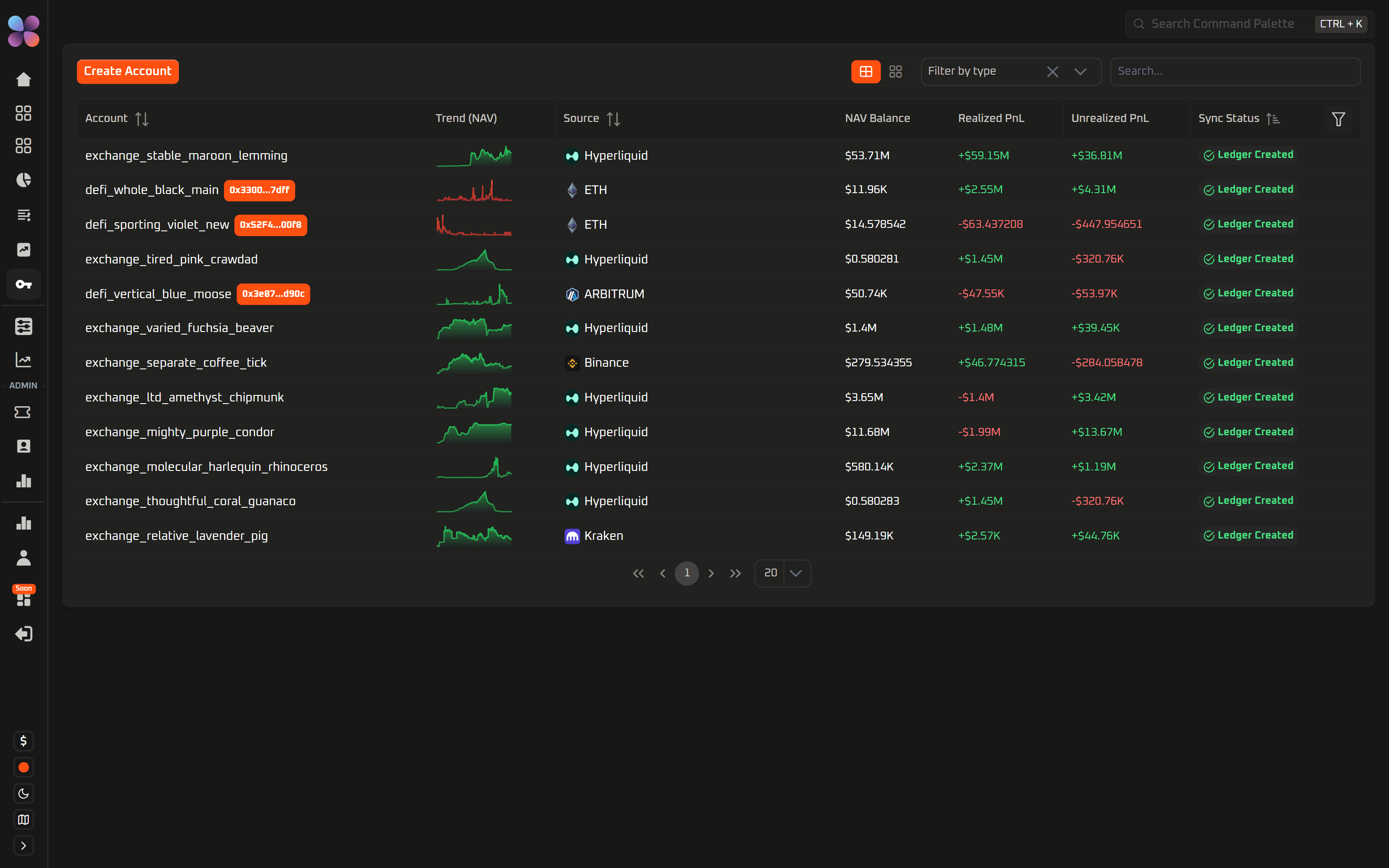
Real-time NAV and reconciled history
NAV computed live from connected accounts, backed by reconciled transaction history: trades matched, transfers between venues paired, fees, funding payments, and yield events captured and attributed. The difference between a balance snapshot and books you can defend to an auditor is exactly this layer, and it is the hardest part of digital asset portfolio management, so it is the part we built first. For the mechanics, see our guide to how NAV calculation works for a DeFi-native crypto fund.

Performance analytics and P&L attribution
Sharpe, Sortino, Alpha, Beta, Calmar, VaR, and drawdown out of the box, benchmarked against BTC, ETH, or a custom composite. P&L attribution splits performance by venue, strategy, and source, so funding income, staking yield, LP fees, and price movement stop hiding inside one number, the visibility problem we walk through in P&L attribution for delta-neutral strategies.

LP reporting and investor dashboards
Investor reports and statements generated from reconciled data instead of assembled by hand, plus an LP dashboard your investors can access directly. The monthly reporting cycle goes from days of manual work to minutes of review.

DeFi-native accounting, not a bolt-on
Most institutional platforms added on-chain support as read-only tracking on top of a CeFi core. Renesis was architected the other way: protocol-level integrations that account for positions the way the protocol actually works, receipt tokens, LP fee accrual, funding on perp DEXs, restaking, and reward emissions, reconciled into P&L rather than mirrored as balances. That depth is also how funds monitor what they hold, the discipline we cover in reducing yield farming risks at the position level. New protocols ship in days, not quarters, because for the funds we serve, the protocol that launched last month is exactly where the book moved.

Built for how funds actually operate
Emerging managers
First external capital, first LP letters, no ops hire yet. The Emerging Manager Program gets a fund-grade stack running for a few hundred dollars a month, with the reporting layer LPs expect from day one.
Liquid crypto funds
Multi-venue, multi-strategy books where reconciliation eats analyst time. One system replaces the spreadsheet bridge between trading and reporting, and the integrated OEMS adds execution algorithms and smart order routing on the same data model.
DAOs and token treasuries
Governance wants transparency, contributors change, and the assets live on-chain. Continuous NAV and clean position history without a fund back office.
Where Renesis sits in the tooling landscape
| Spreadsheets + trackers | Enterprise TradFi platforms | Renesis | |
|---|---|---|---|
| CeFi + DeFi in one book | Manual stitching | CeFi core, DeFi secondary | Native both |
| Reconciled NAV | No | Yes | Yes, real-time |
| DeFi protocol accounting | Balances only | Limited | 100+ protocols, protocol-level |
| LP reporting | Manual | Enterprise add-on | Included |
| Execution (OEMS) | Separate tools | Sometimes | Same platform |
| Time to live | Immediate but fragile | Months | Days |
For funds comparing specific vendors, the axis that decides it is simple: platforms built CeFi-first treat the on-chain half of your book as an afterthought. A digital asset trading platform for this market has to account for both halves natively, which is the architecture decision Renesis is built on.
Live in days, not quarters
Connect read-only.
Exchange API keys (read-only wherever the venue supports it) and wallet addresses. No trade permissions required for the PMS.
History syncs and reconciles.
Trades, transfers, and yield events import and match automatically; we handle the edge cases with you.
Operate.
Live NAV, analytics, and your first LP report out of reconciled data.
Typical onboarding runs about five days. Security: credentials encrypted at rest and in transit, logically segregated hosting per client on AWS.
One platform for the whole operation
The PMS is where funds start; execution through the integrated OEMS runs on the same reconciled data. Start with the books, grow into the rest.
FAQ
What is a crypto portfolio management system?
How does Renesis calculate NAV?
Which exchanges, chains, and protocols are supported?
How is Renesis different from a portfolio tracker?
Does Renesis support DeFi positions properly?
Can my LPs access reporting directly?
How long does onboarding take?
What does it cost?


" height="40px" id="b6zcrI2Wj" width="40.000000141897665px"/></svg>)
" height="40px" id="q3tXZs9hp" width="40px"/></svg>)
" height="40px" id="zrymccGxZ" width="35px"/></svg>)
Built by builders.
For builders.
We're a DeFi-native team shipping fast. No enterprise sales cycles, no bloated pricing. Start free, talk to us when you're ready.
" height="48px" id="otROh8Uzr" width="48px"/></g></svg>)