
Renesis Insights

Renesis Team
The Best Staking Platforms in 2026: An Institutional Guide
The best staking platforms in 2026 for funds, treasuries and DAOs: institutional providers, custodial routes and liquid staking compared on custody, slashing, reporting and accounting, not headline APY.
Most lists of the best staking platforms are written for someone with a personal wallet and a few ETH, and they rank on headline APY.
This one is written for the people we work with: funds, token treasuries and DAOs putting treasury assets to work. There the question is never who quotes the highest yield. It is who you can defend choosing, to your LPs, your auditor, and yourself on the day something gets slashed.
If you are staking a personal wallet, the short version: a major exchange is the convenient option, a liquid staking protocol is the flexible one, and everything below still applies to you in miniature. The rest of this guide assumes size, reporting obligations, and a counterparty-risk budget.
Where Renesis fits
Renesis is not a staking platform. We build the crypto portfolio management system where staked positions end up being tracked, valued and reconciled: native stakes, liquid staking tokens, restaked layers, across the providers and protocols below, for fund clients.
That vantage point shapes this guide. We see what provider choices look like at month-end, in the rewards data, in the NAV, and in the audit. The criteria that follow are the ones that show up there.
The four ways institutions stake
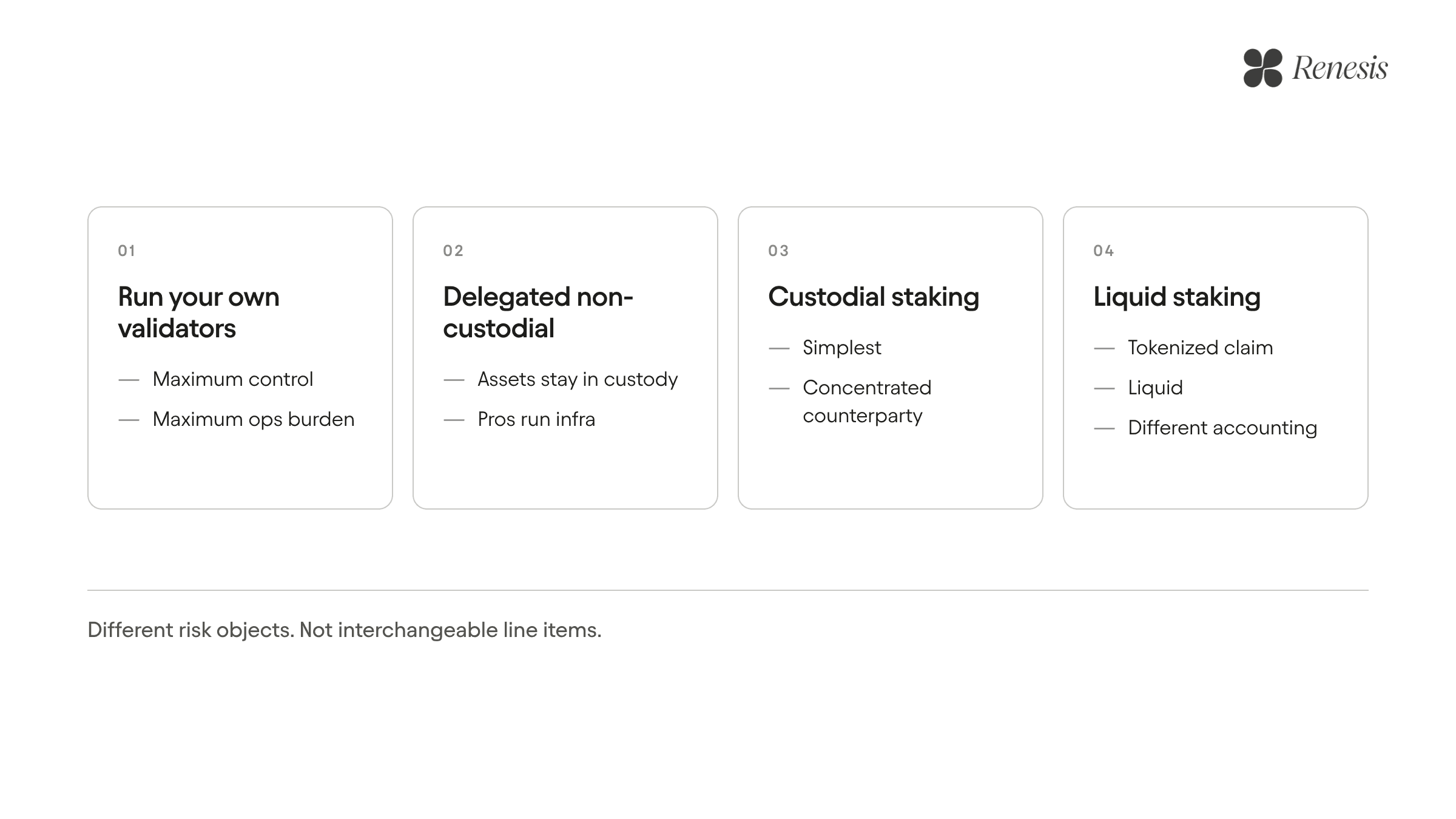
Run your own validators, delegate to non-custodial infrastructure, stake through your custodian, or hold a liquid staking token. Four models, four different risk objects.
Different risk objects. Not interchangeable line items. The custody model should be a deliberate decision, not a default inherited from convenience.
Seven questions before you delegate anything
Custody model. Does capital leave your custody or not? Non-custodial delegation keeps assets with you or your custodian while the provider runs infrastructure. Custodial staking bundles the keys with the service.
Slashing record. Validators run, downtime incidents, double-sign events. A provider that publishes this without being asked is telling you something. One that cannot answer is too.
Slashing coverage. What does the provider cover contractually when its infrastructure causes a loss? Read the actual terms, not the reassurance.
Performance beyond the quoted rate. Realized returns are a function of validator effectiveness, MEV policy and fees, not the marketing number.
Reporting and API quality. The criterion almost every list skips and the one that costs the most time. Rewards data with wallet-level attribution, exportable history, and an API your systems can consume decides whether staking income takes minutes or days to account for each month.
Regulatory posture and terms. Where the entity sits, what its terms promise, and whether the arrangement fits your fund documents.
Exit mechanics. Unbonding periods, exit queues, liquidity at redemption.
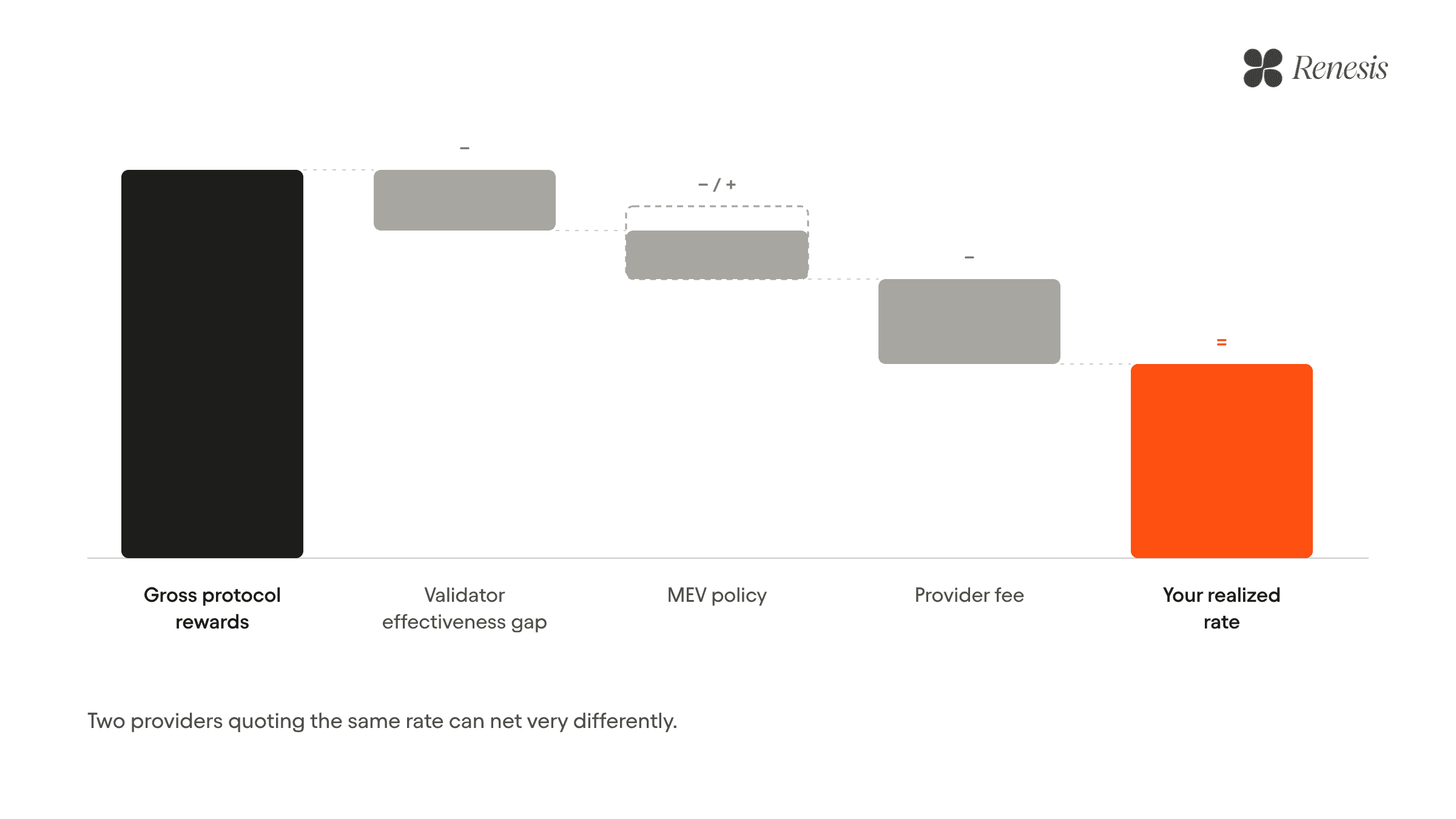
A yield you cannot exit when you need to is a different instrument than the one you were quoted.
The institutional non-custodial providers
The default category for funds that want assets to stay with their custodian while professionals run infrastructure.
Kiln: an institutional layer for on-chain assets at scale. A common choice for embedding staking or running large positions with clean reporting.
Figment: productized integration paths that wallets, custodians and exchanges plug into. You often meet it indirectly through platforms you already use.
Chorus One: infrastructure across 50+ proof-of-stake networks, serious published research on MEV and validator incentives, and audit-ready rewards reporting as a first-class product.
P2P.org: non-custodial infrastructure widely used by intermediaries offering staking without running nodes themselves.
The wider bench: Twinstake, Luganodes, Blockdaemon, Everstake, stakefish. Several of these are the execution layer behind offerings that carry other names.
The custodial route
If assets already sit with an institutional custodian, staking through it can be the operationally simplest path.
Coinbase Custody, Anchorage Digital and BitGo all support staking within custody, increasingly including liquid staking tokens and restaking flows. Custodians such as Hex Trust have gone further, aggregating vetted infrastructure partners behind a single custody interface.
The trade is concentration: custody, staking and counterparty risk stack on one name. For some treasuries that is acceptable simplicity. For funds with LP diligence to pass, it needs to be a documented decision.
Liquid staking: a protocol, not a platform
Lido, Rocket Pool and StakeWise on Ethereum, Jito and Marinade on Solana, often appear alongside platforms and are a different animal: the position becomes a token whose value is a claim through an exchange rate.
That brings liquidity and composability. It also changes the accounting entirely. A liquid staking token is a Level 2 instrument valued through its rate, not a balance with a simple price, as covered in our guide to crypto portfolio valuation.
Lido's institutional stVaults now push this category directly at funds, with staking strategies wrapped in risk-scoped vault infrastructure. Liquid staking is the right answer for many treasuries. It is just not the same risk object as delegated staking, and the two should not share a line item in your policy.
The frontier: restaking and Bitcoin staking
Restaking onto AVSs, and Bitcoin staking through Babylon with providers such as Figment, Galaxy, Kiln and P2P.org acting as finality providers, extend the same infrastructure into new yield layers. The institutional providers above increasingly offer both, with compliance and risk frameworks attached.
Every additional layer is additional slashing surface and additional accounting complexity. Stack layers because the risk is priced, not because the yield is stacked.
The categories side by side
Category | Examples | Custody | Best for | Watch out for |
|---|---|---|---|---|
Non-custodial institutional | Kiln, Figment, Chorus One, P2P.org | Stays with you or your custodian | Funds with LP diligence | Reporting quality varies |
Custodial | Coinbase, Anchorage, BitGo, Hex Trust | With the custodian | Treasuries wanting simplicity | Concentrated counterparty risk |
Liquid staking | Lido, Rocket Pool, Jito, Marinade | Tokenized claim | Liquidity and composability | Exchange-rate accounting |
Restaking / BTC staking | Via the providers above, Babylon | Inherits the base model | Priced additional yield | Added slashing surface |
The accounting reality, which is where we come in
Whatever you choose, someone has to book it.
Rewards need an income recognition policy: at claim or at accrual, and consistently. Liquid staking tokens need exchange-rate valuation and a watchful eye on rate versus market price. Restaked positions need each layer visible, counted once. Slashing needs a loss treatment nobody wants to improvise mid-audit.
All of it depends on the provider's data quality, which is why reporting sits so high in the criteria above.
The pattern we see across fund clients is consistent: the provider decision made on yield alone gets re-made within a year on operations.
If you want to see what your staked, liquid-staked and restaked positions look like reconciled in one place, that is exactly what we build.
Frequently asked questions
Is staking through an exchange safe for a fund?
Safe is the wrong axis; documented is the right one. Exchange staking concentrates custody, staking and counterparty risk on one name, which some treasuries accept for simplicity. A fund with LP diligence obligations should expect that choice to be questioned and should have the reasoning in writing.
What is the difference between a staking platform and liquid staking?
A staking platform runs validator infrastructure for assets that stay whole, in your custody or a custodian's. Liquid staking converts the position into a token, stETH, rETH, JitoSOL, whose value flows through an exchange rate. They carry different custody, liquidity and accounting properties and should be treated as different instruments.
How should staking rewards be accounted for?
Rewards need a written recognition policy, income at claim or at accrual, applied consistently. Liquid staking rewards arrive as exchange-rate appreciation rather than separate payments, which is a different booking. Consistency matters more than the specific choice, and your administrator and auditor should agree to it before month one.
What belongs in an institutional staking policy?
The custody model per asset, approved providers and the diligence performed on them, slashing coverage terms, the rewards recognition method, exit and unbonding constraints, and who signs off on changes. One or two pages, written before the first delegation.
Choose the custody model deliberately, demand the slashing history, weight the reporting as heavily as the rate, and treat liquid and restaked variants as the different instruments they are. That is the institutional version of best, and it is a different list than the one your search probably expected.
Still not sure if Renesis is right for you?
Ask ChatGPT, Claude or Perplexity what they have to talk about us. Click below to ask your favorite AI about us:
" height="40px" id="b6zcrI2Wj" width="40.000000141897665px"/></svg>)
" height="40px" id="q3tXZs9hp" width="40px"/></svg>)
" height="40px" id="zrymccGxZ" width="35px"/></svg>)
Continue reading
Renesis Insights
Portfolio Valuation: How Investment Portfolios Are Actually Valued
What portfolio valuation is, who performs it, the fair value hierarchy across asset classes from listed equities to private equity and digital assets, and how valuation is becoming continuous
Renesis Insights
The Best Staking Platforms in 2026: An Institutional Guide
The best staking platforms in 2026 for funds, treasuries and DAOs: institutional providers, custodial routes and liquid staking compared on custody, slashing, reporting and accounting, not headline APY.
DeFi Research
NAV Attestation: How Vault and DeFi Fund NAVs Get Verified
What NAV attestation means for crypto vaults and DeFi funds: real-time on-chain attestation, administrator and auditor attestation, and how it differs from proof of reserves.
DeFi Research
Pendle Position Tracker: How Funds Track and Value PT, YT and Looped Positions
A Pendle position tracker built for funds: how PT, YT, looped and nested positions should be tracked and valued, and the edge cases that silently break NAV.
See how Renesis brings continuous valuation to digital asset portfolios.
Built by builders.
For builders.
We're a DeFi-native team shipping fast. No enterprise sales cycles, no bloated pricing. Start free, talk to us when you're ready.
Sep 8, 2026
Renesis Insights
Thomas Pratter
Portfolio Valuation: How Investment Portfolios Are Actually Valued
What portfolio valuation is, who performs it, the fair value hierarchy across asset classes from listed equities to private equity and digital assets, and how valuation is becoming continuous
Sep 8, 2026
Renesis Insights
Thomas Pratter
Portfolio Valuation: How Investment Portfolios Are Actually Valued
What portfolio valuation is, who performs it, the fair value hierarchy across asset classes from listed equities to private equity and digital assets, and how valuation is becoming continuous
Most lists of the best staking platforms are written for someone with a personal wallet and a few ETH, and they rank on headline APY.
This one is written for the people we work with: funds, token treasuries and DAOs putting treasury assets to work. There the question is never who quotes the highest yield. It is who you can defend choosing, to your LPs, your auditor, and yourself on the day something gets slashed.
If you are staking a personal wallet, the short version: a major exchange is the convenient option, a liquid staking protocol is the flexible one, and everything below still applies to you in miniature. The rest of this guide assumes size, reporting obligations, and a counterparty-risk budget.
Where Renesis fits
Renesis is not a staking platform. We build the crypto portfolio management system where staked positions end up being tracked, valued and reconciled: native stakes, liquid staking tokens, restaked layers, across the providers and protocols below, for fund clients.
That vantage point shapes this guide. We see what provider choices look like at month-end, in the rewards data, in the NAV, and in the audit. The criteria that follow are the ones that show up there.
The four ways institutions stake
Run your own validators, delegate to non-custodial infrastructure, stake through your custodian, or hold a liquid staking token. Four models, four different risk objects.
Different risk objects. Not interchangeable line items. The custody model should be a deliberate decision, not a default inherited from convenience.
Seven questions before you delegate anything
Custody model. Does capital leave your custody or not? Non-custodial delegation keeps assets with you or your custodian while the provider runs infrastructure. Custodial staking bundles the keys with the service.
Slashing record. Validators run, downtime incidents, double-sign events. A provider that publishes this without being asked is telling you something. One that cannot answer is too.
Slashing coverage. What does the provider cover contractually when its infrastructure causes a loss? Read the actual terms, not the reassurance.
Performance beyond the quoted rate. Realized returns are a function of validator effectiveness, MEV policy and fees, not the marketing number.
Reporting and API quality. The criterion almost every list skips and the one that costs the most time. Rewards data with wallet-level attribution, exportable history, and an API your systems can consume decides whether staking income takes minutes or days to account for each month.
Regulatory posture and terms. Where the entity sits, what its terms promise, and whether the arrangement fits your fund documents.
Exit mechanics. Unbonding periods, exit queues, liquidity at redemption.
A yield you cannot exit when you need to is a different instrument than the one you were quoted.
The institutional non-custodial providers
The default category for funds that want assets to stay with their custodian while professionals run infrastructure.
Kiln: an institutional layer for on-chain assets at scale. A common choice for embedding staking or running large positions with clean reporting.
Figment: productized integration paths that wallets, custodians and exchanges plug into. You often meet it indirectly through platforms you already use.
Chorus One: infrastructure across 50+ proof-of-stake networks, serious published research on MEV and validator incentives, and audit-ready rewards reporting as a first-class product.
P2P.org: non-custodial infrastructure widely used by intermediaries offering staking without running nodes themselves.
The wider bench: Twinstake, Luganodes, Blockdaemon, Everstake, stakefish. Several of these are the execution layer behind offerings that carry other names.
The custodial route
If assets already sit with an institutional custodian, staking through it can be the operationally simplest path.
Coinbase Custody, Anchorage Digital and BitGo all support staking within custody, increasingly including liquid staking tokens and restaking flows. Custodians such as Hex Trust have gone further, aggregating vetted infrastructure partners behind a single custody interface.
The trade is concentration: custody, staking and counterparty risk stack on one name. For some treasuries that is acceptable simplicity. For funds with LP diligence to pass, it needs to be a documented decision.
Liquid staking: a protocol, not a platform
Lido, Rocket Pool and StakeWise on Ethereum, Jito and Marinade on Solana, often appear alongside platforms and are a different animal: the position becomes a token whose value is a claim through an exchange rate.
That brings liquidity and composability. It also changes the accounting entirely. A liquid staking token is a Level 2 instrument valued through its rate, not a balance with a simple price, as covered in our guide to crypto portfolio valuation.
Lido's institutional stVaults now push this category directly at funds, with staking strategies wrapped in risk-scoped vault infrastructure. Liquid staking is the right answer for many treasuries. It is just not the same risk object as delegated staking, and the two should not share a line item in your policy.
The frontier: restaking and Bitcoin staking
Restaking onto AVSs, and Bitcoin staking through Babylon with providers such as Figment, Galaxy, Kiln and P2P.org acting as finality providers, extend the same infrastructure into new yield layers. The institutional providers above increasingly offer both, with compliance and risk frameworks attached.
Every additional layer is additional slashing surface and additional accounting complexity. Stack layers because the risk is priced, not because the yield is stacked.
The categories side by side
Category | Examples | Custody | Best for | Watch out for |
|---|---|---|---|---|
Non-custodial institutional | Kiln, Figment, Chorus One, P2P.org | Stays with you or your custodian | Funds with LP diligence | Reporting quality varies |
Custodial | Coinbase, Anchorage, BitGo, Hex Trust | With the custodian | Treasuries wanting simplicity | Concentrated counterparty risk |
Liquid staking | Lido, Rocket Pool, Jito, Marinade | Tokenized claim | Liquidity and composability | Exchange-rate accounting |
Restaking / BTC staking | Via the providers above, Babylon | Inherits the base model | Priced additional yield | Added slashing surface |
The accounting reality, which is where we come in
Whatever you choose, someone has to book it.
Rewards need an income recognition policy: at claim or at accrual, and consistently. Liquid staking tokens need exchange-rate valuation and a watchful eye on rate versus market price. Restaked positions need each layer visible, counted once. Slashing needs a loss treatment nobody wants to improvise mid-audit.
All of it depends on the provider's data quality, which is why reporting sits so high in the criteria above.
The pattern we see across fund clients is consistent: the provider decision made on yield alone gets re-made within a year on operations.
If you want to see what your staked, liquid-staked and restaked positions look like reconciled in one place, that is exactly what we build.
Frequently asked questions
Is staking through an exchange safe for a fund?
Safe is the wrong axis; documented is the right one. Exchange staking concentrates custody, staking and counterparty risk on one name, which some treasuries accept for simplicity. A fund with LP diligence obligations should expect that choice to be questioned and should have the reasoning in writing.
What is the difference between a staking platform and liquid staking?
A staking platform runs validator infrastructure for assets that stay whole, in your custody or a custodian's. Liquid staking converts the position into a token, stETH, rETH, JitoSOL, whose value flows through an exchange rate. They carry different custody, liquidity and accounting properties and should be treated as different instruments.
How should staking rewards be accounted for?
Rewards need a written recognition policy, income at claim or at accrual, applied consistently. Liquid staking rewards arrive as exchange-rate appreciation rather than separate payments, which is a different booking. Consistency matters more than the specific choice, and your administrator and auditor should agree to it before month one.
What belongs in an institutional staking policy?
The custody model per asset, approved providers and the diligence performed on them, slashing coverage terms, the rewards recognition method, exit and unbonding constraints, and who signs off on changes. One or two pages, written before the first delegation.
Choose the custody model deliberately, demand the slashing history, weight the reporting as heavily as the rate, and treat liquid and restaked variants as the different instruments they are. That is the institutional version of best, and it is a different list than the one your search probably expected.
Sep 8, 2026
Renesis Insights
Thomas Pratter
Portfolio Valuation: How Investment Portfolios Are Actually Valued
What portfolio valuation is, who performs it, the fair value hierarchy across asset classes from listed equities to private equity and digital assets, and how valuation is becoming continuous
Sep 8, 2026
Renesis Insights
Thomas Pratter
Portfolio Valuation: How Investment Portfolios Are Actually Valued
What portfolio valuation is, who performs it, the fair value hierarchy across asset classes from listed equities to private equity and digital assets, and how valuation is becoming continuous
Most lists of the best staking platforms are written for someone with a personal wallet and a few ETH, and they rank on headline APY.
This one is written for the people we work with: funds, token treasuries and DAOs putting treasury assets to work. There the question is never who quotes the highest yield. It is who you can defend choosing, to your LPs, your auditor, and yourself on the day something gets slashed.
If you are staking a personal wallet, the short version: a major exchange is the convenient option, a liquid staking protocol is the flexible one, and everything below still applies to you in miniature. The rest of this guide assumes size, reporting obligations, and a counterparty-risk budget.
Where Renesis fits
Renesis is not a staking platform. We build the crypto portfolio management system where staked positions end up being tracked, valued and reconciled: native stakes, liquid staking tokens, restaked layers, across the providers and protocols below, for fund clients.
That vantage point shapes this guide. We see what provider choices look like at month-end, in the rewards data, in the NAV, and in the audit. The criteria that follow are the ones that show up there.
The four ways institutions stake
Run your own validators, delegate to non-custodial infrastructure, stake through your custodian, or hold a liquid staking token. Four models, four different risk objects.
Different risk objects. Not interchangeable line items. The custody model should be a deliberate decision, not a default inherited from convenience.
Seven questions before you delegate anything
Custody model. Does capital leave your custody or not? Non-custodial delegation keeps assets with you or your custodian while the provider runs infrastructure. Custodial staking bundles the keys with the service.
Slashing record. Validators run, downtime incidents, double-sign events. A provider that publishes this without being asked is telling you something. One that cannot answer is too.
Slashing coverage. What does the provider cover contractually when its infrastructure causes a loss? Read the actual terms, not the reassurance.
Performance beyond the quoted rate. Realized returns are a function of validator effectiveness, MEV policy and fees, not the marketing number.
Reporting and API quality. The criterion almost every list skips and the one that costs the most time. Rewards data with wallet-level attribution, exportable history, and an API your systems can consume decides whether staking income takes minutes or days to account for each month.
Regulatory posture and terms. Where the entity sits, what its terms promise, and whether the arrangement fits your fund documents.
Exit mechanics. Unbonding periods, exit queues, liquidity at redemption.
A yield you cannot exit when you need to is a different instrument than the one you were quoted.
The institutional non-custodial providers
The default category for funds that want assets to stay with their custodian while professionals run infrastructure.
Kiln: an institutional layer for on-chain assets at scale. A common choice for embedding staking or running large positions with clean reporting.
Figment: productized integration paths that wallets, custodians and exchanges plug into. You often meet it indirectly through platforms you already use.
Chorus One: infrastructure across 50+ proof-of-stake networks, serious published research on MEV and validator incentives, and audit-ready rewards reporting as a first-class product.
P2P.org: non-custodial infrastructure widely used by intermediaries offering staking without running nodes themselves.
The wider bench: Twinstake, Luganodes, Blockdaemon, Everstake, stakefish. Several of these are the execution layer behind offerings that carry other names.
The custodial route
If assets already sit with an institutional custodian, staking through it can be the operationally simplest path.
Coinbase Custody, Anchorage Digital and BitGo all support staking within custody, increasingly including liquid staking tokens and restaking flows. Custodians such as Hex Trust have gone further, aggregating vetted infrastructure partners behind a single custody interface.
The trade is concentration: custody, staking and counterparty risk stack on one name. For some treasuries that is acceptable simplicity. For funds with LP diligence to pass, it needs to be a documented decision.
Liquid staking: a protocol, not a platform
Lido, Rocket Pool and StakeWise on Ethereum, Jito and Marinade on Solana, often appear alongside platforms and are a different animal: the position becomes a token whose value is a claim through an exchange rate.
That brings liquidity and composability. It also changes the accounting entirely. A liquid staking token is a Level 2 instrument valued through its rate, not a balance with a simple price, as covered in our guide to crypto portfolio valuation.
Lido's institutional stVaults now push this category directly at funds, with staking strategies wrapped in risk-scoped vault infrastructure. Liquid staking is the right answer for many treasuries. It is just not the same risk object as delegated staking, and the two should not share a line item in your policy.
The frontier: restaking and Bitcoin staking
Restaking onto AVSs, and Bitcoin staking through Babylon with providers such as Figment, Galaxy, Kiln and P2P.org acting as finality providers, extend the same infrastructure into new yield layers. The institutional providers above increasingly offer both, with compliance and risk frameworks attached.
Every additional layer is additional slashing surface and additional accounting complexity. Stack layers because the risk is priced, not because the yield is stacked.
The categories side by side
Category | Examples | Custody | Best for | Watch out for |
|---|---|---|---|---|
Non-custodial institutional | Kiln, Figment, Chorus One, P2P.org | Stays with you or your custodian | Funds with LP diligence | Reporting quality varies |
Custodial | Coinbase, Anchorage, BitGo, Hex Trust | With the custodian | Treasuries wanting simplicity | Concentrated counterparty risk |
Liquid staking | Lido, Rocket Pool, Jito, Marinade | Tokenized claim | Liquidity and composability | Exchange-rate accounting |
Restaking / BTC staking | Via the providers above, Babylon | Inherits the base model | Priced additional yield | Added slashing surface |
The accounting reality, which is where we come in
Whatever you choose, someone has to book it.
Rewards need an income recognition policy: at claim or at accrual, and consistently. Liquid staking tokens need exchange-rate valuation and a watchful eye on rate versus market price. Restaked positions need each layer visible, counted once. Slashing needs a loss treatment nobody wants to improvise mid-audit.
All of it depends on the provider's data quality, which is why reporting sits so high in the criteria above.
The pattern we see across fund clients is consistent: the provider decision made on yield alone gets re-made within a year on operations.
If you want to see what your staked, liquid-staked and restaked positions look like reconciled in one place, that is exactly what we build.
Frequently asked questions
Is staking through an exchange safe for a fund?
Safe is the wrong axis; documented is the right one. Exchange staking concentrates custody, staking and counterparty risk on one name, which some treasuries accept for simplicity. A fund with LP diligence obligations should expect that choice to be questioned and should have the reasoning in writing.
What is the difference between a staking platform and liquid staking?
A staking platform runs validator infrastructure for assets that stay whole, in your custody or a custodian's. Liquid staking converts the position into a token, stETH, rETH, JitoSOL, whose value flows through an exchange rate. They carry different custody, liquidity and accounting properties and should be treated as different instruments.
How should staking rewards be accounted for?
Rewards need a written recognition policy, income at claim or at accrual, applied consistently. Liquid staking rewards arrive as exchange-rate appreciation rather than separate payments, which is a different booking. Consistency matters more than the specific choice, and your administrator and auditor should agree to it before month one.
What belongs in an institutional staking policy?
The custody model per asset, approved providers and the diligence performed on them, slashing coverage terms, the rewards recognition method, exit and unbonding constraints, and who signs off on changes. One or two pages, written before the first delegation.
Choose the custody model deliberately, demand the slashing history, weight the reporting as heavily as the rate, and treat liquid and restaked variants as the different instruments they are. That is the institutional version of best, and it is a different list than the one your search probably expected.
" height="48px" id="otROh8Uzr" width="48px"/></g></svg>)