
Renesis Insights
Thomas Pratter
Portfolio Valuation: How Investment Portfolios Are Actually Valued
What portfolio valuation is, who performs it, the fair value hierarchy across asset classes from listed equities to private equity and digital assets, and how valuation is becoming continuous
Portfolio valuation is the process of determining the fair value of every position an investment portfolio holds, and of the portfolio as a whole. It sounds like bookkeeping. It is closer to the load-bearing wall of asset management: the valuation drives the NAV, the performance record, the management and performance fees, the investor statements, and the price at which anyone enters or exits the fund.
Every downstream number inherits its accuracy.
The term gets used two ways in practice. Valuation firms and the Big Four use it narrowly, for the appraisal of illiquid holdings such as private equity stakes and private credit, because that is where valuation is sold as a service. Used properly it is broader: the discipline of pricing everything, liquid and illiquid, exchange-traded and protocol-native, under one documented policy.
This guide covers the broad version: who performs it, the methods, the fair value hierarchy across asset classes, and where the discipline is heading as assets move on-chain.
Where Renesis fits
Renesis is a crypto portfolio management system that runs this discipline continuously for digital asset portfolios, valuing positions instrument by instrument across exchanges, chains and DeFi protocols, and attesting the resulting NAV directly to on-chain vaults such as Enzyme, where it prices deposits and withdrawals in real time.
Digital assets are the newest and least forgiving asset class to value, which is why they make a useful stress test for everything below. The methods are the same ones the rest of finance uses, applied at a faster tempo.
Who actually values a portfolio
Four parties touch the number, and confusing their roles is a common diligence failure.
The manager marks positions day to day for its own risk and decisions. The fund administrator strikes the official periodic NAV that investors transact at. Independent valuation specialists, the Big Four practices and firms such as Kroll, are engaged for the illiquid positions where no market price exists and an unbiased appraisal is worth paying for. And the auditor attests, annually, that the whole process produced defensible numbers.
A fund can delegate the calculation. It can never delegate responsibility for its accuracy.
The methods, and the hierarchy that organizes them
There are only two fundamental methods. Mark-to-market: take an observable price from a market deep enough to trust. Mark-to-model: when no such market exists, derive the value from observable inputs, or estimate it from assumptions and calibrate against real transactions.
Everything else is detail about which method applies where, and accounting standards organize that detail into the fair value hierarchy of ASC 820 and IFRS 13.
Level | What it means | Examples across asset classes | The real question |
|---|---|---|---|
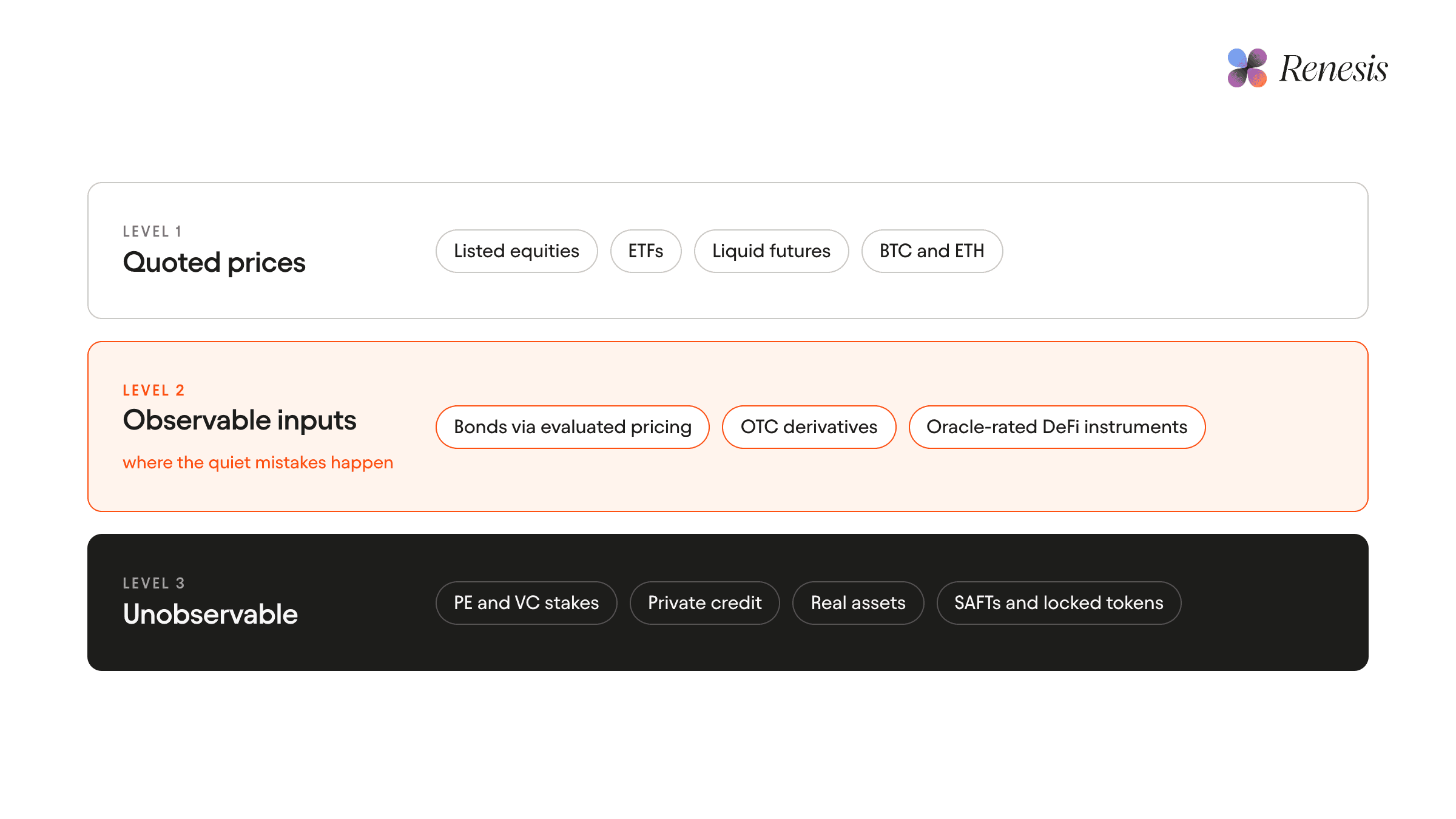
Level 1 | Quoted prices in active markets | Listed equities, ETFs, liquid futures, BTC and ETH | Which venue, which timestamp, which print |
Level 2 | Observable inputs, no direct quote | Bonds via evaluated pricing, OTC derivatives, oracle-rated DeFi instruments, staked assets via exchange rate | Which inputs, which model, applied consistently |
Level 3 | Unobservable inputs | PE and VC stakes, private credit, real assets, SAFTs and locked tokens | Whose judgment, calibrated against what |
Level 1 is where the valuation question is not what the price is but which one. Decisions to make once, in writing.
Level 2 is where the most expensive quiet mistakes happen, because these instruments look like they have a simple price and do not. Most of fixed income lives here, priced by evaluated pricing services, and so do most DeFi instruments. Pricing a Level 2 instrument as if it were Level 1, off a generic feed, is how books end up confidently wrong, in any asset class.
Level 3 is valuation as judgment made defensible: the AICPA's guidance for valuing fund investments, calibration to the fund's own entry transactions, and independent appraisals for material positions. Carta's guide to building a defensible valuation process for private funds covers this territory well. Level 3 is a small share of most portfolios and a large share of most audit friction.
A well-run portfolio knows which level every position sits in. That single classification determines the method, the evidence an auditor will ask for, and how much the number should be trusted.
Fair value is no longer optional
The accounting ground shifted. Under US GAAP, ASU 2023-08 moved qualifying crypto assets to fair value through net income, effective for fiscal years beginning after December 15, 2024, ending the era of cost-less-impairment reporting.
The practical consequence for funds: valuation stopped being a spreadsheet habit and became a documented discipline. Auditors now ask for the valuation policy first and the numbers second, and allocators read the policy as a proxy for operational seriousness.
How often, and the direction of travel
Valuation frequency has compressed for decades. Annual appraisals became quarterly marks, quarterly became the daily NAV that mutual funds standardized, and daily is now becoming continuous.

Two forces drive the last step. Portfolios hold more instruments that trade around the clock. And tokenization turns the valuation into the product itself: when fund shares settle on-chain, the NAV is not a statement mailed monthly, it is the live price of every deposit and withdrawal. Verification networks now recompute vault NAVs continuously and publish them on-chain, and DTCC piloted putting fund NAV data on-chain with Chainlink as early as 2024, with JPMorgan, Franklin Templeton and BNY among the participants. We cover that layer in our guide to NAV attestation.
Valuation built for month-end does not survive contact with a market that settles in seconds.
Digital asset portfolios are where this future already operates daily, spanning all three levels at once, and they have their own playbook: our guide to crypto portfolio valuation covers the hierarchy applied to a real crypto book, the price source ladder, and the instrument edge cases.
The valuation policy that makes it defensible
Whatever the asset mix, the policy that survives an audit answers the same questions in writing:
The price source per asset class, and the fallback order when a source fails
Snapshot timing, and the staleness threshold past which a price is rejected
The model and inputs per Level 2 instrument family
The escalation path and appraisal cadence for Level 3
Who signs off on exceptions
Consistency beats sophistication. Auditors and allocators will accept many reasonable choices applied uniformly, and none applied opportunistically.
The failure modes are also universal. A stale price does not look broken, it looks precise, and flows into fees and statements looking precise. A Level 2 instrument priced off a naive feed produces errors that are largest exactly when markets move. And a missing price fabricated for completeness is worse than an honest, visible gap that gets investigated the same day.
Valuation is becoming more frequent, more instrument-level, and more verified, across every asset class at once. Portfolios already run that way clear the rising bar by default.
Frequently asked questions
What is portfolio valuation?
Portfolio valuation is the process of determining the fair value of every position an investment portfolio holds and of the portfolio in total. It is the input to NAV, performance measurement, fees and investor reporting, and it is governed by the fair value frameworks of ASC 820 and IFRS 13.
Who performs portfolio valuation?
The manager marks positions internally, the fund administrator strikes the official NAV, independent valuation firms appraise illiquid Level 3 holdings, and the auditor attests annually. The responsibility for accuracy stays with the fund regardless of who calculates.
What is the difference between portfolio valuation and NAV?
Valuation prices the individual positions. NAV nets the valued assets against liabilities and expresses the result per share, the number investors actually transact at. A NAV is only as good as the valuation underneath it.
How often should a portfolio be valued?
At minimum, at every point where someone transacts or reports on the number, monthly or daily for most funds. Tokenized vehicles have pushed this to continuous, because on-chain shares price every deposit and withdrawal at NAV in real time.
Still not sure if Renesis is right for you?
Ask ChatGPT, Claude or Perplexity what they have to talk about us. Click below to ask your favorite AI about us:
" height="40px" id="b6zcrI2Wj" width="40.000000141897665px"/></svg>)
" height="40px" id="q3tXZs9hp" width="40px"/></svg>)
" height="40px" id="zrymccGxZ" width="35px"/></svg>)
Continue reading
Renesis Insights
Portfolio Valuation: How Investment Portfolios Are Actually Valued
What portfolio valuation is, who performs it, the fair value hierarchy across asset classes from listed equities to private equity and digital assets, and how valuation is becoming continuous
Renesis Insights
The Best Staking Platforms in 2026: An Institutional Guide
The best staking platforms in 2026 for funds, treasuries and DAOs: institutional providers, custodial routes and liquid staking compared on custody, slashing, reporting and accounting, not headline APY.
DeFi Research
NAV Attestation: How Vault and DeFi Fund NAVs Get Verified
What NAV attestation means for crypto vaults and DeFi funds: real-time on-chain attestation, administrator and auditor attestation, and how it differs from proof of reserves.
DeFi Research
Pendle Position Tracker: How Funds Track and Value PT, YT and Looped Positions
A Pendle position tracker built for funds: how PT, YT, looped and nested positions should be tracked and valued, and the edge cases that silently break NAV.
See how Renesis brings continuous valuation to digital asset portfolios.
Built by builders.
For builders.
We're a DeFi-native team shipping fast. No enterprise sales cycles, no bloated pricing. Start free, talk to us when you're ready.
Sep 8, 2026
Renesis Insights
Thomas Pratter
Portfolio Valuation: How Investment Portfolios Are Actually Valued
What portfolio valuation is, who performs it, the fair value hierarchy across asset classes from listed equities to private equity and digital assets, and how valuation is becoming continuous
Sep 8, 2026
Renesis Insights
Thomas Pratter
Portfolio Valuation: How Investment Portfolios Are Actually Valued
What portfolio valuation is, who performs it, the fair value hierarchy across asset classes from listed equities to private equity and digital assets, and how valuation is becoming continuous
Portfolio valuation is the process of determining the fair value of every position an investment portfolio holds, and of the portfolio as a whole. It sounds like bookkeeping. It is closer to the load-bearing wall of asset management: the valuation drives the NAV, the performance record, the management and performance fees, the investor statements, and the price at which anyone enters or exits the fund.
Every downstream number inherits its accuracy.
The term gets used two ways in practice. Valuation firms and the Big Four use it narrowly, for the appraisal of illiquid holdings such as private equity stakes and private credit, because that is where valuation is sold as a service. Used properly it is broader: the discipline of pricing everything, liquid and illiquid, exchange-traded and protocol-native, under one documented policy.
This guide covers the broad version: who performs it, the methods, the fair value hierarchy across asset classes, and where the discipline is heading as assets move on-chain.
Where Renesis fits
Renesis is a crypto portfolio management system that runs this discipline continuously for digital asset portfolios, valuing positions instrument by instrument across exchanges, chains and DeFi protocols, and attesting the resulting NAV directly to on-chain vaults such as Enzyme, where it prices deposits and withdrawals in real time.
Digital assets are the newest and least forgiving asset class to value, which is why they make a useful stress test for everything below. The methods are the same ones the rest of finance uses, applied at a faster tempo.
Who actually values a portfolio
Four parties touch the number, and confusing their roles is a common diligence failure.
The manager marks positions day to day for its own risk and decisions. The fund administrator strikes the official periodic NAV that investors transact at. Independent valuation specialists, the Big Four practices and firms such as Kroll, are engaged for the illiquid positions where no market price exists and an unbiased appraisal is worth paying for. And the auditor attests, annually, that the whole process produced defensible numbers.
A fund can delegate the calculation. It can never delegate responsibility for its accuracy.
The methods, and the hierarchy that organizes them
There are only two fundamental methods. Mark-to-market: take an observable price from a market deep enough to trust. Mark-to-model: when no such market exists, derive the value from observable inputs, or estimate it from assumptions and calibrate against real transactions.
Everything else is detail about which method applies where, and accounting standards organize that detail into the fair value hierarchy of ASC 820 and IFRS 13.
Level | What it means | Examples across asset classes | The real question |
|---|---|---|---|
Level 1 | Quoted prices in active markets | Listed equities, ETFs, liquid futures, BTC and ETH | Which venue, which timestamp, which print |
Level 2 | Observable inputs, no direct quote | Bonds via evaluated pricing, OTC derivatives, oracle-rated DeFi instruments, staked assets via exchange rate | Which inputs, which model, applied consistently |
Level 3 | Unobservable inputs | PE and VC stakes, private credit, real assets, SAFTs and locked tokens | Whose judgment, calibrated against what |
Level 1 is where the valuation question is not what the price is but which one. Decisions to make once, in writing.
Level 2 is where the most expensive quiet mistakes happen, because these instruments look like they have a simple price and do not. Most of fixed income lives here, priced by evaluated pricing services, and so do most DeFi instruments. Pricing a Level 2 instrument as if it were Level 1, off a generic feed, is how books end up confidently wrong, in any asset class.
Level 3 is valuation as judgment made defensible: the AICPA's guidance for valuing fund investments, calibration to the fund's own entry transactions, and independent appraisals for material positions. Carta's guide to building a defensible valuation process for private funds covers this territory well. Level 3 is a small share of most portfolios and a large share of most audit friction.
A well-run portfolio knows which level every position sits in. That single classification determines the method, the evidence an auditor will ask for, and how much the number should be trusted.
Fair value is no longer optional
The accounting ground shifted. Under US GAAP, ASU 2023-08 moved qualifying crypto assets to fair value through net income, effective for fiscal years beginning after December 15, 2024, ending the era of cost-less-impairment reporting.
The practical consequence for funds: valuation stopped being a spreadsheet habit and became a documented discipline. Auditors now ask for the valuation policy first and the numbers second, and allocators read the policy as a proxy for operational seriousness.
How often, and the direction of travel
Valuation frequency has compressed for decades. Annual appraisals became quarterly marks, quarterly became the daily NAV that mutual funds standardized, and daily is now becoming continuous.
Two forces drive the last step. Portfolios hold more instruments that trade around the clock. And tokenization turns the valuation into the product itself: when fund shares settle on-chain, the NAV is not a statement mailed monthly, it is the live price of every deposit and withdrawal. Verification networks now recompute vault NAVs continuously and publish them on-chain, and DTCC piloted putting fund NAV data on-chain with Chainlink as early as 2024, with JPMorgan, Franklin Templeton and BNY among the participants. We cover that layer in our guide to NAV attestation.
Valuation built for month-end does not survive contact with a market that settles in seconds.
Digital asset portfolios are where this future already operates daily, spanning all three levels at once, and they have their own playbook: our guide to crypto portfolio valuation covers the hierarchy applied to a real crypto book, the price source ladder, and the instrument edge cases.
The valuation policy that makes it defensible
Whatever the asset mix, the policy that survives an audit answers the same questions in writing:
The price source per asset class, and the fallback order when a source fails
Snapshot timing, and the staleness threshold past which a price is rejected
The model and inputs per Level 2 instrument family
The escalation path and appraisal cadence for Level 3
Who signs off on exceptions
Consistency beats sophistication. Auditors and allocators will accept many reasonable choices applied uniformly, and none applied opportunistically.
The failure modes are also universal. A stale price does not look broken, it looks precise, and flows into fees and statements looking precise. A Level 2 instrument priced off a naive feed produces errors that are largest exactly when markets move. And a missing price fabricated for completeness is worse than an honest, visible gap that gets investigated the same day.
Valuation is becoming more frequent, more instrument-level, and more verified, across every asset class at once. Portfolios already run that way clear the rising bar by default.
Frequently asked questions
What is portfolio valuation?
Portfolio valuation is the process of determining the fair value of every position an investment portfolio holds and of the portfolio in total. It is the input to NAV, performance measurement, fees and investor reporting, and it is governed by the fair value frameworks of ASC 820 and IFRS 13.
Who performs portfolio valuation?
The manager marks positions internally, the fund administrator strikes the official NAV, independent valuation firms appraise illiquid Level 3 holdings, and the auditor attests annually. The responsibility for accuracy stays with the fund regardless of who calculates.
What is the difference between portfolio valuation and NAV?
Valuation prices the individual positions. NAV nets the valued assets against liabilities and expresses the result per share, the number investors actually transact at. A NAV is only as good as the valuation underneath it.
How often should a portfolio be valued?
At minimum, at every point where someone transacts or reports on the number, monthly or daily for most funds. Tokenized vehicles have pushed this to continuous, because on-chain shares price every deposit and withdrawal at NAV in real time.
Sep 8, 2026
Renesis Insights
Thomas Pratter
Portfolio Valuation: How Investment Portfolios Are Actually Valued
What portfolio valuation is, who performs it, the fair value hierarchy across asset classes from listed equities to private equity and digital assets, and how valuation is becoming continuous
Sep 8, 2026
Renesis Insights
Thomas Pratter
Portfolio Valuation: How Investment Portfolios Are Actually Valued
What portfolio valuation is, who performs it, the fair value hierarchy across asset classes from listed equities to private equity and digital assets, and how valuation is becoming continuous
Portfolio valuation is the process of determining the fair value of every position an investment portfolio holds, and of the portfolio as a whole. It sounds like bookkeeping. It is closer to the load-bearing wall of asset management: the valuation drives the NAV, the performance record, the management and performance fees, the investor statements, and the price at which anyone enters or exits the fund.
Every downstream number inherits its accuracy.
The term gets used two ways in practice. Valuation firms and the Big Four use it narrowly, for the appraisal of illiquid holdings such as private equity stakes and private credit, because that is where valuation is sold as a service. Used properly it is broader: the discipline of pricing everything, liquid and illiquid, exchange-traded and protocol-native, under one documented policy.
This guide covers the broad version: who performs it, the methods, the fair value hierarchy across asset classes, and where the discipline is heading as assets move on-chain.
Where Renesis fits
Renesis is a crypto portfolio management system that runs this discipline continuously for digital asset portfolios, valuing positions instrument by instrument across exchanges, chains and DeFi protocols, and attesting the resulting NAV directly to on-chain vaults such as Enzyme, where it prices deposits and withdrawals in real time.
Digital assets are the newest and least forgiving asset class to value, which is why they make a useful stress test for everything below. The methods are the same ones the rest of finance uses, applied at a faster tempo.
Who actually values a portfolio
Four parties touch the number, and confusing their roles is a common diligence failure.
The manager marks positions day to day for its own risk and decisions. The fund administrator strikes the official periodic NAV that investors transact at. Independent valuation specialists, the Big Four practices and firms such as Kroll, are engaged for the illiquid positions where no market price exists and an unbiased appraisal is worth paying for. And the auditor attests, annually, that the whole process produced defensible numbers.
A fund can delegate the calculation. It can never delegate responsibility for its accuracy.
The methods, and the hierarchy that organizes them
There are only two fundamental methods. Mark-to-market: take an observable price from a market deep enough to trust. Mark-to-model: when no such market exists, derive the value from observable inputs, or estimate it from assumptions and calibrate against real transactions.
Everything else is detail about which method applies where, and accounting standards organize that detail into the fair value hierarchy of ASC 820 and IFRS 13.
Level | What it means | Examples across asset classes | The real question |
|---|---|---|---|
Level 1 | Quoted prices in active markets | Listed equities, ETFs, liquid futures, BTC and ETH | Which venue, which timestamp, which print |
Level 2 | Observable inputs, no direct quote | Bonds via evaluated pricing, OTC derivatives, oracle-rated DeFi instruments, staked assets via exchange rate | Which inputs, which model, applied consistently |
Level 3 | Unobservable inputs | PE and VC stakes, private credit, real assets, SAFTs and locked tokens | Whose judgment, calibrated against what |
Level 1 is where the valuation question is not what the price is but which one. Decisions to make once, in writing.
Level 2 is where the most expensive quiet mistakes happen, because these instruments look like they have a simple price and do not. Most of fixed income lives here, priced by evaluated pricing services, and so do most DeFi instruments. Pricing a Level 2 instrument as if it were Level 1, off a generic feed, is how books end up confidently wrong, in any asset class.
Level 3 is valuation as judgment made defensible: the AICPA's guidance for valuing fund investments, calibration to the fund's own entry transactions, and independent appraisals for material positions. Carta's guide to building a defensible valuation process for private funds covers this territory well. Level 3 is a small share of most portfolios and a large share of most audit friction.
A well-run portfolio knows which level every position sits in. That single classification determines the method, the evidence an auditor will ask for, and how much the number should be trusted.
Fair value is no longer optional
The accounting ground shifted. Under US GAAP, ASU 2023-08 moved qualifying crypto assets to fair value through net income, effective for fiscal years beginning after December 15, 2024, ending the era of cost-less-impairment reporting.
The practical consequence for funds: valuation stopped being a spreadsheet habit and became a documented discipline. Auditors now ask for the valuation policy first and the numbers second, and allocators read the policy as a proxy for operational seriousness.
How often, and the direction of travel
Valuation frequency has compressed for decades. Annual appraisals became quarterly marks, quarterly became the daily NAV that mutual funds standardized, and daily is now becoming continuous.
Two forces drive the last step. Portfolios hold more instruments that trade around the clock. And tokenization turns the valuation into the product itself: when fund shares settle on-chain, the NAV is not a statement mailed monthly, it is the live price of every deposit and withdrawal. Verification networks now recompute vault NAVs continuously and publish them on-chain, and DTCC piloted putting fund NAV data on-chain with Chainlink as early as 2024, with JPMorgan, Franklin Templeton and BNY among the participants. We cover that layer in our guide to NAV attestation.
Valuation built for month-end does not survive contact with a market that settles in seconds.
Digital asset portfolios are where this future already operates daily, spanning all three levels at once, and they have their own playbook: our guide to crypto portfolio valuation covers the hierarchy applied to a real crypto book, the price source ladder, and the instrument edge cases.
The valuation policy that makes it defensible
Whatever the asset mix, the policy that survives an audit answers the same questions in writing:
The price source per asset class, and the fallback order when a source fails
Snapshot timing, and the staleness threshold past which a price is rejected
The model and inputs per Level 2 instrument family
The escalation path and appraisal cadence for Level 3
Who signs off on exceptions
Consistency beats sophistication. Auditors and allocators will accept many reasonable choices applied uniformly, and none applied opportunistically.
The failure modes are also universal. A stale price does not look broken, it looks precise, and flows into fees and statements looking precise. A Level 2 instrument priced off a naive feed produces errors that are largest exactly when markets move. And a missing price fabricated for completeness is worse than an honest, visible gap that gets investigated the same day.
Valuation is becoming more frequent, more instrument-level, and more verified, across every asset class at once. Portfolios already run that way clear the rising bar by default.
Frequently asked questions
What is portfolio valuation?
Portfolio valuation is the process of determining the fair value of every position an investment portfolio holds and of the portfolio in total. It is the input to NAV, performance measurement, fees and investor reporting, and it is governed by the fair value frameworks of ASC 820 and IFRS 13.
Who performs portfolio valuation?
The manager marks positions internally, the fund administrator strikes the official NAV, independent valuation firms appraise illiquid Level 3 holdings, and the auditor attests annually. The responsibility for accuracy stays with the fund regardless of who calculates.
What is the difference between portfolio valuation and NAV?
Valuation prices the individual positions. NAV nets the valued assets against liabilities and expresses the result per share, the number investors actually transact at. A NAV is only as good as the valuation underneath it.
How often should a portfolio be valued?
At minimum, at every point where someone transacts or reports on the number, monthly or daily for most funds. Tokenized vehicles have pushed this to continuous, because on-chain shares price every deposit and withdrawal at NAV in real time.
" height="48px" id="otROh8Uzr" width="48px"/></g></svg>)