
DeFi Research

Renesis Team
NAV Attestation: How Vault and DeFi Fund NAVs Get Verified
What NAV attestation means for crypto vaults and DeFi funds: real-time on-chain attestation, administrator and auditor attestation, and how it differs from proof of reserves.
A NAV is a claim. Somebody computed a number, and everybody downstream, the LPs subscribing at it, the lender lending against it, the depositor whose vault shares are priced by it, is trusting that the computation was right. NAV attestation is the discipline of making that claim verifiable, and in 2026 it is turning from a back-office afterthought into on-chain infrastructure, because tokenized vaults have made the NAV itself the live share price.
This guide covers what NAV attestation means, how the new real-time vault version works, why DeFi positions make it genuinely hard, and how it differs from proof of reserves.
Where Renesis fits
Renesis is a portfolio management system for funds that computes NAV continuously, position by position, across centralized exchanges, chains and DeFi protocols. For funds, that computation feeds the administrators and auditors whose job is to verify it independently, because an attestation is only as strong as the computation underneath it. For on-chain vaults we go a step further: Renesis attests NAV directly to vault infrastructure such as Enzyme, so the share price a depositor transacts at reflects every underlying position rather than a summary someone typed in. If you run a vault and need a position-level NAV behind the share price, that is exactly the work we do, and we work with vault teams on it today. The rest of this article is the landscape as we see it from the computation layer.
What NAV attestation actually means
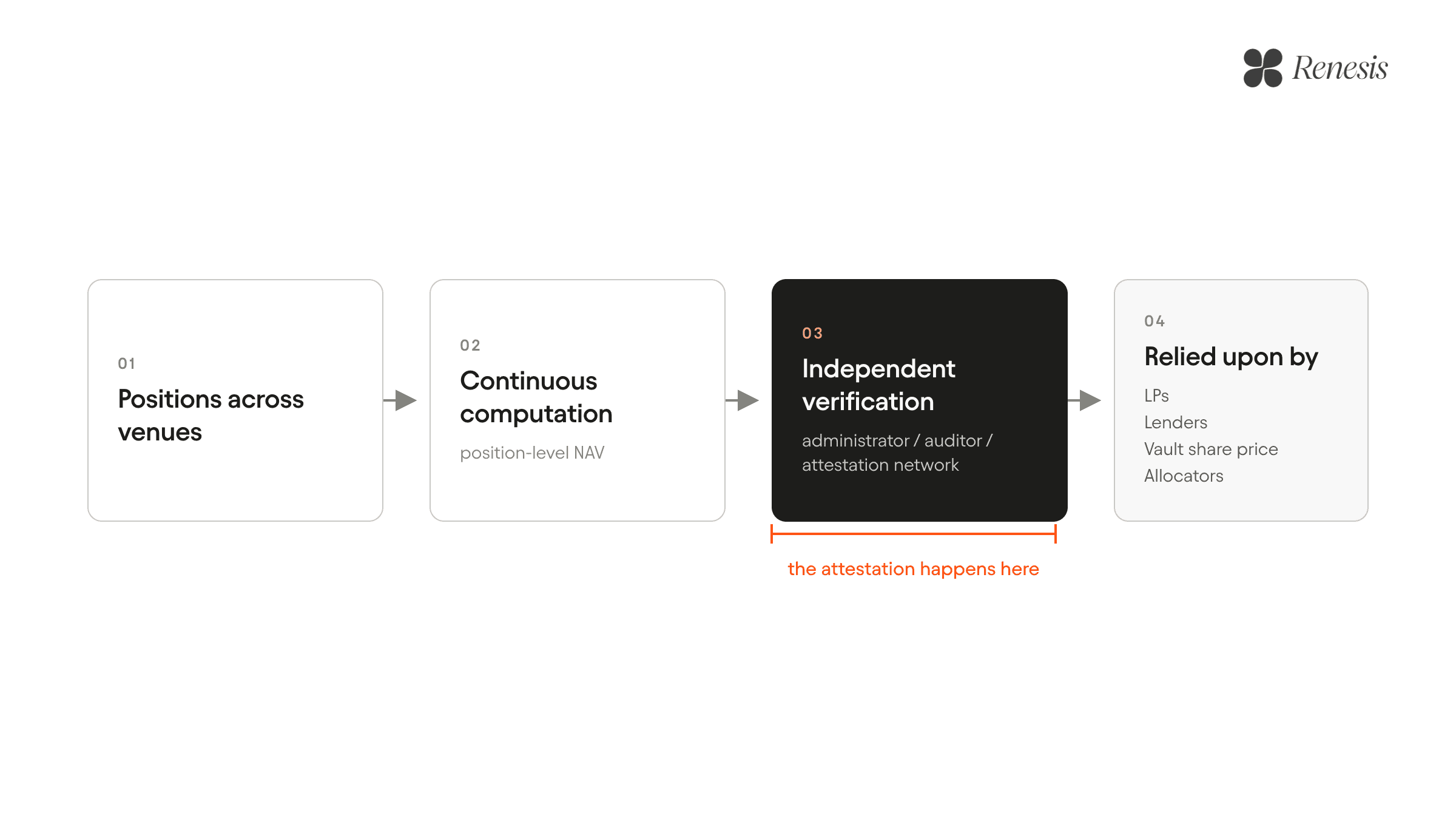
Strip the term to its parts and there are three distinct jobs that get blurred together.
Computation. Someone values every asset and liability and strikes the number. In traditional funds this is the administrator's core task, performed monthly or daily.
Oversight and validation. Someone checks the computation against independent sources, prices, positions, accruals, before it is released. An entire category of NAV oversight tooling exists in traditional asset management to run daily exception checks, because the industry learned that a fund can delegate the calculation but never the responsibility for its accuracy.
Attestation. An independent party puts its name on the result: the administrator issuing the official NAV, the auditor attesting the year-end figures, or, in the newest version, a cryptographic network attesting a value on-chain.
The stakes are not theoretical. In the litigation that followed the Madoff feeder funds, the administrator's handling of its NAV obligations was central, and the matter settled for 235 million dollars. That case is why allocators treat independent administration as non-negotiable, and it is the standard the on-chain world is now rebuilding in software.
Vault NAV attestation: the real-time version
Tokenized vaults changed the tempo. When vault shares trade and settle on-chain, the NAV is not a monthly statement, it is the live price at which every deposit and withdrawal executes. Misprice it and the error is not embarrassing, it is exploitable: someone enters or exits at the wrong number and the difference is paid by everyone else in the vault.
That is the problem real-time attestation systems exist to solve. Accountable, the team that has pushed the term furthest, computes a vault's net asset value independently from every underlying position, requires parallel calculations to reach consensus, and only then publishes the value on-chain as the share price. Live deployments already span a structured reinsurance vault curated by RockawayX, tokenized credit vaults, and solvency verification for strategies holding positions across custodians, exchanges and TradFi brokerage accounts. Traditional infrastructure is moving the same direction from the other side: DTCC, the backbone of US fund plumbing, piloted publishing mutual fund NAV data on-chain with Chainlink as early as 2024.
The design principle shared by all of them: the party computing the NAV must be independent of the party whose vault it prices, and the computation must cover every underlying position, not a summary someone typed in.
DeFi NAV attestation: why it is genuinely hard
Publishing a number on-chain is the easy half. The hard half is computing a number worth attesting, because DeFi positions do not present themselves honestly to a naive reader of wallet balances.
A fund's books can contain receipt tokens whose balance never changes while their value grows, rebasing tokens whose balance changes daily, principal tokens that must be discounted to maturity and flip to par the moment it passes, yield tokens whose worth is a decaying claim rather than a market print, perp positions where hourly funding payments are part of the return, and positions nested inside other positions that must be counted exactly once. Every one of those is a place where a NAV can be confidently, precisely wrong. We have written up the worst offender in detail in our Pendle position tracker guide, and the same discipline applies protocol by protocol.
This is why serious attestation is position-level. An attestor that verifies a total is attesting the fund's own summary. An attestor that recomputes from raw positions, venue by venue, protocol by protocol, is attesting reality. The difference between those two is exactly the difference LPs and lenders care about. Find how to calculate NAV for a crypto fund in our blog.
NAV attestation vs proof of reserves
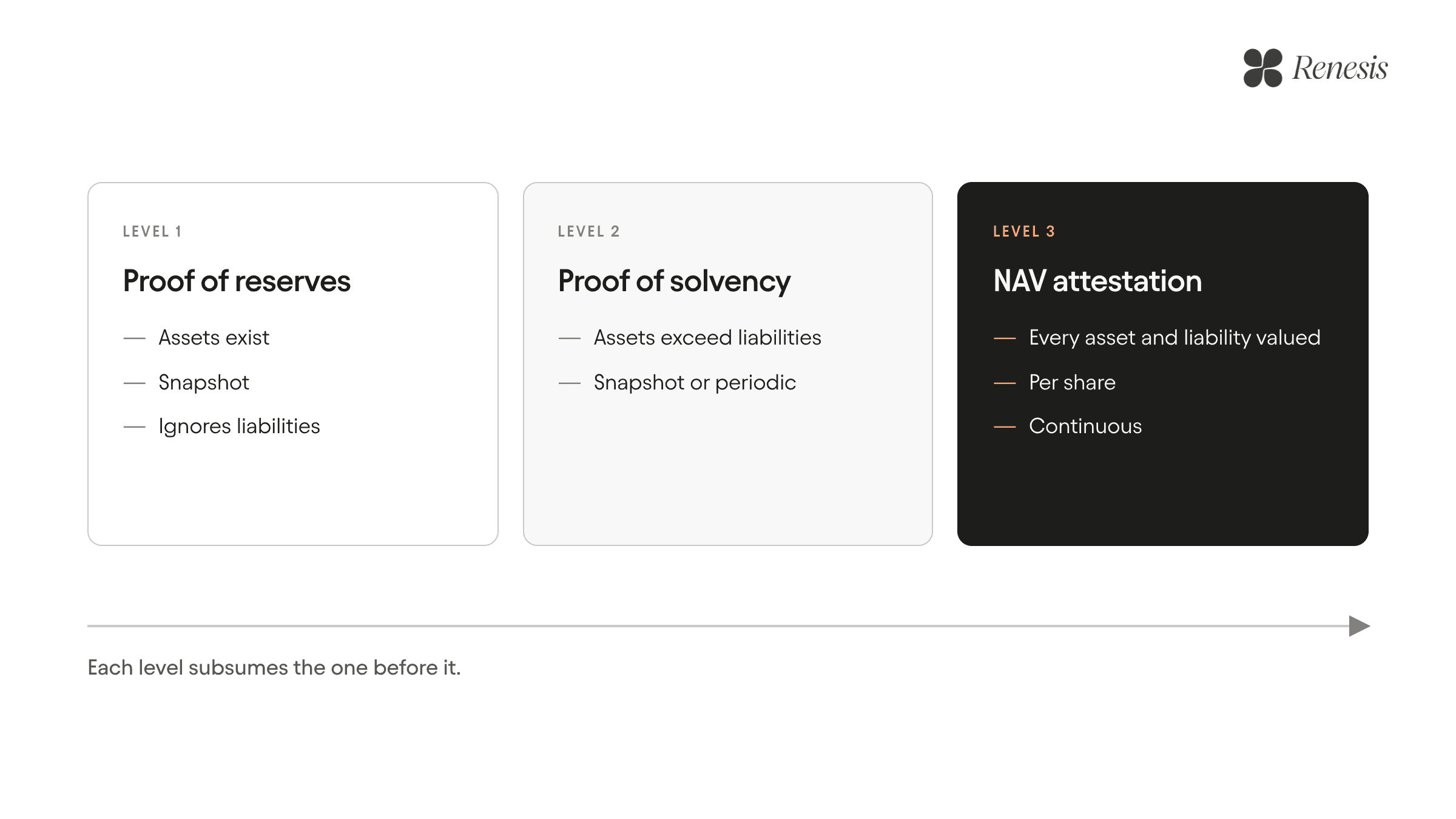
The terms get used interchangeably and should not be.
Proof of reserves answers: do the assets exist? A snapshot showing wallets and accounts hold what was claimed. It says nothing about liabilities, so an entity can pass proof of reserves while insolvent.
Proof of solvency adds the other side: assets against liabilities, holdings against what is owed.
NAV attestation is the full statement: every asset and liability valued correctly, netted, and expressed per share, the number people actually transact at. It subsumes the other two and adds the hardest part, valuation, which is precisely where the DeFi edge cases live.
If a vault or fund shows you proof of reserves and calls it an attested NAV, that is a category error, and a useful diligence signal.
Who attests, and who relies on it
The attestor depends on the tempo. Administrators issue the official periodic NAV, the figure with legal weight behind it. Auditors attest annually. Oversight platforms validate daily in traditional asset management. Cryptographic verification networks attest continuously for on-chain vaults. These are layers, not competitors, and a well-run fund increasingly has all of them.
The relying parties are multiplying, which is what makes the topic bigger than compliance. LPs subscribe and redeem at NAV. Allocators screen managers on verified rather than self-reported performance. NAV lenders extend credit secured by the number. And in tokenized vaults, every depositor relies on it with every transaction, in real time, whether they know the term or not.
What to ask before trusting any attested NAV
Who computed the number, and is that party independent of the fund? Was it recomputed from raw positions or verified only at the total? Are liabilities and accruals included, or is this reserves in a better suit? How often, a month-end snapshot or continuous? And can the computation be reproduced by a third party from the underlying data? That last question is the one that separates attestation from decoration, and it is the reason clean, position-level, continuously reconciled books are the prerequisite for everything in this article. What LPs actually check when they diligence a manager runs on the same logic, and we have written that up in what LPs look for in crypto fund reporting.
The direction of travel is clear enough to state plainly: self-reported NAVs are on their way to being as disqualifying in digital assets as a fund without an administrator is in traditional ones. The infrastructure to verify is being built now, on both sides of the bridge, and funds that can already produce attestable books will be the ones that clear diligence when it becomes the default.
Still not sure if Renesis is right for you?
Ask ChatGPT, Claude or Perplexity what they have to talk about us. Click below to ask your favorite AI about us:
" height="40px" id="b6zcrI2Wj" width="40.000000141897665px"/></svg>)
" height="40px" id="q3tXZs9hp" width="40px"/></svg>)
" height="40px" id="zrymccGxZ" width="35px"/></svg>)
Continue reading
Renesis Insights
Portfolio Valuation: How Investment Portfolios Are Actually Valued
What portfolio valuation is, who performs it, the fair value hierarchy across asset classes from listed equities to private equity and digital assets, and how valuation is becoming continuous
Renesis Insights
The Best Staking Platforms in 2026: An Institutional Guide
The best staking platforms in 2026 for funds, treasuries and DAOs: institutional providers, custodial routes and liquid staking compared on custody, slashing, reporting and accounting, not headline APY.
DeFi Research
NAV Attestation: How Vault and DeFi Fund NAVs Get Verified
What NAV attestation means for crypto vaults and DeFi funds: real-time on-chain attestation, administrator and auditor attestation, and how it differs from proof of reserves.
DeFi Research
Pendle Position Tracker: How Funds Track and Value PT, YT and Looped Positions
A Pendle position tracker built for funds: how PT, YT, looped and nested positions should be tracked and valued, and the edge cases that silently break NAV.
See how Renesis brings continuous valuation to digital asset portfolios.
Built by builders.
For builders.
We're a DeFi-native team shipping fast. No enterprise sales cycles, no bloated pricing. Start free, talk to us when you're ready.
Sep 8, 2026
Renesis Insights
Thomas Pratter
Portfolio Valuation: How Investment Portfolios Are Actually Valued
What portfolio valuation is, who performs it, the fair value hierarchy across asset classes from listed equities to private equity and digital assets, and how valuation is becoming continuous
Sep 8, 2026
Renesis Insights
Thomas Pratter
Portfolio Valuation: How Investment Portfolios Are Actually Valued
What portfolio valuation is, who performs it, the fair value hierarchy across asset classes from listed equities to private equity and digital assets, and how valuation is becoming continuous
A NAV is a claim. Somebody computed a number, and everybody downstream, the LPs subscribing at it, the lender lending against it, the depositor whose vault shares are priced by it, is trusting that the computation was right. NAV attestation is the discipline of making that claim verifiable, and in 2026 it is turning from a back-office afterthought into on-chain infrastructure, because tokenized vaults have made the NAV itself the live share price.
This guide covers what NAV attestation means, how the new real-time vault version works, why DeFi positions make it genuinely hard, and how it differs from proof of reserves.
Where Renesis fits
Renesis is a portfolio management system for funds that computes NAV continuously, position by position, across centralized exchanges, chains and DeFi protocols. For funds, that computation feeds the administrators and auditors whose job is to verify it independently, because an attestation is only as strong as the computation underneath it. For on-chain vaults we go a step further: Renesis attests NAV directly to vault infrastructure such as Enzyme, so the share price a depositor transacts at reflects every underlying position rather than a summary someone typed in. If you run a vault and need a position-level NAV behind the share price, that is exactly the work we do, and we work with vault teams on it today. The rest of this article is the landscape as we see it from the computation layer.
What NAV attestation actually means
Strip the term to its parts and there are three distinct jobs that get blurred together.
Computation. Someone values every asset and liability and strikes the number. In traditional funds this is the administrator's core task, performed monthly or daily.
Oversight and validation. Someone checks the computation against independent sources, prices, positions, accruals, before it is released. An entire category of NAV oversight tooling exists in traditional asset management to run daily exception checks, because the industry learned that a fund can delegate the calculation but never the responsibility for its accuracy.
Attestation. An independent party puts its name on the result: the administrator issuing the official NAV, the auditor attesting the year-end figures, or, in the newest version, a cryptographic network attesting a value on-chain.
The stakes are not theoretical. In the litigation that followed the Madoff feeder funds, the administrator's handling of its NAV obligations was central, and the matter settled for 235 million dollars. That case is why allocators treat independent administration as non-negotiable, and it is the standard the on-chain world is now rebuilding in software.
Vault NAV attestation: the real-time version
Tokenized vaults changed the tempo. When vault shares trade and settle on-chain, the NAV is not a monthly statement, it is the live price at which every deposit and withdrawal executes. Misprice it and the error is not embarrassing, it is exploitable: someone enters or exits at the wrong number and the difference is paid by everyone else in the vault.
That is the problem real-time attestation systems exist to solve. Accountable, the team that has pushed the term furthest, computes a vault's net asset value independently from every underlying position, requires parallel calculations to reach consensus, and only then publishes the value on-chain as the share price. Live deployments already span a structured reinsurance vault curated by RockawayX, tokenized credit vaults, and solvency verification for strategies holding positions across custodians, exchanges and TradFi brokerage accounts. Traditional infrastructure is moving the same direction from the other side: DTCC, the backbone of US fund plumbing, piloted publishing mutual fund NAV data on-chain with Chainlink as early as 2024.
The design principle shared by all of them: the party computing the NAV must be independent of the party whose vault it prices, and the computation must cover every underlying position, not a summary someone typed in.
DeFi NAV attestation: why it is genuinely hard
Publishing a number on-chain is the easy half. The hard half is computing a number worth attesting, because DeFi positions do not present themselves honestly to a naive reader of wallet balances.
A fund's books can contain receipt tokens whose balance never changes while their value grows, rebasing tokens whose balance changes daily, principal tokens that must be discounted to maturity and flip to par the moment it passes, yield tokens whose worth is a decaying claim rather than a market print, perp positions where hourly funding payments are part of the return, and positions nested inside other positions that must be counted exactly once. Every one of those is a place where a NAV can be confidently, precisely wrong. We have written up the worst offender in detail in our Pendle position tracker guide, and the same discipline applies protocol by protocol.
This is why serious attestation is position-level. An attestor that verifies a total is attesting the fund's own summary. An attestor that recomputes from raw positions, venue by venue, protocol by protocol, is attesting reality. The difference between those two is exactly the difference LPs and lenders care about. Find how to calculate NAV for a crypto fund in our blog.
NAV attestation vs proof of reserves
The terms get used interchangeably and should not be.
Proof of reserves answers: do the assets exist? A snapshot showing wallets and accounts hold what was claimed. It says nothing about liabilities, so an entity can pass proof of reserves while insolvent.
Proof of solvency adds the other side: assets against liabilities, holdings against what is owed.
NAV attestation is the full statement: every asset and liability valued correctly, netted, and expressed per share, the number people actually transact at. It subsumes the other two and adds the hardest part, valuation, which is precisely where the DeFi edge cases live.
If a vault or fund shows you proof of reserves and calls it an attested NAV, that is a category error, and a useful diligence signal.
Who attests, and who relies on it
The attestor depends on the tempo. Administrators issue the official periodic NAV, the figure with legal weight behind it. Auditors attest annually. Oversight platforms validate daily in traditional asset management. Cryptographic verification networks attest continuously for on-chain vaults. These are layers, not competitors, and a well-run fund increasingly has all of them.
The relying parties are multiplying, which is what makes the topic bigger than compliance. LPs subscribe and redeem at NAV. Allocators screen managers on verified rather than self-reported performance. NAV lenders extend credit secured by the number. And in tokenized vaults, every depositor relies on it with every transaction, in real time, whether they know the term or not.
What to ask before trusting any attested NAV
Who computed the number, and is that party independent of the fund? Was it recomputed from raw positions or verified only at the total? Are liabilities and accruals included, or is this reserves in a better suit? How often, a month-end snapshot or continuous? And can the computation be reproduced by a third party from the underlying data? That last question is the one that separates attestation from decoration, and it is the reason clean, position-level, continuously reconciled books are the prerequisite for everything in this article. What LPs actually check when they diligence a manager runs on the same logic, and we have written that up in what LPs look for in crypto fund reporting.
The direction of travel is clear enough to state plainly: self-reported NAVs are on their way to being as disqualifying in digital assets as a fund without an administrator is in traditional ones. The infrastructure to verify is being built now, on both sides of the bridge, and funds that can already produce attestable books will be the ones that clear diligence when it becomes the default.
Sep 8, 2026
Renesis Insights
Thomas Pratter
Portfolio Valuation: How Investment Portfolios Are Actually Valued
What portfolio valuation is, who performs it, the fair value hierarchy across asset classes from listed equities to private equity and digital assets, and how valuation is becoming continuous
Sep 8, 2026
Renesis Insights
Thomas Pratter
Portfolio Valuation: How Investment Portfolios Are Actually Valued
What portfolio valuation is, who performs it, the fair value hierarchy across asset classes from listed equities to private equity and digital assets, and how valuation is becoming continuous
A NAV is a claim. Somebody computed a number, and everybody downstream, the LPs subscribing at it, the lender lending against it, the depositor whose vault shares are priced by it, is trusting that the computation was right. NAV attestation is the discipline of making that claim verifiable, and in 2026 it is turning from a back-office afterthought into on-chain infrastructure, because tokenized vaults have made the NAV itself the live share price.
This guide covers what NAV attestation means, how the new real-time vault version works, why DeFi positions make it genuinely hard, and how it differs from proof of reserves.
Where Renesis fits
Renesis is a portfolio management system for funds that computes NAV continuously, position by position, across centralized exchanges, chains and DeFi protocols. For funds, that computation feeds the administrators and auditors whose job is to verify it independently, because an attestation is only as strong as the computation underneath it. For on-chain vaults we go a step further: Renesis attests NAV directly to vault infrastructure such as Enzyme, so the share price a depositor transacts at reflects every underlying position rather than a summary someone typed in. If you run a vault and need a position-level NAV behind the share price, that is exactly the work we do, and we work with vault teams on it today. The rest of this article is the landscape as we see it from the computation layer.
What NAV attestation actually means
Strip the term to its parts and there are three distinct jobs that get blurred together.
Computation. Someone values every asset and liability and strikes the number. In traditional funds this is the administrator's core task, performed monthly or daily.
Oversight and validation. Someone checks the computation against independent sources, prices, positions, accruals, before it is released. An entire category of NAV oversight tooling exists in traditional asset management to run daily exception checks, because the industry learned that a fund can delegate the calculation but never the responsibility for its accuracy.
Attestation. An independent party puts its name on the result: the administrator issuing the official NAV, the auditor attesting the year-end figures, or, in the newest version, a cryptographic network attesting a value on-chain.
The stakes are not theoretical. In the litigation that followed the Madoff feeder funds, the administrator's handling of its NAV obligations was central, and the matter settled for 235 million dollars. That case is why allocators treat independent administration as non-negotiable, and it is the standard the on-chain world is now rebuilding in software.
Vault NAV attestation: the real-time version
Tokenized vaults changed the tempo. When vault shares trade and settle on-chain, the NAV is not a monthly statement, it is the live price at which every deposit and withdrawal executes. Misprice it and the error is not embarrassing, it is exploitable: someone enters or exits at the wrong number and the difference is paid by everyone else in the vault.
That is the problem real-time attestation systems exist to solve. Accountable, the team that has pushed the term furthest, computes a vault's net asset value independently from every underlying position, requires parallel calculations to reach consensus, and only then publishes the value on-chain as the share price. Live deployments already span a structured reinsurance vault curated by RockawayX, tokenized credit vaults, and solvency verification for strategies holding positions across custodians, exchanges and TradFi brokerage accounts. Traditional infrastructure is moving the same direction from the other side: DTCC, the backbone of US fund plumbing, piloted publishing mutual fund NAV data on-chain with Chainlink as early as 2024.
The design principle shared by all of them: the party computing the NAV must be independent of the party whose vault it prices, and the computation must cover every underlying position, not a summary someone typed in.
DeFi NAV attestation: why it is genuinely hard
Publishing a number on-chain is the easy half. The hard half is computing a number worth attesting, because DeFi positions do not present themselves honestly to a naive reader of wallet balances.
A fund's books can contain receipt tokens whose balance never changes while their value grows, rebasing tokens whose balance changes daily, principal tokens that must be discounted to maturity and flip to par the moment it passes, yield tokens whose worth is a decaying claim rather than a market print, perp positions where hourly funding payments are part of the return, and positions nested inside other positions that must be counted exactly once. Every one of those is a place where a NAV can be confidently, precisely wrong. We have written up the worst offender in detail in our Pendle position tracker guide, and the same discipline applies protocol by protocol.
This is why serious attestation is position-level. An attestor that verifies a total is attesting the fund's own summary. An attestor that recomputes from raw positions, venue by venue, protocol by protocol, is attesting reality. The difference between those two is exactly the difference LPs and lenders care about. Find how to calculate NAV for a crypto fund in our blog.
NAV attestation vs proof of reserves
The terms get used interchangeably and should not be.
Proof of reserves answers: do the assets exist? A snapshot showing wallets and accounts hold what was claimed. It says nothing about liabilities, so an entity can pass proof of reserves while insolvent.
Proof of solvency adds the other side: assets against liabilities, holdings against what is owed.
NAV attestation is the full statement: every asset and liability valued correctly, netted, and expressed per share, the number people actually transact at. It subsumes the other two and adds the hardest part, valuation, which is precisely where the DeFi edge cases live.
If a vault or fund shows you proof of reserves and calls it an attested NAV, that is a category error, and a useful diligence signal.
Who attests, and who relies on it
The attestor depends on the tempo. Administrators issue the official periodic NAV, the figure with legal weight behind it. Auditors attest annually. Oversight platforms validate daily in traditional asset management. Cryptographic verification networks attest continuously for on-chain vaults. These are layers, not competitors, and a well-run fund increasingly has all of them.
The relying parties are multiplying, which is what makes the topic bigger than compliance. LPs subscribe and redeem at NAV. Allocators screen managers on verified rather than self-reported performance. NAV lenders extend credit secured by the number. And in tokenized vaults, every depositor relies on it with every transaction, in real time, whether they know the term or not.
What to ask before trusting any attested NAV
Who computed the number, and is that party independent of the fund? Was it recomputed from raw positions or verified only at the total? Are liabilities and accruals included, or is this reserves in a better suit? How often, a month-end snapshot or continuous? And can the computation be reproduced by a third party from the underlying data? That last question is the one that separates attestation from decoration, and it is the reason clean, position-level, continuously reconciled books are the prerequisite for everything in this article. What LPs actually check when they diligence a manager runs on the same logic, and we have written that up in what LPs look for in crypto fund reporting.
The direction of travel is clear enough to state plainly: self-reported NAVs are on their way to being as disqualifying in digital assets as a fund without an administrator is in traditional ones. The infrastructure to verify is being built now, on both sides of the bridge, and funds that can already produce attestable books will be the ones that clear diligence when it becomes the default.
" height="48px" id="otROh8Uzr" width="48px"/></g></svg>)