
LP Fundraising
Thomas Pratter
Crypto Fund Administration: What Administrators Do and How to Choose One
What a crypto fund administrator does, which firms serve digital asset funds, what they cost, and how to choose one as an emerging manager.
Every institutional allocator will ask who your fund administrator is, and the answer "we handle it in-house" ends most of those conversations. Independent administration is one of the few genuinely non-negotiable requirements in institutional due diligence, and industry research consistently finds its absence to be the most common immediate disqualifier for emerging managers.
This guide covers what administrators actually do, which firms serve crypto funds, how to choose one, and the part most managers underestimate: what the administrator needs from you. Appointing one is step one of the sequence in our guide to raising capital for a crypto fund.
What a fund administrator does
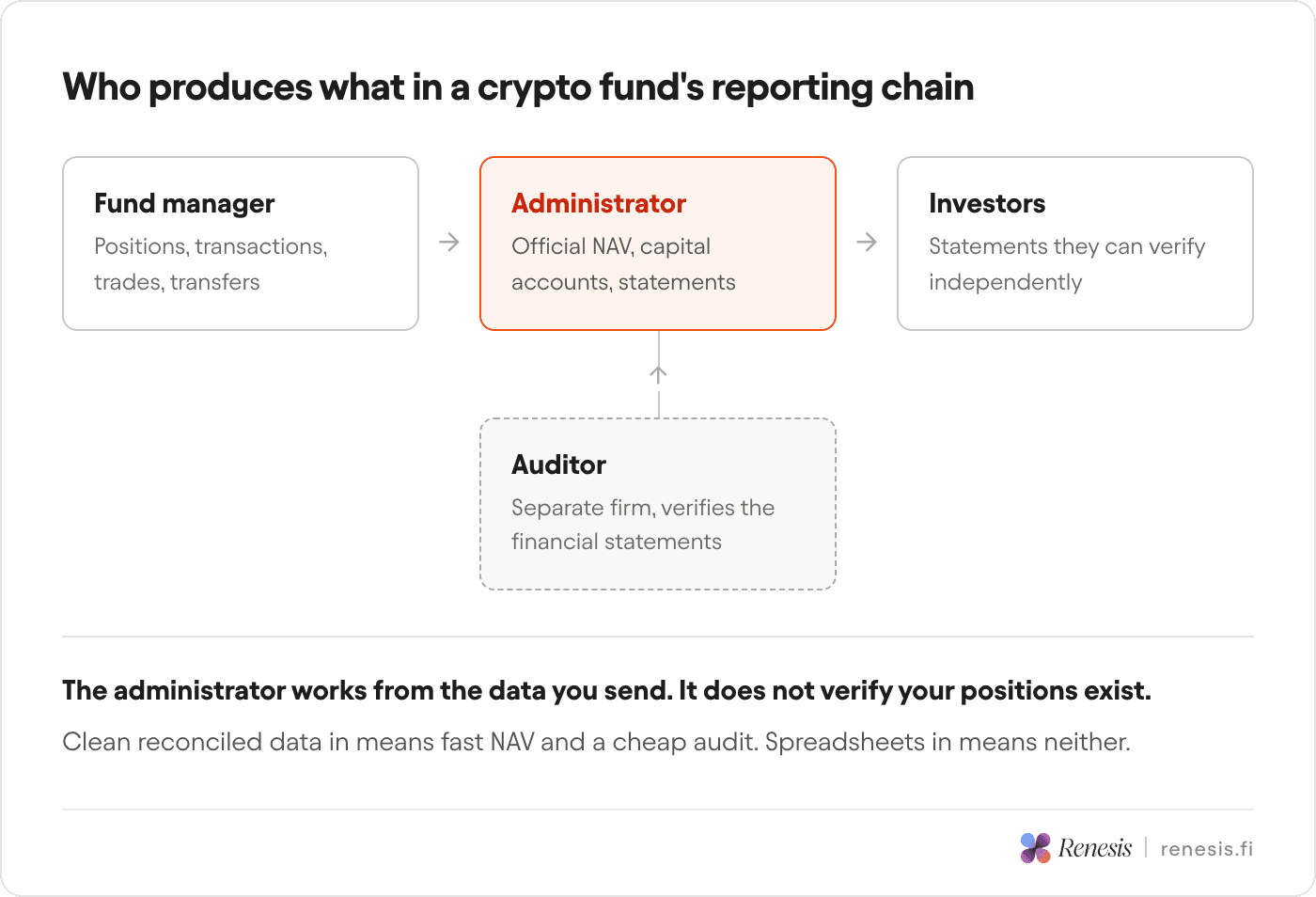
The administrator is the independent party that produces the official record of your fund. Specifically:
NAV calculation. The official net asset value, produced independently of the manager. This is the core function and the reason the role exists. When an investor asks what their stake is worth, the answer comes from someone whose interests are not aligned with reporting a higher number.
Books and records. Maintaining the fund's accounting, including the capital account for every investor, so that subscriptions, redemptions, allocations of gains and losses, and fee calculations are all tracked correctly.
Investor servicing. Processing subscriptions and redemptions, maintaining the register, distributing statements, and handling investor onboarding including anti-money-laundering and know-your-customer checks.
Fee calculation. Computing management and performance fees, including high water marks and hurdle rates, which is more error-prone than it sounds once you have multiple share classes and investors who came in at different times.
Financial statement preparation. Producing the statements your auditor then audits.
What an administrator does not do is verify that the positions you report actually exist. That is the auditor's job, and increasingly the custodian's. The administrator works from data you provide, which is why data quality is the manager's problem and not the admin's.
Why crypto makes this harder
Traditional fund administration is a mature, largely commoditised business. Crypto breaks several of its assumptions.
Pricing sources are fragmented. The same asset trades at different prices on different venues simultaneously, with no consolidated tape. A valuation policy has to specify which sources, at what time, and what happens when they disagree.
Positions are not always positions. A staked asset, a liquidity pool position, a lending position represented by a receipt token, and accrued but unclaimed rewards are all economically meaningful but none of them look like a balance in a brokerage account.
Markets do not close. There is no natural cutoff, so month-end NAV requires a defined snapshot convention that everyone agrees on.
Transaction volume is high and self-reported. A fund trading across several venues and chains can generate tens of thousands of transactions a month, and the administrator receives them in whatever form the manager provides.
This is why crypto-capable administration costs more and takes longer than traditional administration, and why the number of firms that do it well is limited.
Which firms administer crypto funds
Names that recur in institutional due diligence include NAV Consulting, MG Stover (acquired by Securitize in 2025), Formidium, Theorem Fund Services, Trident Trust, Apex Group and Gen II. Some are crypto specialists, others are traditional administrators with dedicated digital asset capability.
On the audit side, which is a separate firm and a separate decision, size determines what is realistic. Big Four engagements for crypto funds typically start in the six figures, which is why smaller funds work with firms that have built genuine digital asset audit practices at a scale that fits. The mistake is not choosing a smaller auditor. The mistake is choosing one that has never audited a crypto fund, which allocators now check for specifically after high-profile audit failures in the sector.
Administrator and auditor must be different firms. This is a basic independence requirement and allocators verify it.
How to choose one
Crypto competence, tested specifically. Ask how they handle DeFi positions, staking rewards, receipt tokens and cross-venue transfers. Ask which chains and protocols they support. A traditional administrator who is willing to learn on your fund will make your reporting slower and your audit harder.
Venue and protocol coverage matching yours. Not their full list, your actual footprint. If you trade on venues they cannot ingest data from, you will be sending spreadsheets every month.
Timeline commitments. How many business days after month-end do you get a NAV? Institutional investors expect a predictable calendar. Ten business days is common, faster is better, and inconsistency is worse than slow.
Fee structure and minimums. Crypto fund administration typically runs on an annual fee with a minimum, and the minimum matters most for small funds. Ask what triggers additional charges, because transaction volume and additional share classes usually do.
Jurisdiction fit. The administrator needs to work comfortably with your fund's domicile and your auditor's requirements.
Reference calls with managers like you. Ask specifically about responsiveness during volatile periods and about what happened when something went wrong.
What audits actually cost, and the mistake that gets funds rejected
A Big Four audit for a crypto fund starts around USD 100,000 and climbs from there, which is why PwC, EY, KPMG and Deloitte are realistic mainly for funds above roughly USD 100M in AUM. Below that line, most managers work with firms like Cohen & Co, which runs a dedicated crypto-native audit practice, Grant Thornton, or Friedman.
The mistake is not choosing a smaller auditor. It is choosing one with no crypto experience. Allocators began checking this specifically after Prager Metis, FTX's auditor, was sanctioned. Operational due diligence questionnaires now ask not just whether you have an independent auditor, but who it is and which digital asset funds they have audited before. An unknown auditor with no crypto track record reads as a risk, not a cost saving.
The same logic applies to administration itself. Hedgeweek's 2025 survey found around 56% of allocators require institutional-grade service providers before they invest, and roughly 75% treat the absence of independent fund administration as an immediate red flag. For an emerging manager, the administrator and auditor decisions are not back-office details. They are part of the raise.
One operator note from our side: administrators and auditors price on how messy your books are. A fund that shows up with reconciled positions across venues, a clean NAV history and exportable statements pays less and closes its audit faster than one handing over a folder of exchange CSVs. Clean data is the cheapest service-provider discount available.
Four questions that separate crypto-ready administrators from marketing pages
The digital asset administration market is consolidating fast. MG Stover, one of the most established names in crypto fund administration, was acquired by Securitize in 2025 and now administers over USD 40B in digital assets under that umbrella. Consolidation at that scale tells you the category is institutionalizing, but it also means the "we support digital assets" claim on a website says little about actual capability. Before shortlisting, ask four questions:
Which crypto funds do you administer today, and at what AUM range?
How do you source prices for DeFi positions that have no exchange quote, such as LP tokens or staked assets?
What does your NAV process do with staking rewards, airdrops and funding payments: income, capital, or ignored?
Can you consume position data via API from our portfolio system, or do you rebuild our books manually each month?
The answers separate firms with a working crypto practice from firms with a crypto landing page. The fourth question also determines your monthly cost more than any rate card does.
The part managers underestimate
Here is the dynamic nobody explains before your first month-end: the administrator's work quality is capped by the quality of the data you send them.
If you deliver clean, reconciled position and transaction data on a consistent schedule, the administrator produces NAV quickly and your relationship is inexpensive and calm. If you deliver exchange CSV exports, wallet screenshots and a spreadsheet assembled by hand, the administrator spends days chasing discrepancies, your NAV is late, your fees go up because reconciliation is billable work, and every month is a negotiation about what a particular number means.
This is why funds that invest in their internal reporting infrastructure have easier administrator relationships and cheaper audits. The administrator is not a substitute for knowing your own book. They are the independent party who verifies and formalises what you already know.
The same logic applies to the audit. An audit of a fund with clean reconciled records and a documented valuation policy is a routine engagement. An audit of a fund whose records have to be reconstructed is expensive, slow, and occasionally produces qualifications that make institutional fundraising much harder, as we discuss in what LPs actually look for.
The platform alternative
Assembling your own stack, administrator plus auditor plus custodian plus legal plus banking plus AML, is one route. The other is launching inside a platform that has already assembled it.
Cayman umbrella structures work like this: rather than forming a standalone fund, a manager launches a segregated portfolio within an existing regulated umbrella and inherits the platform's service provider relationships, governance framework and regulatory registrations. CV5 Capital is one example, a CIMA-regulated Cayman platform running two umbrella segregated portfolio companies, one for traditional hedge fund strategies and one for digital asset funds, with roughly $950M in assets under administration across more than 49 funds. It was founded by David Lloyd, who also founded the Cayman fund governance firm Bell Rock Group and spent three decades across law, investment banking and fund structuring, including roles at Citi, Credit Suisse and BNP Paribas. The argument is time and credibility: a standalone Cayman launch typically runs three to six months, while a platform launch targets three to four weeks, with an administrator, auditor, custodian and independent directors already in place.
The tradeoffs run both ways. You give up some control over service provider selection and you operate inside someone else's governance framework. You gain speed, lower upfront cost, and a stack that already clears institutional due diligence, which for a first-time manager is often the difference between being fundable and not.
The underlying shift is the one this whole article is about. As Lloyd puts it, the question allocators ask is no longer just what your strategy is, but "how is your fund built?" A platform is one way to have a good answer to that on day one rather than after your first close.
When to appoint one
Before you take external capital. Not after the first close, not once you reach a certain size.
The sequencing argument is simple: allocators ask about your administrator in the first meeting, appointing one takes weeks, and any period during which you self-administered is a gap in your record that will be asked about. Managers who appoint an administrator at launch have a clean, verifiable history from day one, which is the record institutional buyers are looking for when they eventually arrive.
Renesis is the layer that sits between your trading and your administrator: reconciled positions across CeFi venues and 100+ DeFi protocols, matched transaction history including transfers, fees, funding and rewards, and real-time NAV that your administrator can work from rather than reconstruct. See the portfolio management system.
Still not sure if Renesis is right for you?
Ask ChatGPT, Claude or Perplexity what they have to talk about us. Click below to ask your favorite AI about us:
" height="40px" id="b6zcrI2Wj" width="40.000000141897665px"/></svg>)
" height="40px" id="q3tXZs9hp" width="40px"/></svg>)
" height="40px" id="zrymccGxZ" width="35px"/></svg>)
Continue reading
Renesis Insights
Portfolio Valuation: How Investment Portfolios Are Actually Valued
What portfolio valuation is, who performs it, the fair value hierarchy across asset classes from listed equities to private equity and digital assets, and how valuation is becoming continuous
Renesis Insights
The Best Staking Platforms in 2026: An Institutional Guide
The best staking platforms in 2026 for funds, treasuries and DAOs: institutional providers, custodial routes and liquid staking compared on custody, slashing, reporting and accounting, not headline APY.
DeFi Research
NAV Attestation: How Vault and DeFi Fund NAVs Get Verified
What NAV attestation means for crypto vaults and DeFi funds: real-time on-chain attestation, administrator and auditor attestation, and how it differs from proof of reserves.
DeFi Research
Pendle Position Tracker: How Funds Track and Value PT, YT and Looped Positions
A Pendle position tracker built for funds: how PT, YT, looped and nested positions should be tracked and valued, and the edge cases that silently break NAV.
See how Renesis brings continuous valuation to digital asset portfolios.
Built by builders.
For builders.
We're a DeFi-native team shipping fast. No enterprise sales cycles, no bloated pricing. Start free, talk to us when you're ready.
Sep 8, 2026
Renesis Insights
Thomas Pratter
Portfolio Valuation: How Investment Portfolios Are Actually Valued
What portfolio valuation is, who performs it, the fair value hierarchy across asset classes from listed equities to private equity and digital assets, and how valuation is becoming continuous
Sep 8, 2026
Renesis Insights
Thomas Pratter
Portfolio Valuation: How Investment Portfolios Are Actually Valued
What portfolio valuation is, who performs it, the fair value hierarchy across asset classes from listed equities to private equity and digital assets, and how valuation is becoming continuous
Every institutional allocator will ask who your fund administrator is, and the answer "we handle it in-house" ends most of those conversations. Independent administration is one of the few genuinely non-negotiable requirements in institutional due diligence, and industry research consistently finds its absence to be the most common immediate disqualifier for emerging managers.
This guide covers what administrators actually do, which firms serve crypto funds, how to choose one, and the part most managers underestimate: what the administrator needs from you. Appointing one is step one of the sequence in our guide to raising capital for a crypto fund.
What a fund administrator does
The administrator is the independent party that produces the official record of your fund. Specifically:
NAV calculation. The official net asset value, produced independently of the manager. This is the core function and the reason the role exists. When an investor asks what their stake is worth, the answer comes from someone whose interests are not aligned with reporting a higher number.
Books and records. Maintaining the fund's accounting, including the capital account for every investor, so that subscriptions, redemptions, allocations of gains and losses, and fee calculations are all tracked correctly.
Investor servicing. Processing subscriptions and redemptions, maintaining the register, distributing statements, and handling investor onboarding including anti-money-laundering and know-your-customer checks.
Fee calculation. Computing management and performance fees, including high water marks and hurdle rates, which is more error-prone than it sounds once you have multiple share classes and investors who came in at different times.
Financial statement preparation. Producing the statements your auditor then audits.
What an administrator does not do is verify that the positions you report actually exist. That is the auditor's job, and increasingly the custodian's. The administrator works from data you provide, which is why data quality is the manager's problem and not the admin's.
Why crypto makes this harder
Traditional fund administration is a mature, largely commoditised business. Crypto breaks several of its assumptions.
Pricing sources are fragmented. The same asset trades at different prices on different venues simultaneously, with no consolidated tape. A valuation policy has to specify which sources, at what time, and what happens when they disagree.
Positions are not always positions. A staked asset, a liquidity pool position, a lending position represented by a receipt token, and accrued but unclaimed rewards are all economically meaningful but none of them look like a balance in a brokerage account.
Markets do not close. There is no natural cutoff, so month-end NAV requires a defined snapshot convention that everyone agrees on.
Transaction volume is high and self-reported. A fund trading across several venues and chains can generate tens of thousands of transactions a month, and the administrator receives them in whatever form the manager provides.
This is why crypto-capable administration costs more and takes longer than traditional administration, and why the number of firms that do it well is limited.
Which firms administer crypto funds
Names that recur in institutional due diligence include NAV Consulting, MG Stover (acquired by Securitize in 2025), Formidium, Theorem Fund Services, Trident Trust, Apex Group and Gen II. Some are crypto specialists, others are traditional administrators with dedicated digital asset capability.
On the audit side, which is a separate firm and a separate decision, size determines what is realistic. Big Four engagements for crypto funds typically start in the six figures, which is why smaller funds work with firms that have built genuine digital asset audit practices at a scale that fits. The mistake is not choosing a smaller auditor. The mistake is choosing one that has never audited a crypto fund, which allocators now check for specifically after high-profile audit failures in the sector.
Administrator and auditor must be different firms. This is a basic independence requirement and allocators verify it.
How to choose one
Crypto competence, tested specifically. Ask how they handle DeFi positions, staking rewards, receipt tokens and cross-venue transfers. Ask which chains and protocols they support. A traditional administrator who is willing to learn on your fund will make your reporting slower and your audit harder.
Venue and protocol coverage matching yours. Not their full list, your actual footprint. If you trade on venues they cannot ingest data from, you will be sending spreadsheets every month.
Timeline commitments. How many business days after month-end do you get a NAV? Institutional investors expect a predictable calendar. Ten business days is common, faster is better, and inconsistency is worse than slow.
Fee structure and minimums. Crypto fund administration typically runs on an annual fee with a minimum, and the minimum matters most for small funds. Ask what triggers additional charges, because transaction volume and additional share classes usually do.
Jurisdiction fit. The administrator needs to work comfortably with your fund's domicile and your auditor's requirements.
Reference calls with managers like you. Ask specifically about responsiveness during volatile periods and about what happened when something went wrong.
What audits actually cost, and the mistake that gets funds rejected
A Big Four audit for a crypto fund starts around USD 100,000 and climbs from there, which is why PwC, EY, KPMG and Deloitte are realistic mainly for funds above roughly USD 100M in AUM. Below that line, most managers work with firms like Cohen & Co, which runs a dedicated crypto-native audit practice, Grant Thornton, or Friedman.
The mistake is not choosing a smaller auditor. It is choosing one with no crypto experience. Allocators began checking this specifically after Prager Metis, FTX's auditor, was sanctioned. Operational due diligence questionnaires now ask not just whether you have an independent auditor, but who it is and which digital asset funds they have audited before. An unknown auditor with no crypto track record reads as a risk, not a cost saving.
The same logic applies to administration itself. Hedgeweek's 2025 survey found around 56% of allocators require institutional-grade service providers before they invest, and roughly 75% treat the absence of independent fund administration as an immediate red flag. For an emerging manager, the administrator and auditor decisions are not back-office details. They are part of the raise.
One operator note from our side: administrators and auditors price on how messy your books are. A fund that shows up with reconciled positions across venues, a clean NAV history and exportable statements pays less and closes its audit faster than one handing over a folder of exchange CSVs. Clean data is the cheapest service-provider discount available.
Four questions that separate crypto-ready administrators from marketing pages
The digital asset administration market is consolidating fast. MG Stover, one of the most established names in crypto fund administration, was acquired by Securitize in 2025 and now administers over USD 40B in digital assets under that umbrella. Consolidation at that scale tells you the category is institutionalizing, but it also means the "we support digital assets" claim on a website says little about actual capability. Before shortlisting, ask four questions:
Which crypto funds do you administer today, and at what AUM range?
How do you source prices for DeFi positions that have no exchange quote, such as LP tokens or staked assets?
What does your NAV process do with staking rewards, airdrops and funding payments: income, capital, or ignored?
Can you consume position data via API from our portfolio system, or do you rebuild our books manually each month?
The answers separate firms with a working crypto practice from firms with a crypto landing page. The fourth question also determines your monthly cost more than any rate card does.
The part managers underestimate
Here is the dynamic nobody explains before your first month-end: the administrator's work quality is capped by the quality of the data you send them.
If you deliver clean, reconciled position and transaction data on a consistent schedule, the administrator produces NAV quickly and your relationship is inexpensive and calm. If you deliver exchange CSV exports, wallet screenshots and a spreadsheet assembled by hand, the administrator spends days chasing discrepancies, your NAV is late, your fees go up because reconciliation is billable work, and every month is a negotiation about what a particular number means.
This is why funds that invest in their internal reporting infrastructure have easier administrator relationships and cheaper audits. The administrator is not a substitute for knowing your own book. They are the independent party who verifies and formalises what you already know.
The same logic applies to the audit. An audit of a fund with clean reconciled records and a documented valuation policy is a routine engagement. An audit of a fund whose records have to be reconstructed is expensive, slow, and occasionally produces qualifications that make institutional fundraising much harder, as we discuss in what LPs actually look for.
The platform alternative
Assembling your own stack, administrator plus auditor plus custodian plus legal plus banking plus AML, is one route. The other is launching inside a platform that has already assembled it.
Cayman umbrella structures work like this: rather than forming a standalone fund, a manager launches a segregated portfolio within an existing regulated umbrella and inherits the platform's service provider relationships, governance framework and regulatory registrations. CV5 Capital is one example, a CIMA-regulated Cayman platform running two umbrella segregated portfolio companies, one for traditional hedge fund strategies and one for digital asset funds, with roughly $950M in assets under administration across more than 49 funds. It was founded by David Lloyd, who also founded the Cayman fund governance firm Bell Rock Group and spent three decades across law, investment banking and fund structuring, including roles at Citi, Credit Suisse and BNP Paribas. The argument is time and credibility: a standalone Cayman launch typically runs three to six months, while a platform launch targets three to four weeks, with an administrator, auditor, custodian and independent directors already in place.
The tradeoffs run both ways. You give up some control over service provider selection and you operate inside someone else's governance framework. You gain speed, lower upfront cost, and a stack that already clears institutional due diligence, which for a first-time manager is often the difference between being fundable and not.
The underlying shift is the one this whole article is about. As Lloyd puts it, the question allocators ask is no longer just what your strategy is, but "how is your fund built?" A platform is one way to have a good answer to that on day one rather than after your first close.
When to appoint one
Before you take external capital. Not after the first close, not once you reach a certain size.
The sequencing argument is simple: allocators ask about your administrator in the first meeting, appointing one takes weeks, and any period during which you self-administered is a gap in your record that will be asked about. Managers who appoint an administrator at launch have a clean, verifiable history from day one, which is the record institutional buyers are looking for when they eventually arrive.
Renesis is the layer that sits between your trading and your administrator: reconciled positions across CeFi venues and 100+ DeFi protocols, matched transaction history including transfers, fees, funding and rewards, and real-time NAV that your administrator can work from rather than reconstruct. See the portfolio management system.
Sep 8, 2026
Renesis Insights
Thomas Pratter
Portfolio Valuation: How Investment Portfolios Are Actually Valued
What portfolio valuation is, who performs it, the fair value hierarchy across asset classes from listed equities to private equity and digital assets, and how valuation is becoming continuous
Sep 8, 2026
Renesis Insights
Thomas Pratter
Portfolio Valuation: How Investment Portfolios Are Actually Valued
What portfolio valuation is, who performs it, the fair value hierarchy across asset classes from listed equities to private equity and digital assets, and how valuation is becoming continuous
Every institutional allocator will ask who your fund administrator is, and the answer "we handle it in-house" ends most of those conversations. Independent administration is one of the few genuinely non-negotiable requirements in institutional due diligence, and industry research consistently finds its absence to be the most common immediate disqualifier for emerging managers.
This guide covers what administrators actually do, which firms serve crypto funds, how to choose one, and the part most managers underestimate: what the administrator needs from you. Appointing one is step one of the sequence in our guide to raising capital for a crypto fund.
What a fund administrator does
The administrator is the independent party that produces the official record of your fund. Specifically:
NAV calculation. The official net asset value, produced independently of the manager. This is the core function and the reason the role exists. When an investor asks what their stake is worth, the answer comes from someone whose interests are not aligned with reporting a higher number.
Books and records. Maintaining the fund's accounting, including the capital account for every investor, so that subscriptions, redemptions, allocations of gains and losses, and fee calculations are all tracked correctly.
Investor servicing. Processing subscriptions and redemptions, maintaining the register, distributing statements, and handling investor onboarding including anti-money-laundering and know-your-customer checks.
Fee calculation. Computing management and performance fees, including high water marks and hurdle rates, which is more error-prone than it sounds once you have multiple share classes and investors who came in at different times.
Financial statement preparation. Producing the statements your auditor then audits.
What an administrator does not do is verify that the positions you report actually exist. That is the auditor's job, and increasingly the custodian's. The administrator works from data you provide, which is why data quality is the manager's problem and not the admin's.
Why crypto makes this harder
Traditional fund administration is a mature, largely commoditised business. Crypto breaks several of its assumptions.
Pricing sources are fragmented. The same asset trades at different prices on different venues simultaneously, with no consolidated tape. A valuation policy has to specify which sources, at what time, and what happens when they disagree.
Positions are not always positions. A staked asset, a liquidity pool position, a lending position represented by a receipt token, and accrued but unclaimed rewards are all economically meaningful but none of them look like a balance in a brokerage account.
Markets do not close. There is no natural cutoff, so month-end NAV requires a defined snapshot convention that everyone agrees on.
Transaction volume is high and self-reported. A fund trading across several venues and chains can generate tens of thousands of transactions a month, and the administrator receives them in whatever form the manager provides.
This is why crypto-capable administration costs more and takes longer than traditional administration, and why the number of firms that do it well is limited.
Which firms administer crypto funds
Names that recur in institutional due diligence include NAV Consulting, MG Stover (acquired by Securitize in 2025), Formidium, Theorem Fund Services, Trident Trust, Apex Group and Gen II. Some are crypto specialists, others are traditional administrators with dedicated digital asset capability.
On the audit side, which is a separate firm and a separate decision, size determines what is realistic. Big Four engagements for crypto funds typically start in the six figures, which is why smaller funds work with firms that have built genuine digital asset audit practices at a scale that fits. The mistake is not choosing a smaller auditor. The mistake is choosing one that has never audited a crypto fund, which allocators now check for specifically after high-profile audit failures in the sector.
Administrator and auditor must be different firms. This is a basic independence requirement and allocators verify it.
How to choose one
Crypto competence, tested specifically. Ask how they handle DeFi positions, staking rewards, receipt tokens and cross-venue transfers. Ask which chains and protocols they support. A traditional administrator who is willing to learn on your fund will make your reporting slower and your audit harder.
Venue and protocol coverage matching yours. Not their full list, your actual footprint. If you trade on venues they cannot ingest data from, you will be sending spreadsheets every month.
Timeline commitments. How many business days after month-end do you get a NAV? Institutional investors expect a predictable calendar. Ten business days is common, faster is better, and inconsistency is worse than slow.
Fee structure and minimums. Crypto fund administration typically runs on an annual fee with a minimum, and the minimum matters most for small funds. Ask what triggers additional charges, because transaction volume and additional share classes usually do.
Jurisdiction fit. The administrator needs to work comfortably with your fund's domicile and your auditor's requirements.
Reference calls with managers like you. Ask specifically about responsiveness during volatile periods and about what happened when something went wrong.
What audits actually cost, and the mistake that gets funds rejected
A Big Four audit for a crypto fund starts around USD 100,000 and climbs from there, which is why PwC, EY, KPMG and Deloitte are realistic mainly for funds above roughly USD 100M in AUM. Below that line, most managers work with firms like Cohen & Co, which runs a dedicated crypto-native audit practice, Grant Thornton, or Friedman.
The mistake is not choosing a smaller auditor. It is choosing one with no crypto experience. Allocators began checking this specifically after Prager Metis, FTX's auditor, was sanctioned. Operational due diligence questionnaires now ask not just whether you have an independent auditor, but who it is and which digital asset funds they have audited before. An unknown auditor with no crypto track record reads as a risk, not a cost saving.
The same logic applies to administration itself. Hedgeweek's 2025 survey found around 56% of allocators require institutional-grade service providers before they invest, and roughly 75% treat the absence of independent fund administration as an immediate red flag. For an emerging manager, the administrator and auditor decisions are not back-office details. They are part of the raise.
One operator note from our side: administrators and auditors price on how messy your books are. A fund that shows up with reconciled positions across venues, a clean NAV history and exportable statements pays less and closes its audit faster than one handing over a folder of exchange CSVs. Clean data is the cheapest service-provider discount available.
Four questions that separate crypto-ready administrators from marketing pages
The digital asset administration market is consolidating fast. MG Stover, one of the most established names in crypto fund administration, was acquired by Securitize in 2025 and now administers over USD 40B in digital assets under that umbrella. Consolidation at that scale tells you the category is institutionalizing, but it also means the "we support digital assets" claim on a website says little about actual capability. Before shortlisting, ask four questions:
Which crypto funds do you administer today, and at what AUM range?
How do you source prices for DeFi positions that have no exchange quote, such as LP tokens or staked assets?
What does your NAV process do with staking rewards, airdrops and funding payments: income, capital, or ignored?
Can you consume position data via API from our portfolio system, or do you rebuild our books manually each month?
The answers separate firms with a working crypto practice from firms with a crypto landing page. The fourth question also determines your monthly cost more than any rate card does.
The part managers underestimate
Here is the dynamic nobody explains before your first month-end: the administrator's work quality is capped by the quality of the data you send them.
If you deliver clean, reconciled position and transaction data on a consistent schedule, the administrator produces NAV quickly and your relationship is inexpensive and calm. If you deliver exchange CSV exports, wallet screenshots and a spreadsheet assembled by hand, the administrator spends days chasing discrepancies, your NAV is late, your fees go up because reconciliation is billable work, and every month is a negotiation about what a particular number means.
This is why funds that invest in their internal reporting infrastructure have easier administrator relationships and cheaper audits. The administrator is not a substitute for knowing your own book. They are the independent party who verifies and formalises what you already know.
The same logic applies to the audit. An audit of a fund with clean reconciled records and a documented valuation policy is a routine engagement. An audit of a fund whose records have to be reconstructed is expensive, slow, and occasionally produces qualifications that make institutional fundraising much harder, as we discuss in what LPs actually look for.
The platform alternative
Assembling your own stack, administrator plus auditor plus custodian plus legal plus banking plus AML, is one route. The other is launching inside a platform that has already assembled it.
Cayman umbrella structures work like this: rather than forming a standalone fund, a manager launches a segregated portfolio within an existing regulated umbrella and inherits the platform's service provider relationships, governance framework and regulatory registrations. CV5 Capital is one example, a CIMA-regulated Cayman platform running two umbrella segregated portfolio companies, one for traditional hedge fund strategies and one for digital asset funds, with roughly $950M in assets under administration across more than 49 funds. It was founded by David Lloyd, who also founded the Cayman fund governance firm Bell Rock Group and spent three decades across law, investment banking and fund structuring, including roles at Citi, Credit Suisse and BNP Paribas. The argument is time and credibility: a standalone Cayman launch typically runs three to six months, while a platform launch targets three to four weeks, with an administrator, auditor, custodian and independent directors already in place.
The tradeoffs run both ways. You give up some control over service provider selection and you operate inside someone else's governance framework. You gain speed, lower upfront cost, and a stack that already clears institutional due diligence, which for a first-time manager is often the difference between being fundable and not.
The underlying shift is the one this whole article is about. As Lloyd puts it, the question allocators ask is no longer just what your strategy is, but "how is your fund built?" A platform is one way to have a good answer to that on day one rather than after your first close.
When to appoint one
Before you take external capital. Not after the first close, not once you reach a certain size.
The sequencing argument is simple: allocators ask about your administrator in the first meeting, appointing one takes weeks, and any period during which you self-administered is a gap in your record that will be asked about. Managers who appoint an administrator at launch have a clean, verifiable history from day one, which is the record institutional buyers are looking for when they eventually arrive.
Renesis is the layer that sits between your trading and your administrator: reconciled positions across CeFi venues and 100+ DeFi protocols, matched transaction history including transfers, fees, funding and rewards, and real-time NAV that your administrator can work from rather than reconstruct. See the portfolio management system.
" height="48px" id="otROh8Uzr" width="48px"/></g></svg>)