
LP Fundraising
Thomas Pratter
What LPs Actually Look For in a Crypto Fund's Reporting and Operations
The operational standards allocators apply to crypto funds: custody, administration, audit, NAV, attribution and track record, plus the reasons emerging managers get rejected.
Most crypto funds that fail to raise capital do not fail on performance. They fail on operational due diligence, usually early, and usually for reasons the manager considered administrative details.
Coinbase's institutional research has put the scale of this bluntly: only around a third of crypto funds are considered ready for institutional capital, and the service provider stack is the most common reason the rest are not. Meanwhile more than 80% of crypto funds manage under $50M, which describes most of the market. The gap between those two facts is where fundraises die.
This article covers what allocators actually check, in the order they check it. For who those allocators are and how to sequence a raise around them, see our guide to raising capital for a crypto fund.
The standards exist, and they are public
You do not have to guess what will be asked. In February 2023, AIMA's Digital Assets Working Group published due diligence questionnaires specifically for digital asset funds, with modules for open-ended and closed-ended vehicles covering strategy, trading, risk management, leverage, liquidity, valuation and service providers. The timing was not accidental: the release followed the counterparty failures of the previous year.
Coinbase's allocator guides and the Standards Board for Alternative Investments' operational due diligence work on digital assets cover similar ground. Between them, they are effectively the syllabus. A manager who has worked through the AIMA questionnaire before their first institutional meeting is answering questions they have already seen.
Custody: the first filter
Every serious allocator starts here, and the bar has three parts.
Segregation. Assets must be identifiably yours, not commingled with a platform's or other clients'. This is the direct lesson of exchange failures where customer assets could not be separated from firm assets.
Controlled key management. Who can move assets, under what approvals, and can any single person do it alone. Multi-party computation, hardware security modules and documented multi-signature policies are what allocators expect to hear about. "The founder holds the keys" ends the conversation.
Independent verification. Balances that a third party can confirm, rather than screenshots and trust. Qualified custodians commonly cited in institutional diligence include Coinbase Custody, Anchorage Digital, BitGo and Fidelity Digital Assets, alongside off-exchange settlement arrangements through providers like Fireblocks and Copper that let funds trade on venues without leaving assets there.
Allocators also probe venue concentration directly: how many exchanges you use, what happens if one fails, what your counterparty limits are, and how quickly you can move.
Administration and audit
Two separate firms, both independent, is the non-negotiable structure. An administrator who calculates NAV and an auditor who verifies the financials cannot be the same organisation, and neither can be you.
Industry research on allocator behaviour has found that a majority now treat institutional-grade service providers as a minimum requirement for emerging managers, and that the absence of independent fund administration is the single most common immediate disqualifier.
On administrators, the crypto-capable names that recur in institutional diligence include NAV Consulting, MG Stover (now part of Securitize), Formidium, Theorem Fund Services, Trident Trust, Apex Group and Gen II. On auditors, size determines realism: Big Four engagements typically start around six figures for crypto funds, which is why smaller funds work with firms like Cohen & Co, Grant Thornton or comparable practices that have built genuine digital asset audit capability. The mistake is not using a smaller auditor. The mistake is using one with no crypto experience, which allocators now check for specifically.
We cover the selection process in detail in our guide to crypto fund administration.
NAV and valuation policy
This is where crypto funds diverge most from traditional funds, and where allocators concentrate their technical questions.
They will ask how NAV is calculated, how often, and from what data. They will ask about your pricing sources and what happens when venues disagree. They will ask how you value positions that have no clean market price: illiquid tokens, LP positions in AMMs, staked assets with lockups, protocol rewards that have accrued but not been claimed.
The answer they are looking for is a documented policy applied consistently, with an independent administrator producing the official number. The answer that fails is a manager who calculates their own NAV in a spreadsheet, however careful they are, because there is no way for an outsider to distinguish careful from convenient.
Track record and attribution
One year of performance gets you a meeting. Three years of audited performance gets you considered. What matters alongside duration is whether the numbers are independently verifiable and whether you can explain them.
Attribution is where most technical conversations go wrong. Allocators want returns decomposed by source: how much came from funding, from basis, from spread capture, from directional price movement, from staking or protocol rewards, and what fees and slippage cost. A single blended return number invites the conclusion that the manager does not know where their edge comes from, which is fatal for strategies where the distinction matters, as in the delta-neutral strategies most first-time institutional allocations favour.
They will also ask about drawdowns, and specifically about what you did during them. Not the number, the behaviour.
Why managers get rejected
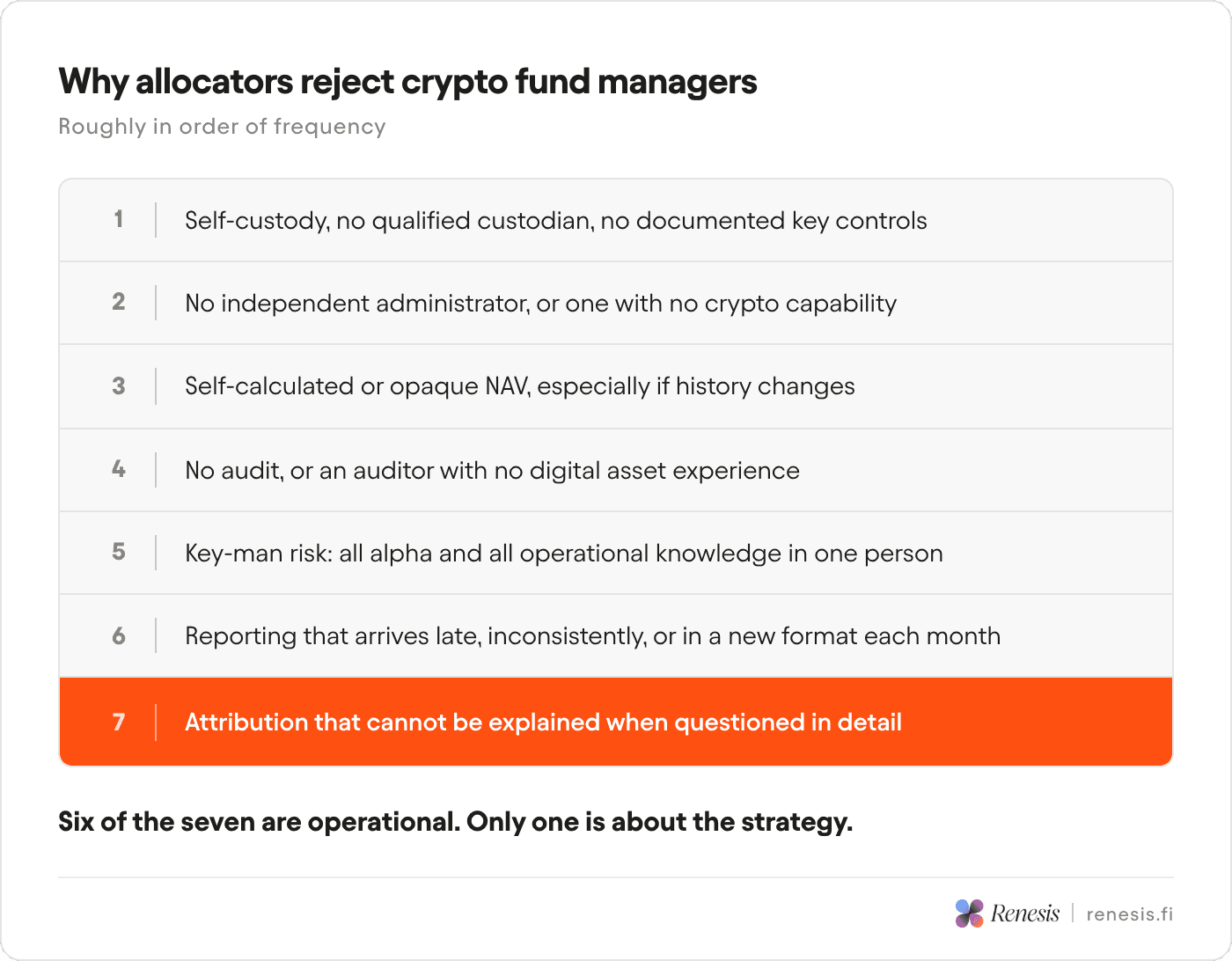
Ranked roughly by frequency, the disqualifiers are:
Self-custody with no qualified custodian and no documented key controls.
No independent administrator, or an administrator with no crypto capability.
Self-calculated or opaque NAV, especially where historical numbers change without explanation.
No audit, or an auditor without digital asset experience.
Key-man risk, where all alpha and all operational knowledge sit with one person.
Reporting that arrives late, inconsistently, or in a different format each month.
Attribution that cannot be explained when questioned in detail.
Note how few of these are about the strategy. Six of the seven are operational.
Getting around the AUM problem
Most allocators have minimum ticket sizes that would represent an uncomfortable share of a small fund, which creates a circular problem: you need institutional capital to reach institutional size, and institutional size to receive institutional capital.
The practical routes through it:
Separately managed accounts. Give the allocator a segregated mandate rather than a fund subscription. They keep custody and transparency, you get capital without them dominating your fund. This requires per-account reporting and clean attribution, which is an infrastructure question.
Founder or funding share classes. Discounted terms for early investors, in exchange for the credibility their name provides to the next investor.
Sub-advisory and incubation. Running a sleeve under an established platform to build a verifiable track record before launching standalone.
Seeding arrangements. Day-one capital in exchange for revenue share or management company equity. Terms vary widely and are usually not public, so treat any specific percentages you hear as anecdote rather than market standard.
The underlying point
Almost everything on this list reduces to one question: can an outsider verify what you are telling them, without taking your word for it? Custody, administration, audit and attribution are all mechanisms for making a fund's claims checkable by someone who does not know you.
Managers who understand that stop treating operations as overhead and start treating it as the product they are actually selling to allocators.
Renesis is built for exactly this layer: reconciled positions across CeFi venues and 100+ DeFi protocols, real-time NAV built on matched transaction history rather than balance snapshots, P&L attributed by source, and investor reporting generated from the same reconciled data your administrator works from. See the portfolio management system.
Still not sure if Renesis is right for you?
Ask ChatGPT, Claude or Perplexity what they have to talk about us. Click below to ask your favorite AI about us:
" height="40px" id="b6zcrI2Wj" width="40.000000141897665px"/></svg>)
" height="40px" id="q3tXZs9hp" width="40px"/></svg>)
" height="40px" id="zrymccGxZ" width="35px"/></svg>)
Continue reading
Renesis Insights
Portfolio Valuation: How Investment Portfolios Are Actually Valued
What portfolio valuation is, who performs it, the fair value hierarchy across asset classes from listed equities to private equity and digital assets, and how valuation is becoming continuous
Renesis Insights
The Best Staking Platforms in 2026: An Institutional Guide
The best staking platforms in 2026 for funds, treasuries and DAOs: institutional providers, custodial routes and liquid staking compared on custody, slashing, reporting and accounting, not headline APY.
DeFi Research
NAV Attestation: How Vault and DeFi Fund NAVs Get Verified
What NAV attestation means for crypto vaults and DeFi funds: real-time on-chain attestation, administrator and auditor attestation, and how it differs from proof of reserves.
DeFi Research
Pendle Position Tracker: How Funds Track and Value PT, YT and Looped Positions
A Pendle position tracker built for funds: how PT, YT, looped and nested positions should be tracked and valued, and the edge cases that silently break NAV.
See how Renesis brings continuous valuation to digital asset portfolios.
Built by builders.
For builders.
We're a DeFi-native team shipping fast. No enterprise sales cycles, no bloated pricing. Start free, talk to us when you're ready.
Sep 8, 2026
Renesis Insights
Thomas Pratter
Portfolio Valuation: How Investment Portfolios Are Actually Valued
What portfolio valuation is, who performs it, the fair value hierarchy across asset classes from listed equities to private equity and digital assets, and how valuation is becoming continuous
Sep 8, 2026
Renesis Insights
Thomas Pratter
Portfolio Valuation: How Investment Portfolios Are Actually Valued
What portfolio valuation is, who performs it, the fair value hierarchy across asset classes from listed equities to private equity and digital assets, and how valuation is becoming continuous
Most crypto funds that fail to raise capital do not fail on performance. They fail on operational due diligence, usually early, and usually for reasons the manager considered administrative details.
Coinbase's institutional research has put the scale of this bluntly: only around a third of crypto funds are considered ready for institutional capital, and the service provider stack is the most common reason the rest are not. Meanwhile more than 80% of crypto funds manage under $50M, which describes most of the market. The gap between those two facts is where fundraises die.
This article covers what allocators actually check, in the order they check it. For who those allocators are and how to sequence a raise around them, see our guide to raising capital for a crypto fund.
The standards exist, and they are public
You do not have to guess what will be asked. In February 2023, AIMA's Digital Assets Working Group published due diligence questionnaires specifically for digital asset funds, with modules for open-ended and closed-ended vehicles covering strategy, trading, risk management, leverage, liquidity, valuation and service providers. The timing was not accidental: the release followed the counterparty failures of the previous year.
Coinbase's allocator guides and the Standards Board for Alternative Investments' operational due diligence work on digital assets cover similar ground. Between them, they are effectively the syllabus. A manager who has worked through the AIMA questionnaire before their first institutional meeting is answering questions they have already seen.
Custody: the first filter
Every serious allocator starts here, and the bar has three parts.
Segregation. Assets must be identifiably yours, not commingled with a platform's or other clients'. This is the direct lesson of exchange failures where customer assets could not be separated from firm assets.
Controlled key management. Who can move assets, under what approvals, and can any single person do it alone. Multi-party computation, hardware security modules and documented multi-signature policies are what allocators expect to hear about. "The founder holds the keys" ends the conversation.
Independent verification. Balances that a third party can confirm, rather than screenshots and trust. Qualified custodians commonly cited in institutional diligence include Coinbase Custody, Anchorage Digital, BitGo and Fidelity Digital Assets, alongside off-exchange settlement arrangements through providers like Fireblocks and Copper that let funds trade on venues without leaving assets there.
Allocators also probe venue concentration directly: how many exchanges you use, what happens if one fails, what your counterparty limits are, and how quickly you can move.
Administration and audit
Two separate firms, both independent, is the non-negotiable structure. An administrator who calculates NAV and an auditor who verifies the financials cannot be the same organisation, and neither can be you.
Industry research on allocator behaviour has found that a majority now treat institutional-grade service providers as a minimum requirement for emerging managers, and that the absence of independent fund administration is the single most common immediate disqualifier.
On administrators, the crypto-capable names that recur in institutional diligence include NAV Consulting, MG Stover (now part of Securitize), Formidium, Theorem Fund Services, Trident Trust, Apex Group and Gen II. On auditors, size determines realism: Big Four engagements typically start around six figures for crypto funds, which is why smaller funds work with firms like Cohen & Co, Grant Thornton or comparable practices that have built genuine digital asset audit capability. The mistake is not using a smaller auditor. The mistake is using one with no crypto experience, which allocators now check for specifically.
We cover the selection process in detail in our guide to crypto fund administration.
NAV and valuation policy
This is where crypto funds diverge most from traditional funds, and where allocators concentrate their technical questions.
They will ask how NAV is calculated, how often, and from what data. They will ask about your pricing sources and what happens when venues disagree. They will ask how you value positions that have no clean market price: illiquid tokens, LP positions in AMMs, staked assets with lockups, protocol rewards that have accrued but not been claimed.
The answer they are looking for is a documented policy applied consistently, with an independent administrator producing the official number. The answer that fails is a manager who calculates their own NAV in a spreadsheet, however careful they are, because there is no way for an outsider to distinguish careful from convenient.
Track record and attribution
One year of performance gets you a meeting. Three years of audited performance gets you considered. What matters alongside duration is whether the numbers are independently verifiable and whether you can explain them.
Attribution is where most technical conversations go wrong. Allocators want returns decomposed by source: how much came from funding, from basis, from spread capture, from directional price movement, from staking or protocol rewards, and what fees and slippage cost. A single blended return number invites the conclusion that the manager does not know where their edge comes from, which is fatal for strategies where the distinction matters, as in the delta-neutral strategies most first-time institutional allocations favour.
They will also ask about drawdowns, and specifically about what you did during them. Not the number, the behaviour.
Why managers get rejected
Ranked roughly by frequency, the disqualifiers are:
Self-custody with no qualified custodian and no documented key controls.
No independent administrator, or an administrator with no crypto capability.
Self-calculated or opaque NAV, especially where historical numbers change without explanation.
No audit, or an auditor without digital asset experience.
Key-man risk, where all alpha and all operational knowledge sit with one person.
Reporting that arrives late, inconsistently, or in a different format each month.
Attribution that cannot be explained when questioned in detail.
Note how few of these are about the strategy. Six of the seven are operational.
Getting around the AUM problem
Most allocators have minimum ticket sizes that would represent an uncomfortable share of a small fund, which creates a circular problem: you need institutional capital to reach institutional size, and institutional size to receive institutional capital.
The practical routes through it:
Separately managed accounts. Give the allocator a segregated mandate rather than a fund subscription. They keep custody and transparency, you get capital without them dominating your fund. This requires per-account reporting and clean attribution, which is an infrastructure question.
Founder or funding share classes. Discounted terms for early investors, in exchange for the credibility their name provides to the next investor.
Sub-advisory and incubation. Running a sleeve under an established platform to build a verifiable track record before launching standalone.
Seeding arrangements. Day-one capital in exchange for revenue share or management company equity. Terms vary widely and are usually not public, so treat any specific percentages you hear as anecdote rather than market standard.
The underlying point
Almost everything on this list reduces to one question: can an outsider verify what you are telling them, without taking your word for it? Custody, administration, audit and attribution are all mechanisms for making a fund's claims checkable by someone who does not know you.
Managers who understand that stop treating operations as overhead and start treating it as the product they are actually selling to allocators.
Renesis is built for exactly this layer: reconciled positions across CeFi venues and 100+ DeFi protocols, real-time NAV built on matched transaction history rather than balance snapshots, P&L attributed by source, and investor reporting generated from the same reconciled data your administrator works from. See the portfolio management system.
Sep 8, 2026
Renesis Insights
Thomas Pratter
Portfolio Valuation: How Investment Portfolios Are Actually Valued
What portfolio valuation is, who performs it, the fair value hierarchy across asset classes from listed equities to private equity and digital assets, and how valuation is becoming continuous
Sep 8, 2026
Renesis Insights
Thomas Pratter
Portfolio Valuation: How Investment Portfolios Are Actually Valued
What portfolio valuation is, who performs it, the fair value hierarchy across asset classes from listed equities to private equity and digital assets, and how valuation is becoming continuous
Most crypto funds that fail to raise capital do not fail on performance. They fail on operational due diligence, usually early, and usually for reasons the manager considered administrative details.
Coinbase's institutional research has put the scale of this bluntly: only around a third of crypto funds are considered ready for institutional capital, and the service provider stack is the most common reason the rest are not. Meanwhile more than 80% of crypto funds manage under $50M, which describes most of the market. The gap between those two facts is where fundraises die.
This article covers what allocators actually check, in the order they check it. For who those allocators are and how to sequence a raise around them, see our guide to raising capital for a crypto fund.
The standards exist, and they are public
You do not have to guess what will be asked. In February 2023, AIMA's Digital Assets Working Group published due diligence questionnaires specifically for digital asset funds, with modules for open-ended and closed-ended vehicles covering strategy, trading, risk management, leverage, liquidity, valuation and service providers. The timing was not accidental: the release followed the counterparty failures of the previous year.
Coinbase's allocator guides and the Standards Board for Alternative Investments' operational due diligence work on digital assets cover similar ground. Between them, they are effectively the syllabus. A manager who has worked through the AIMA questionnaire before their first institutional meeting is answering questions they have already seen.
Custody: the first filter
Every serious allocator starts here, and the bar has three parts.
Segregation. Assets must be identifiably yours, not commingled with a platform's or other clients'. This is the direct lesson of exchange failures where customer assets could not be separated from firm assets.
Controlled key management. Who can move assets, under what approvals, and can any single person do it alone. Multi-party computation, hardware security modules and documented multi-signature policies are what allocators expect to hear about. "The founder holds the keys" ends the conversation.
Independent verification. Balances that a third party can confirm, rather than screenshots and trust. Qualified custodians commonly cited in institutional diligence include Coinbase Custody, Anchorage Digital, BitGo and Fidelity Digital Assets, alongside off-exchange settlement arrangements through providers like Fireblocks and Copper that let funds trade on venues without leaving assets there.
Allocators also probe venue concentration directly: how many exchanges you use, what happens if one fails, what your counterparty limits are, and how quickly you can move.
Administration and audit
Two separate firms, both independent, is the non-negotiable structure. An administrator who calculates NAV and an auditor who verifies the financials cannot be the same organisation, and neither can be you.
Industry research on allocator behaviour has found that a majority now treat institutional-grade service providers as a minimum requirement for emerging managers, and that the absence of independent fund administration is the single most common immediate disqualifier.
On administrators, the crypto-capable names that recur in institutional diligence include NAV Consulting, MG Stover (now part of Securitize), Formidium, Theorem Fund Services, Trident Trust, Apex Group and Gen II. On auditors, size determines realism: Big Four engagements typically start around six figures for crypto funds, which is why smaller funds work with firms like Cohen & Co, Grant Thornton or comparable practices that have built genuine digital asset audit capability. The mistake is not using a smaller auditor. The mistake is using one with no crypto experience, which allocators now check for specifically.
We cover the selection process in detail in our guide to crypto fund administration.
NAV and valuation policy
This is where crypto funds diverge most from traditional funds, and where allocators concentrate their technical questions.
They will ask how NAV is calculated, how often, and from what data. They will ask about your pricing sources and what happens when venues disagree. They will ask how you value positions that have no clean market price: illiquid tokens, LP positions in AMMs, staked assets with lockups, protocol rewards that have accrued but not been claimed.
The answer they are looking for is a documented policy applied consistently, with an independent administrator producing the official number. The answer that fails is a manager who calculates their own NAV in a spreadsheet, however careful they are, because there is no way for an outsider to distinguish careful from convenient.
Track record and attribution
One year of performance gets you a meeting. Three years of audited performance gets you considered. What matters alongside duration is whether the numbers are independently verifiable and whether you can explain them.
Attribution is where most technical conversations go wrong. Allocators want returns decomposed by source: how much came from funding, from basis, from spread capture, from directional price movement, from staking or protocol rewards, and what fees and slippage cost. A single blended return number invites the conclusion that the manager does not know where their edge comes from, which is fatal for strategies where the distinction matters, as in the delta-neutral strategies most first-time institutional allocations favour.
They will also ask about drawdowns, and specifically about what you did during them. Not the number, the behaviour.
Why managers get rejected
Ranked roughly by frequency, the disqualifiers are:
Self-custody with no qualified custodian and no documented key controls.
No independent administrator, or an administrator with no crypto capability.
Self-calculated or opaque NAV, especially where historical numbers change without explanation.
No audit, or an auditor without digital asset experience.
Key-man risk, where all alpha and all operational knowledge sit with one person.
Reporting that arrives late, inconsistently, or in a different format each month.
Attribution that cannot be explained when questioned in detail.
Note how few of these are about the strategy. Six of the seven are operational.
Getting around the AUM problem
Most allocators have minimum ticket sizes that would represent an uncomfortable share of a small fund, which creates a circular problem: you need institutional capital to reach institutional size, and institutional size to receive institutional capital.
The practical routes through it:
Separately managed accounts. Give the allocator a segregated mandate rather than a fund subscription. They keep custody and transparency, you get capital without them dominating your fund. This requires per-account reporting and clean attribution, which is an infrastructure question.
Founder or funding share classes. Discounted terms for early investors, in exchange for the credibility their name provides to the next investor.
Sub-advisory and incubation. Running a sleeve under an established platform to build a verifiable track record before launching standalone.
Seeding arrangements. Day-one capital in exchange for revenue share or management company equity. Terms vary widely and are usually not public, so treat any specific percentages you hear as anecdote rather than market standard.
The underlying point
Almost everything on this list reduces to one question: can an outsider verify what you are telling them, without taking your word for it? Custody, administration, audit and attribution are all mechanisms for making a fund's claims checkable by someone who does not know you.
Managers who understand that stop treating operations as overhead and start treating it as the product they are actually selling to allocators.
Renesis is built for exactly this layer: reconciled positions across CeFi venues and 100+ DeFi protocols, real-time NAV built on matched transaction history rather than balance snapshots, P&L attributed by source, and investor reporting generated from the same reconciled data your administrator works from. See the portfolio management system.
" height="48px" id="otROh8Uzr" width="48px"/></g></svg>)