
LP Fundraising

Renesis Team
How to Raise Capital for a Crypto Fund
A practical guide to raising capital for a crypto fund in 2026: who the buyers are, what they require, why most managers get rejected, and how emerging managers get to first close.
The crypto fund industry is larger and more crowded than most first-time managers expect. Industry trackers put total crypto fund AUM somewhere around $93B across more than 870 funds, with the median fund managing roughly $60M and only a handful above $1B. More than 80% of crypto funds manage under $50M.
That distribution tells you two things. There is real institutional capital in the asset class, and almost all of it sits with a small number of managers. If you are raising for a fund below $50M, you are competing in the most crowded part of the market for the attention of buyers who can only do a limited number of deals a year.
This guide covers who those buyers are, what they require, and the sequence that actually works.
Who allocates to crypto funds
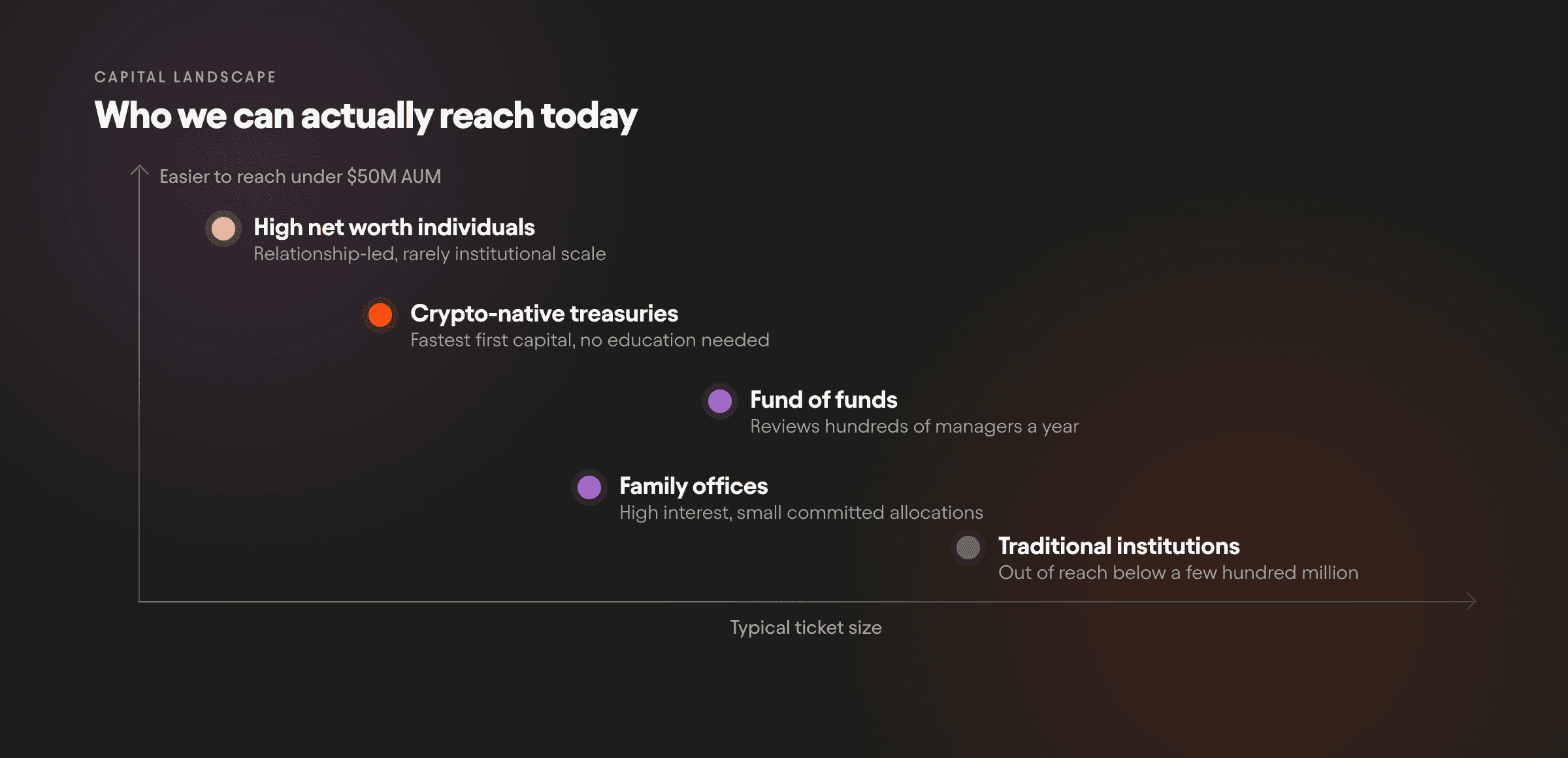
The buyer universe is narrower than the pitch-deck version suggests. In practice it breaks into five groups.
Fund of funds and multi-manager vehicles exist specifically to select managers, which makes them the most reachable institutional buyer for a small fund. They are also the most professionally sceptical, because they review hundreds of managers a year. We cover the specific vehicles and their selection process in crypto fund of funds: who allocates and how they choose managers.
Family offices and multi-family offices are the most-discussed and least-understood segment. Survey data on their crypto participation is genuinely contradictory, and the reality is high interest with small committed allocations. The full picture is in family offices investing in crypto funds.
Crypto-native businesses and treasuries including exchanges, market makers, protocol treasuries and successful founders. Often the fastest source of first capital because they understand the asset class without education, and because their diligence is more commercial than institutional.
High net worth individuals, typically through relationships rather than process. Usually the source of friends-and-family and seed capital, rarely of institutional scale.
Traditional institutions, meaning endowments, foundations, pensions and insurance. Realistically out of reach below a few hundred million in AUM, with the exception of dedicated emerging-manager programs.
Note who is missing: retail. Whatever your structure, if you are running a fund you are selling to a small, professional, well-informed buyer set who talk to each other.
The sequence that works
1. Fix operations before you pitch. This inverts the instinct of most first-time managers, who raise first and build later. It is the wrong order, because the most common rejection reasons are operational and they are visible in the first meeting. Independent administrator, independent auditor, qualified custody, documented valuation policy. The full checklist is in what LPs actually look for, and the service provider selection in crypto fund administration.
2. Build a track record you can prove. One year of audited performance opens conversations, three years wins mandates. Duration matters less than verifiability. A shorter record confirmed by an independent administrator beats a longer one that exists only in your own spreadsheets.
3. Start with buyers who need no education. Crypto-native capital first, because you spend the meeting discussing your strategy rather than defending the asset class. These allocations also give you referenceable investors for institutional conversations later.
4. Get one credible institutional name. The first institutional investor is disproportionately hard and disproportionately valuable, because subsequent buyers use it as a diligence shortcut. Discounted founder share classes exist precisely for this trade.
5. Then approach multi-manager vehicles and family offices with a track record, a service provider stack, and at least one reference.
What actually gets you rejected
Across the buyer types, the pattern is remarkably consistent, and it is mostly not about returns.
Managers get filtered out for self-custody without qualified custodians, for calculating their own NAV, for having no independent administrator, for audits from firms with no digital asset experience, for reporting that arrives late or changes retroactively, and for being unable to explain where returns came from when asked in detail.
There is a reason allocators weight these so heavily. Performance can be evaluated in an afternoon. Whether an operation is sound takes months, so allocators use operational infrastructure as a proxy, and a manager who has not invested in it looks like a manager who does not know what institutional capital requires.
Emerging manager realities
Two structural problems affect every small fund, and both have known workarounds.
The minimum ticket problem. Most institutional allocators write cheques large enough to represent an uncomfortable concentration in a small fund. Separately managed accounts solve this: the allocator gets a segregated mandate with full transparency and custody, you get capital without a single investor owning half your fund. SMAs require per-account reporting and clean attribution, which is an infrastructure requirement rather than a fundraising one.
The capacity problem. If your strategy caps out at $30M, you are structurally uninteresting to allocators deploying $10M tickets, regardless of returns. Be honest about capacity early, because discovering it late damages relationships that took a year to build.
Other routes into first capital include sub-advisory arrangements under an established platform, incubation, and seeding deals that trade day-one capital for revenue share or management company equity. Seed terms vary widely and are rarely disclosed publicly.
What to prepare before you start
A realistic package for institutional conversations:
Audited financials, or an administrator-produced NAV history if you are pre-audit
A completed due diligence questionnaire, using the AIMA digital asset templates as your base
A documented valuation policy, including how you price illiquid and on-chain positions
Service provider details: administrator, auditor, custodian, legal counsel
Performance attribution by source, not a single blended return
A written account of your worst drawdown and what you did during it
Clear terms, including any founder share class
Notice that most of this is operational documentation rather than marketing material. The deck matters less than managers think.
The uncomfortable summary
Raising a crypto fund in 2026 is not primarily a marketing problem. The buyer set is small, professional and well-informed, the standards are published, and the reasons managers get rejected are known, documented and largely fixable.
The managers who raise successfully are not usually the ones with the best returns in the room. They are the ones whose numbers can be verified by someone who does not know them.
Renesis provides that verifiability: reconciled positions across CeFi venues and 100+ DeFi protocols, real-time NAV built on matched transaction history, P&L attributed by source, and investor reporting generated from reconciled data. See the portfolio management system.
Still not sure if Renesis is right for you?
Ask ChatGPT, Claude or Perplexity what they have to talk about us. Click below to ask your favorite AI about us:
" height="40px" id="b6zcrI2Wj" width="40.000000141897665px"/></svg>)
" height="40px" id="q3tXZs9hp" width="40px"/></svg>)
" height="40px" id="zrymccGxZ" width="35px"/></svg>)
Continue reading
Renesis Insights
Portfolio Valuation: How Investment Portfolios Are Actually Valued
What portfolio valuation is, who performs it, the fair value hierarchy across asset classes from listed equities to private equity and digital assets, and how valuation is becoming continuous
Renesis Insights
The Best Staking Platforms in 2026: An Institutional Guide
The best staking platforms in 2026 for funds, treasuries and DAOs: institutional providers, custodial routes and liquid staking compared on custody, slashing, reporting and accounting, not headline APY.
DeFi Research
NAV Attestation: How Vault and DeFi Fund NAVs Get Verified
What NAV attestation means for crypto vaults and DeFi funds: real-time on-chain attestation, administrator and auditor attestation, and how it differs from proof of reserves.
DeFi Research
Pendle Position Tracker: How Funds Track and Value PT, YT and Looped Positions
A Pendle position tracker built for funds: how PT, YT, looped and nested positions should be tracked and valued, and the edge cases that silently break NAV.
See how Renesis brings continuous valuation to digital asset portfolios.
Built by builders.
For builders.
We're a DeFi-native team shipping fast. No enterprise sales cycles, no bloated pricing. Start free, talk to us when you're ready.
Sep 8, 2026
Renesis Insights
Thomas Pratter
Portfolio Valuation: How Investment Portfolios Are Actually Valued
What portfolio valuation is, who performs it, the fair value hierarchy across asset classes from listed equities to private equity and digital assets, and how valuation is becoming continuous
Sep 8, 2026
Renesis Insights
Thomas Pratter
Portfolio Valuation: How Investment Portfolios Are Actually Valued
What portfolio valuation is, who performs it, the fair value hierarchy across asset classes from listed equities to private equity and digital assets, and how valuation is becoming continuous
The crypto fund industry is larger and more crowded than most first-time managers expect. Industry trackers put total crypto fund AUM somewhere around $93B across more than 870 funds, with the median fund managing roughly $60M and only a handful above $1B. More than 80% of crypto funds manage under $50M.
That distribution tells you two things. There is real institutional capital in the asset class, and almost all of it sits with a small number of managers. If you are raising for a fund below $50M, you are competing in the most crowded part of the market for the attention of buyers who can only do a limited number of deals a year.
This guide covers who those buyers are, what they require, and the sequence that actually works.
Who allocates to crypto funds
The buyer universe is narrower than the pitch-deck version suggests. In practice it breaks into five groups.
Fund of funds and multi-manager vehicles exist specifically to select managers, which makes them the most reachable institutional buyer for a small fund. They are also the most professionally sceptical, because they review hundreds of managers a year. We cover the specific vehicles and their selection process in crypto fund of funds: who allocates and how they choose managers.
Family offices and multi-family offices are the most-discussed and least-understood segment. Survey data on their crypto participation is genuinely contradictory, and the reality is high interest with small committed allocations. The full picture is in family offices investing in crypto funds.
Crypto-native businesses and treasuries including exchanges, market makers, protocol treasuries and successful founders. Often the fastest source of first capital because they understand the asset class without education, and because their diligence is more commercial than institutional.
High net worth individuals, typically through relationships rather than process. Usually the source of friends-and-family and seed capital, rarely of institutional scale.
Traditional institutions, meaning endowments, foundations, pensions and insurance. Realistically out of reach below a few hundred million in AUM, with the exception of dedicated emerging-manager programs.
Note who is missing: retail. Whatever your structure, if you are running a fund you are selling to a small, professional, well-informed buyer set who talk to each other.
The sequence that works
1. Fix operations before you pitch. This inverts the instinct of most first-time managers, who raise first and build later. It is the wrong order, because the most common rejection reasons are operational and they are visible in the first meeting. Independent administrator, independent auditor, qualified custody, documented valuation policy. The full checklist is in what LPs actually look for, and the service provider selection in crypto fund administration.
2. Build a track record you can prove. One year of audited performance opens conversations, three years wins mandates. Duration matters less than verifiability. A shorter record confirmed by an independent administrator beats a longer one that exists only in your own spreadsheets.
3. Start with buyers who need no education. Crypto-native capital first, because you spend the meeting discussing your strategy rather than defending the asset class. These allocations also give you referenceable investors for institutional conversations later.
4. Get one credible institutional name. The first institutional investor is disproportionately hard and disproportionately valuable, because subsequent buyers use it as a diligence shortcut. Discounted founder share classes exist precisely for this trade.
5. Then approach multi-manager vehicles and family offices with a track record, a service provider stack, and at least one reference.
What actually gets you rejected
Across the buyer types, the pattern is remarkably consistent, and it is mostly not about returns.
Managers get filtered out for self-custody without qualified custodians, for calculating their own NAV, for having no independent administrator, for audits from firms with no digital asset experience, for reporting that arrives late or changes retroactively, and for being unable to explain where returns came from when asked in detail.
There is a reason allocators weight these so heavily. Performance can be evaluated in an afternoon. Whether an operation is sound takes months, so allocators use operational infrastructure as a proxy, and a manager who has not invested in it looks like a manager who does not know what institutional capital requires.
Emerging manager realities
Two structural problems affect every small fund, and both have known workarounds.
The minimum ticket problem. Most institutional allocators write cheques large enough to represent an uncomfortable concentration in a small fund. Separately managed accounts solve this: the allocator gets a segregated mandate with full transparency and custody, you get capital without a single investor owning half your fund. SMAs require per-account reporting and clean attribution, which is an infrastructure requirement rather than a fundraising one.
The capacity problem. If your strategy caps out at $30M, you are structurally uninteresting to allocators deploying $10M tickets, regardless of returns. Be honest about capacity early, because discovering it late damages relationships that took a year to build.
Other routes into first capital include sub-advisory arrangements under an established platform, incubation, and seeding deals that trade day-one capital for revenue share or management company equity. Seed terms vary widely and are rarely disclosed publicly.
What to prepare before you start
A realistic package for institutional conversations:
Audited financials, or an administrator-produced NAV history if you are pre-audit
A completed due diligence questionnaire, using the AIMA digital asset templates as your base
A documented valuation policy, including how you price illiquid and on-chain positions
Service provider details: administrator, auditor, custodian, legal counsel
Performance attribution by source, not a single blended return
A written account of your worst drawdown and what you did during it
Clear terms, including any founder share class
Notice that most of this is operational documentation rather than marketing material. The deck matters less than managers think.
The uncomfortable summary
Raising a crypto fund in 2026 is not primarily a marketing problem. The buyer set is small, professional and well-informed, the standards are published, and the reasons managers get rejected are known, documented and largely fixable.
The managers who raise successfully are not usually the ones with the best returns in the room. They are the ones whose numbers can be verified by someone who does not know them.
Renesis provides that verifiability: reconciled positions across CeFi venues and 100+ DeFi protocols, real-time NAV built on matched transaction history, P&L attributed by source, and investor reporting generated from reconciled data. See the portfolio management system.
Sep 8, 2026
Renesis Insights
Thomas Pratter
Portfolio Valuation: How Investment Portfolios Are Actually Valued
What portfolio valuation is, who performs it, the fair value hierarchy across asset classes from listed equities to private equity and digital assets, and how valuation is becoming continuous
Sep 8, 2026
Renesis Insights
Thomas Pratter
Portfolio Valuation: How Investment Portfolios Are Actually Valued
What portfolio valuation is, who performs it, the fair value hierarchy across asset classes from listed equities to private equity and digital assets, and how valuation is becoming continuous
The crypto fund industry is larger and more crowded than most first-time managers expect. Industry trackers put total crypto fund AUM somewhere around $93B across more than 870 funds, with the median fund managing roughly $60M and only a handful above $1B. More than 80% of crypto funds manage under $50M.
That distribution tells you two things. There is real institutional capital in the asset class, and almost all of it sits with a small number of managers. If you are raising for a fund below $50M, you are competing in the most crowded part of the market for the attention of buyers who can only do a limited number of deals a year.
This guide covers who those buyers are, what they require, and the sequence that actually works.
Who allocates to crypto funds
The buyer universe is narrower than the pitch-deck version suggests. In practice it breaks into five groups.
Fund of funds and multi-manager vehicles exist specifically to select managers, which makes them the most reachable institutional buyer for a small fund. They are also the most professionally sceptical, because they review hundreds of managers a year. We cover the specific vehicles and their selection process in crypto fund of funds: who allocates and how they choose managers.
Family offices and multi-family offices are the most-discussed and least-understood segment. Survey data on their crypto participation is genuinely contradictory, and the reality is high interest with small committed allocations. The full picture is in family offices investing in crypto funds.
Crypto-native businesses and treasuries including exchanges, market makers, protocol treasuries and successful founders. Often the fastest source of first capital because they understand the asset class without education, and because their diligence is more commercial than institutional.
High net worth individuals, typically through relationships rather than process. Usually the source of friends-and-family and seed capital, rarely of institutional scale.
Traditional institutions, meaning endowments, foundations, pensions and insurance. Realistically out of reach below a few hundred million in AUM, with the exception of dedicated emerging-manager programs.
Note who is missing: retail. Whatever your structure, if you are running a fund you are selling to a small, professional, well-informed buyer set who talk to each other.
The sequence that works
1. Fix operations before you pitch. This inverts the instinct of most first-time managers, who raise first and build later. It is the wrong order, because the most common rejection reasons are operational and they are visible in the first meeting. Independent administrator, independent auditor, qualified custody, documented valuation policy. The full checklist is in what LPs actually look for, and the service provider selection in crypto fund administration.
2. Build a track record you can prove. One year of audited performance opens conversations, three years wins mandates. Duration matters less than verifiability. A shorter record confirmed by an independent administrator beats a longer one that exists only in your own spreadsheets.
3. Start with buyers who need no education. Crypto-native capital first, because you spend the meeting discussing your strategy rather than defending the asset class. These allocations also give you referenceable investors for institutional conversations later.
4. Get one credible institutional name. The first institutional investor is disproportionately hard and disproportionately valuable, because subsequent buyers use it as a diligence shortcut. Discounted founder share classes exist precisely for this trade.
5. Then approach multi-manager vehicles and family offices with a track record, a service provider stack, and at least one reference.
What actually gets you rejected
Across the buyer types, the pattern is remarkably consistent, and it is mostly not about returns.
Managers get filtered out for self-custody without qualified custodians, for calculating their own NAV, for having no independent administrator, for audits from firms with no digital asset experience, for reporting that arrives late or changes retroactively, and for being unable to explain where returns came from when asked in detail.
There is a reason allocators weight these so heavily. Performance can be evaluated in an afternoon. Whether an operation is sound takes months, so allocators use operational infrastructure as a proxy, and a manager who has not invested in it looks like a manager who does not know what institutional capital requires.
Emerging manager realities
Two structural problems affect every small fund, and both have known workarounds.
The minimum ticket problem. Most institutional allocators write cheques large enough to represent an uncomfortable concentration in a small fund. Separately managed accounts solve this: the allocator gets a segregated mandate with full transparency and custody, you get capital without a single investor owning half your fund. SMAs require per-account reporting and clean attribution, which is an infrastructure requirement rather than a fundraising one.
The capacity problem. If your strategy caps out at $30M, you are structurally uninteresting to allocators deploying $10M tickets, regardless of returns. Be honest about capacity early, because discovering it late damages relationships that took a year to build.
Other routes into first capital include sub-advisory arrangements under an established platform, incubation, and seeding deals that trade day-one capital for revenue share or management company equity. Seed terms vary widely and are rarely disclosed publicly.
What to prepare before you start
A realistic package for institutional conversations:
Audited financials, or an administrator-produced NAV history if you are pre-audit
A completed due diligence questionnaire, using the AIMA digital asset templates as your base
A documented valuation policy, including how you price illiquid and on-chain positions
Service provider details: administrator, auditor, custodian, legal counsel
Performance attribution by source, not a single blended return
A written account of your worst drawdown and what you did during it
Clear terms, including any founder share class
Notice that most of this is operational documentation rather than marketing material. The deck matters less than managers think.
The uncomfortable summary
Raising a crypto fund in 2026 is not primarily a marketing problem. The buyer set is small, professional and well-informed, the standards are published, and the reasons managers get rejected are known, documented and largely fixable.
The managers who raise successfully are not usually the ones with the best returns in the room. They are the ones whose numbers can be verified by someone who does not know them.
Renesis provides that verifiability: reconciled positions across CeFi venues and 100+ DeFi protocols, real-time NAV built on matched transaction history, P&L attributed by source, and investor reporting generated from reconciled data. See the portfolio management system.
" height="48px" id="otROh8Uzr" width="48px"/></g></svg>)