
LP Fundraising
Thomas Pratter
Crypto Fund of Funds: Who Allocates, and How They Choose Managers
Eight verified crypto fund-of-funds and multi-manager allocators, their structures, jurisdictions and minimums, and how they select managers.
If you run a crypto fund below roughly $100M, a fund of funds is one of the few institutional buyers that can actually write you a cheque. Most endowments and pensions have minimum ticket sizes larger than your entire fund, and most family offices are still deciding whether the asset class belongs in the portfolio at all. Multi-manager vehicles exist specifically to solve the problem of finding, evaluating and allocating to managers like you. They are one part of a wider buyer landscape we map in our guide to raising capital for a crypto fund.
This guide covers who those vehicles are, how the structures differ, what they actually look for, and the fee math that determines whether they can afford to allocate to you at all.
What a crypto fund of funds does
A fund of funds does not trade. It raises capital from investors who want digital asset exposure without selecting managers themselves, then allocates that capital across a portfolio of underlying funds, typically five to fifteen. The FoF team handles sourcing, due diligence, portfolio construction across strategies, ongoing monitoring and rebalancing.
For an underlying manager, this changes the sales motion entirely. You are not pitching an investment committee that needs educating about crypto. You are pitching a professional buyer who has already reviewed dozens of funds like yours, knows exactly what questions to ask, and is measuring you against a peer set they can see and you cannot.
Fund of funds versus manager of managers
The structural distinction matters more in crypto than it does anywhere else, and it is a direct consequence of 2022.
In a traditional commingled fund of funds, the FoF subscribes into your fund like any other LP. Your fund holds the assets. If your fund has an operational failure, the FoF is exposed alongside every other investor.
In a manager of managers (MoM) structure, the allocator opens a separately managed account and gives you trading authority over assets that remain in their custody. You trade; you do not hold. The allocator sees positions in real time and can pull the mandate without a redemption cycle.
After counterparty failures wiped out fund assets sitting on exchanges, the MoM model gained ground fast among larger allocators, because segregated custody is the structural answer to the problem. 3iQ launched what it described as the industry's first buy-side multi-manager managed account platform for digital assets in November 2023, starting with roughly $50M across nine strategies. Nickel Digital runs an external pod model where managers keep their own IP and trade allocated capital rather than joining the firm.
The practical implication for an emerging manager: if your operational setup cannot support an SMA mandate (segregated accounts, per-account reporting, clean attribution), you are excluded from a growing share of institutional capital regardless of your returns.
How much allocator money is actually in crypto right now
Two of the most cited surveys on family office crypto adoption appear to contradict each other, and the contradiction is the most useful data point in the category.
BNY Wealth's 2025 study of 282 single family offices found 74% invested in or actively exploring cryptocurrencies. J.P. Morgan's 2026 Global Family Office Report, covering 333 family offices across 30 countries, found 89% with no crypto exposure at all, and an average portfolio weight of 0.4%.
Both are accurate. BNY counted interest, invested or exploring. J.P. Morgan measured actual holdings. Different questions, different samples, different geographies, different timing. Read together, they describe the real funnel: broad curiosity at the top, thin committed capital at the bottom.
The hedge fund side shows the same shape further along. The seventh annual AIMA and PwC survey (November 2025, 122 funds, roughly USD 982bn combined AUM) found 55% of traditional hedge funds now hold some digital asset exposure, up from 47% a year earlier. But the average allocation is about 7% of AUM, and more than half of those funds hold under 2%.
For scale on the receiving side: Crypto Fund Research counts 871+ crypto funds managing roughly USD 93.4B in total, with a median fund around USD 60M and only eight funds above USD 1B (Q4 2025). The buyer universe for a sub-USD 150M manager is small and identifiable.
The practical implication for a manager raising: conversations are easy to get, because the top of the funnel is wide. They convert on operational evidence, independently verifiable track record, real NAV and reporting, recognizable service providers, because the bottom is narrow. A fund of funds is often the first institutional cheque precisely because its diligence process exists to bridge that gap. They underwrite managers the direct allocators are still only exploring.
The vehicles allocating to crypto funds
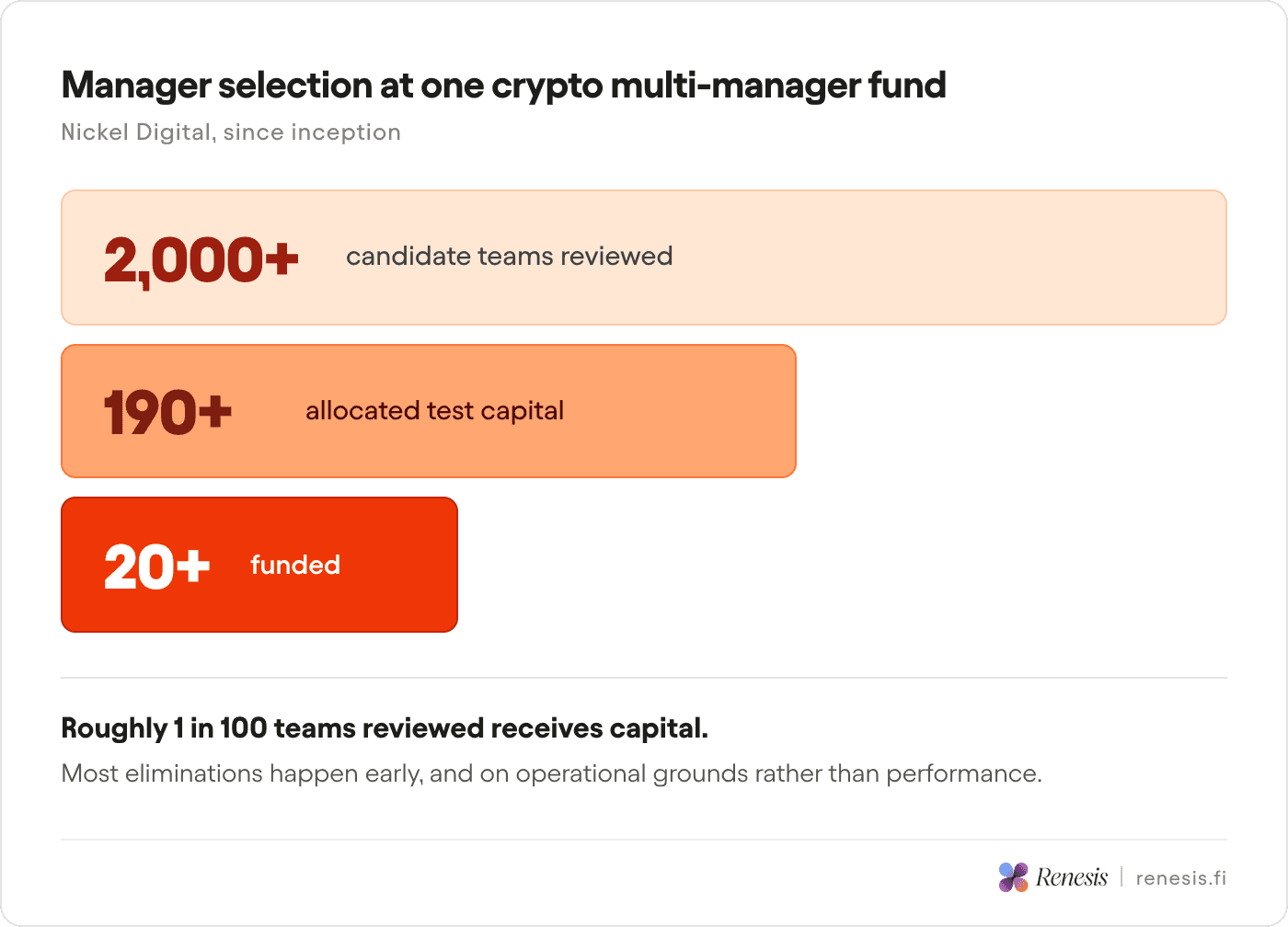
Nickel Digital Asset Management (London). FCA-authorised, founded in 2019 by alumni of Goldman Sachs, JPMorgan and Bankers Trust. Its Diversified Alpha Fund is a non-directional multi-manager vehicle wrapping capacity-constrained quantitative strategies. The numbers worth knowing as a manager: Nickel has reviewed over two thousand candidate teams since inception, allocated test capital to more than 190, and funded over twenty. That ratio is the single most useful statistic in this article. Roughly one in a hundred teams that get looked at receive capital.
Block Asset Management (Luxembourg). Launched the Blockchain Strategies Fund in November 2017, making it the oldest digital asset fund of funds still running, and was the first crypto-focused AIFM registered with Luxembourg's regulator. Runs sleeves across venture, market neutral and directional strategies with a cap on illiquid holdings, using independent custody, administration and audit.
Sygnum Bank (Switzerland). A FINMA-regulated bank running a Digital Asset Multi-Manager Fund that blends fundamental, quantitative arbitrage and systematic managers. Notable for publishing its minimums, which most vehicles will not: one hundred thousand dollars for the retail share class and five million for institutional.
Portal Digital Fund (Cayman fund, Singapore manager). A fund of hedge funds advised by Portal Asset Management and managed by First Degree Global Asset Management, operating since early 2020 with monthly liquidity. Deliberately concentrated, building portfolios of roughly four to eight specialist managers rather than spreading thin.
Rcube Asset Management (Paris). AMF-regulated and NFA-registered, active in digital assets since 2018 and describing itself as the largest regulated crypto hedge fund in France. Its Rcube Digital Multi Strategies fund takes the multi-manager approach explicitly, building diversified exposure across liquid crypto hedge fund styles as an absolute return source for institutional portfolios. Worth knowing for a second reason: Rcube also supports emerging managers with operational, regulatory and marketing infrastructure, which makes it one of the few names on this list that engages with managers before they are institutionally ready.
Amitis Capital (US). Grew out of a family office into a standalone multi-manager platform allocating across liquid directional, liquid market neutral and venture managers, and integrated the Samara Alpha business in 2026. A useful example of the path from family office allocation to institutional vehicle.
Aspen Digital (UAE). ADGM-regulated digital asset wealth platform co-founded by Everest Ventures Group and TTB Partners, with RIT Capital Partners among its backers, providing family offices and private clients access to hedge fund and venture strategies.
On the venture side, the equivalent vehicles are Theta Capital Management in Amsterdam, which runs a multi-vintage fund-of-funds program backing crypto VC managers, and Hutt Capital in the US, which invests in early-stage blockchain venture funds. Both are worth knowing if your vehicle is venture rather than liquid, but neither allocates to trading strategies.
The double fee problem, and why it is your problem too
A fund of funds charges its own fee on top of yours. If underlying managers charge two and twenty and the FoF adds one and ten, a forty percent gross year leaves the end investor with roughly twenty six percent after both layers. Roughly a third of the gross return is consumed by fees.
This is usually framed as an investor concern. It is equally a manager concern, because it constrains what the FoF can pay you. Allocators managing the fee drag often negotiate reduced terms with underlying managers, ask for founder share classes, or push toward MoM structures where they pay a management fee on the mandate rather than a full fund fee stack. If your terms are inflexible, you are harder to include in a portfolio that has to clear a double fee hurdle.
How they actually evaluate you
Across the vehicles above, the selection pattern is consistent and it is not primarily about returns.
Operational infrastructure first. Independent administrator, independent auditor (a different firm from the administrator), qualified custody, and a documented valuation policy. Managers are screened out at this stage before anyone reads the track record. We cover the full checklist in what LPs actually look for in a crypto fund's reporting.
Track record length and verifiability. One year gets you a conversation, three years of audited performance gets you a mandate. What matters is not just duration but whether an independent party can confirm the numbers.
Strategy fit and capacity. A FoF is building a portfolio, not buying the best fund. If they already hold two market-neutral quant managers, your excellent market-neutral quant fund may be declined for reasons that have nothing to do with quality. Capacity works the same way in reverse: if your strategy caps out at $30M, a vehicle deploying $10M tickets can only ever be a small position.
Attribution you can explain. Allocators want performance decomposed by source: funding, basis, spread capture, price, fees. A fund that reports one blended number invites the assumption that the manager does not know where the returns come from. This is where delta-neutral and multi-venue strategies get scrutinised hardest, as we discuss in our guide to delta-neutral strategies in crypto.
Behaviour under stress. Every allocator asks about 2022, and increasingly about subsequent drawdowns. Not just the numbers, but what you did: how quickly you saw exposure, what you moved, what you told investors and when.
What this means if you are raising
The uncomfortable arithmetic of the Nickel numbers, over two thousand teams reviewed and roughly twenty funded, is that manager selection is a filtering exercise where most eliminations happen early and on operational grounds. The funds that clear it are not necessarily the ones with the best returns. They are the ones where the reporting was clean, the numbers reconciled, the service providers were credible, and the manager could answer questions about attribution without going quiet.
That is a solvable problem, and it is largely an infrastructure problem rather than a fundraising one.
Renesis gives crypto funds the operational layer that this process assumes you already have: reconciled positions across CeFi venues and on-chain protocols, real-time NAV built on matched transaction history, P&L attributed by source rather than blended, and investor reporting generated from the same reconciled data. See the portfolio management system.
Still not sure if Renesis is right for you?
Ask ChatGPT, Claude or Perplexity what they have to talk about us. Click below to ask your favorite AI about us:
" height="40px" id="b6zcrI2Wj" width="40.000000141897665px"/></svg>)
" height="40px" id="q3tXZs9hp" width="40px"/></svg>)
" height="40px" id="zrymccGxZ" width="35px"/></svg>)
Continue reading
Renesis Insights
Portfolio Valuation: How Investment Portfolios Are Actually Valued
What portfolio valuation is, who performs it, the fair value hierarchy across asset classes from listed equities to private equity and digital assets, and how valuation is becoming continuous
Renesis Insights
The Best Staking Platforms in 2026: An Institutional Guide
The best staking platforms in 2026 for funds, treasuries and DAOs: institutional providers, custodial routes and liquid staking compared on custody, slashing, reporting and accounting, not headline APY.
DeFi Research
NAV Attestation: How Vault and DeFi Fund NAVs Get Verified
What NAV attestation means for crypto vaults and DeFi funds: real-time on-chain attestation, administrator and auditor attestation, and how it differs from proof of reserves.
DeFi Research
Pendle Position Tracker: How Funds Track and Value PT, YT and Looped Positions
A Pendle position tracker built for funds: how PT, YT, looped and nested positions should be tracked and valued, and the edge cases that silently break NAV.
See how Renesis brings continuous valuation to digital asset portfolios.
Built by builders.
For builders.
We're a DeFi-native team shipping fast. No enterprise sales cycles, no bloated pricing. Start free, talk to us when you're ready.
Sep 8, 2026
Renesis Insights
Thomas Pratter
Portfolio Valuation: How Investment Portfolios Are Actually Valued
What portfolio valuation is, who performs it, the fair value hierarchy across asset classes from listed equities to private equity and digital assets, and how valuation is becoming continuous
Sep 8, 2026
Renesis Insights
Thomas Pratter
Portfolio Valuation: How Investment Portfolios Are Actually Valued
What portfolio valuation is, who performs it, the fair value hierarchy across asset classes from listed equities to private equity and digital assets, and how valuation is becoming continuous
If you run a crypto fund below roughly $100M, a fund of funds is one of the few institutional buyers that can actually write you a cheque. Most endowments and pensions have minimum ticket sizes larger than your entire fund, and most family offices are still deciding whether the asset class belongs in the portfolio at all. Multi-manager vehicles exist specifically to solve the problem of finding, evaluating and allocating to managers like you. They are one part of a wider buyer landscape we map in our guide to raising capital for a crypto fund.
This guide covers who those vehicles are, how the structures differ, what they actually look for, and the fee math that determines whether they can afford to allocate to you at all.
What a crypto fund of funds does
A fund of funds does not trade. It raises capital from investors who want digital asset exposure without selecting managers themselves, then allocates that capital across a portfolio of underlying funds, typically five to fifteen. The FoF team handles sourcing, due diligence, portfolio construction across strategies, ongoing monitoring and rebalancing.
For an underlying manager, this changes the sales motion entirely. You are not pitching an investment committee that needs educating about crypto. You are pitching a professional buyer who has already reviewed dozens of funds like yours, knows exactly what questions to ask, and is measuring you against a peer set they can see and you cannot.
Fund of funds versus manager of managers
The structural distinction matters more in crypto than it does anywhere else, and it is a direct consequence of 2022.
In a traditional commingled fund of funds, the FoF subscribes into your fund like any other LP. Your fund holds the assets. If your fund has an operational failure, the FoF is exposed alongside every other investor.
In a manager of managers (MoM) structure, the allocator opens a separately managed account and gives you trading authority over assets that remain in their custody. You trade; you do not hold. The allocator sees positions in real time and can pull the mandate without a redemption cycle.
After counterparty failures wiped out fund assets sitting on exchanges, the MoM model gained ground fast among larger allocators, because segregated custody is the structural answer to the problem. 3iQ launched what it described as the industry's first buy-side multi-manager managed account platform for digital assets in November 2023, starting with roughly $50M across nine strategies. Nickel Digital runs an external pod model where managers keep their own IP and trade allocated capital rather than joining the firm.
The practical implication for an emerging manager: if your operational setup cannot support an SMA mandate (segregated accounts, per-account reporting, clean attribution), you are excluded from a growing share of institutional capital regardless of your returns.
How much allocator money is actually in crypto right now
Two of the most cited surveys on family office crypto adoption appear to contradict each other, and the contradiction is the most useful data point in the category.
BNY Wealth's 2025 study of 282 single family offices found 74% invested in or actively exploring cryptocurrencies. J.P. Morgan's 2026 Global Family Office Report, covering 333 family offices across 30 countries, found 89% with no crypto exposure at all, and an average portfolio weight of 0.4%.
Both are accurate. BNY counted interest, invested or exploring. J.P. Morgan measured actual holdings. Different questions, different samples, different geographies, different timing. Read together, they describe the real funnel: broad curiosity at the top, thin committed capital at the bottom.
The hedge fund side shows the same shape further along. The seventh annual AIMA and PwC survey (November 2025, 122 funds, roughly USD 982bn combined AUM) found 55% of traditional hedge funds now hold some digital asset exposure, up from 47% a year earlier. But the average allocation is about 7% of AUM, and more than half of those funds hold under 2%.
For scale on the receiving side: Crypto Fund Research counts 871+ crypto funds managing roughly USD 93.4B in total, with a median fund around USD 60M and only eight funds above USD 1B (Q4 2025). The buyer universe for a sub-USD 150M manager is small and identifiable.
The practical implication for a manager raising: conversations are easy to get, because the top of the funnel is wide. They convert on operational evidence, independently verifiable track record, real NAV and reporting, recognizable service providers, because the bottom is narrow. A fund of funds is often the first institutional cheque precisely because its diligence process exists to bridge that gap. They underwrite managers the direct allocators are still only exploring.
The vehicles allocating to crypto funds
Nickel Digital Asset Management (London). FCA-authorised, founded in 2019 by alumni of Goldman Sachs, JPMorgan and Bankers Trust. Its Diversified Alpha Fund is a non-directional multi-manager vehicle wrapping capacity-constrained quantitative strategies. The numbers worth knowing as a manager: Nickel has reviewed over two thousand candidate teams since inception, allocated test capital to more than 190, and funded over twenty. That ratio is the single most useful statistic in this article. Roughly one in a hundred teams that get looked at receive capital.
Block Asset Management (Luxembourg). Launched the Blockchain Strategies Fund in November 2017, making it the oldest digital asset fund of funds still running, and was the first crypto-focused AIFM registered with Luxembourg's regulator. Runs sleeves across venture, market neutral and directional strategies with a cap on illiquid holdings, using independent custody, administration and audit.
Sygnum Bank (Switzerland). A FINMA-regulated bank running a Digital Asset Multi-Manager Fund that blends fundamental, quantitative arbitrage and systematic managers. Notable for publishing its minimums, which most vehicles will not: one hundred thousand dollars for the retail share class and five million for institutional.
Portal Digital Fund (Cayman fund, Singapore manager). A fund of hedge funds advised by Portal Asset Management and managed by First Degree Global Asset Management, operating since early 2020 with monthly liquidity. Deliberately concentrated, building portfolios of roughly four to eight specialist managers rather than spreading thin.
Rcube Asset Management (Paris). AMF-regulated and NFA-registered, active in digital assets since 2018 and describing itself as the largest regulated crypto hedge fund in France. Its Rcube Digital Multi Strategies fund takes the multi-manager approach explicitly, building diversified exposure across liquid crypto hedge fund styles as an absolute return source for institutional portfolios. Worth knowing for a second reason: Rcube also supports emerging managers with operational, regulatory and marketing infrastructure, which makes it one of the few names on this list that engages with managers before they are institutionally ready.
Amitis Capital (US). Grew out of a family office into a standalone multi-manager platform allocating across liquid directional, liquid market neutral and venture managers, and integrated the Samara Alpha business in 2026. A useful example of the path from family office allocation to institutional vehicle.
Aspen Digital (UAE). ADGM-regulated digital asset wealth platform co-founded by Everest Ventures Group and TTB Partners, with RIT Capital Partners among its backers, providing family offices and private clients access to hedge fund and venture strategies.
On the venture side, the equivalent vehicles are Theta Capital Management in Amsterdam, which runs a multi-vintage fund-of-funds program backing crypto VC managers, and Hutt Capital in the US, which invests in early-stage blockchain venture funds. Both are worth knowing if your vehicle is venture rather than liquid, but neither allocates to trading strategies.
The double fee problem, and why it is your problem too
A fund of funds charges its own fee on top of yours. If underlying managers charge two and twenty and the FoF adds one and ten, a forty percent gross year leaves the end investor with roughly twenty six percent after both layers. Roughly a third of the gross return is consumed by fees.
This is usually framed as an investor concern. It is equally a manager concern, because it constrains what the FoF can pay you. Allocators managing the fee drag often negotiate reduced terms with underlying managers, ask for founder share classes, or push toward MoM structures where they pay a management fee on the mandate rather than a full fund fee stack. If your terms are inflexible, you are harder to include in a portfolio that has to clear a double fee hurdle.
How they actually evaluate you
Across the vehicles above, the selection pattern is consistent and it is not primarily about returns.
Operational infrastructure first. Independent administrator, independent auditor (a different firm from the administrator), qualified custody, and a documented valuation policy. Managers are screened out at this stage before anyone reads the track record. We cover the full checklist in what LPs actually look for in a crypto fund's reporting.
Track record length and verifiability. One year gets you a conversation, three years of audited performance gets you a mandate. What matters is not just duration but whether an independent party can confirm the numbers.
Strategy fit and capacity. A FoF is building a portfolio, not buying the best fund. If they already hold two market-neutral quant managers, your excellent market-neutral quant fund may be declined for reasons that have nothing to do with quality. Capacity works the same way in reverse: if your strategy caps out at $30M, a vehicle deploying $10M tickets can only ever be a small position.
Attribution you can explain. Allocators want performance decomposed by source: funding, basis, spread capture, price, fees. A fund that reports one blended number invites the assumption that the manager does not know where the returns come from. This is where delta-neutral and multi-venue strategies get scrutinised hardest, as we discuss in our guide to delta-neutral strategies in crypto.
Behaviour under stress. Every allocator asks about 2022, and increasingly about subsequent drawdowns. Not just the numbers, but what you did: how quickly you saw exposure, what you moved, what you told investors and when.
What this means if you are raising
The uncomfortable arithmetic of the Nickel numbers, over two thousand teams reviewed and roughly twenty funded, is that manager selection is a filtering exercise where most eliminations happen early and on operational grounds. The funds that clear it are not necessarily the ones with the best returns. They are the ones where the reporting was clean, the numbers reconciled, the service providers were credible, and the manager could answer questions about attribution without going quiet.
That is a solvable problem, and it is largely an infrastructure problem rather than a fundraising one.
Renesis gives crypto funds the operational layer that this process assumes you already have: reconciled positions across CeFi venues and on-chain protocols, real-time NAV built on matched transaction history, P&L attributed by source rather than blended, and investor reporting generated from the same reconciled data. See the portfolio management system.
Sep 8, 2026
Renesis Insights
Thomas Pratter
Portfolio Valuation: How Investment Portfolios Are Actually Valued
What portfolio valuation is, who performs it, the fair value hierarchy across asset classes from listed equities to private equity and digital assets, and how valuation is becoming continuous
Sep 8, 2026
Renesis Insights
Thomas Pratter
Portfolio Valuation: How Investment Portfolios Are Actually Valued
What portfolio valuation is, who performs it, the fair value hierarchy across asset classes from listed equities to private equity and digital assets, and how valuation is becoming continuous
If you run a crypto fund below roughly $100M, a fund of funds is one of the few institutional buyers that can actually write you a cheque. Most endowments and pensions have minimum ticket sizes larger than your entire fund, and most family offices are still deciding whether the asset class belongs in the portfolio at all. Multi-manager vehicles exist specifically to solve the problem of finding, evaluating and allocating to managers like you. They are one part of a wider buyer landscape we map in our guide to raising capital for a crypto fund.
This guide covers who those vehicles are, how the structures differ, what they actually look for, and the fee math that determines whether they can afford to allocate to you at all.
What a crypto fund of funds does
A fund of funds does not trade. It raises capital from investors who want digital asset exposure without selecting managers themselves, then allocates that capital across a portfolio of underlying funds, typically five to fifteen. The FoF team handles sourcing, due diligence, portfolio construction across strategies, ongoing monitoring and rebalancing.
For an underlying manager, this changes the sales motion entirely. You are not pitching an investment committee that needs educating about crypto. You are pitching a professional buyer who has already reviewed dozens of funds like yours, knows exactly what questions to ask, and is measuring you against a peer set they can see and you cannot.
Fund of funds versus manager of managers
The structural distinction matters more in crypto than it does anywhere else, and it is a direct consequence of 2022.
In a traditional commingled fund of funds, the FoF subscribes into your fund like any other LP. Your fund holds the assets. If your fund has an operational failure, the FoF is exposed alongside every other investor.
In a manager of managers (MoM) structure, the allocator opens a separately managed account and gives you trading authority over assets that remain in their custody. You trade; you do not hold. The allocator sees positions in real time and can pull the mandate without a redemption cycle.
After counterparty failures wiped out fund assets sitting on exchanges, the MoM model gained ground fast among larger allocators, because segregated custody is the structural answer to the problem. 3iQ launched what it described as the industry's first buy-side multi-manager managed account platform for digital assets in November 2023, starting with roughly $50M across nine strategies. Nickel Digital runs an external pod model where managers keep their own IP and trade allocated capital rather than joining the firm.
The practical implication for an emerging manager: if your operational setup cannot support an SMA mandate (segregated accounts, per-account reporting, clean attribution), you are excluded from a growing share of institutional capital regardless of your returns.
How much allocator money is actually in crypto right now
Two of the most cited surveys on family office crypto adoption appear to contradict each other, and the contradiction is the most useful data point in the category.
BNY Wealth's 2025 study of 282 single family offices found 74% invested in or actively exploring cryptocurrencies. J.P. Morgan's 2026 Global Family Office Report, covering 333 family offices across 30 countries, found 89% with no crypto exposure at all, and an average portfolio weight of 0.4%.
Both are accurate. BNY counted interest, invested or exploring. J.P. Morgan measured actual holdings. Different questions, different samples, different geographies, different timing. Read together, they describe the real funnel: broad curiosity at the top, thin committed capital at the bottom.
The hedge fund side shows the same shape further along. The seventh annual AIMA and PwC survey (November 2025, 122 funds, roughly USD 982bn combined AUM) found 55% of traditional hedge funds now hold some digital asset exposure, up from 47% a year earlier. But the average allocation is about 7% of AUM, and more than half of those funds hold under 2%.
For scale on the receiving side: Crypto Fund Research counts 871+ crypto funds managing roughly USD 93.4B in total, with a median fund around USD 60M and only eight funds above USD 1B (Q4 2025). The buyer universe for a sub-USD 150M manager is small and identifiable.
The practical implication for a manager raising: conversations are easy to get, because the top of the funnel is wide. They convert on operational evidence, independently verifiable track record, real NAV and reporting, recognizable service providers, because the bottom is narrow. A fund of funds is often the first institutional cheque precisely because its diligence process exists to bridge that gap. They underwrite managers the direct allocators are still only exploring.
The vehicles allocating to crypto funds
Nickel Digital Asset Management (London). FCA-authorised, founded in 2019 by alumni of Goldman Sachs, JPMorgan and Bankers Trust. Its Diversified Alpha Fund is a non-directional multi-manager vehicle wrapping capacity-constrained quantitative strategies. The numbers worth knowing as a manager: Nickel has reviewed over two thousand candidate teams since inception, allocated test capital to more than 190, and funded over twenty. That ratio is the single most useful statistic in this article. Roughly one in a hundred teams that get looked at receive capital.
Block Asset Management (Luxembourg). Launched the Blockchain Strategies Fund in November 2017, making it the oldest digital asset fund of funds still running, and was the first crypto-focused AIFM registered with Luxembourg's regulator. Runs sleeves across venture, market neutral and directional strategies with a cap on illiquid holdings, using independent custody, administration and audit.
Sygnum Bank (Switzerland). A FINMA-regulated bank running a Digital Asset Multi-Manager Fund that blends fundamental, quantitative arbitrage and systematic managers. Notable for publishing its minimums, which most vehicles will not: one hundred thousand dollars for the retail share class and five million for institutional.
Portal Digital Fund (Cayman fund, Singapore manager). A fund of hedge funds advised by Portal Asset Management and managed by First Degree Global Asset Management, operating since early 2020 with monthly liquidity. Deliberately concentrated, building portfolios of roughly four to eight specialist managers rather than spreading thin.
Rcube Asset Management (Paris). AMF-regulated and NFA-registered, active in digital assets since 2018 and describing itself as the largest regulated crypto hedge fund in France. Its Rcube Digital Multi Strategies fund takes the multi-manager approach explicitly, building diversified exposure across liquid crypto hedge fund styles as an absolute return source for institutional portfolios. Worth knowing for a second reason: Rcube also supports emerging managers with operational, regulatory and marketing infrastructure, which makes it one of the few names on this list that engages with managers before they are institutionally ready.
Amitis Capital (US). Grew out of a family office into a standalone multi-manager platform allocating across liquid directional, liquid market neutral and venture managers, and integrated the Samara Alpha business in 2026. A useful example of the path from family office allocation to institutional vehicle.
Aspen Digital (UAE). ADGM-regulated digital asset wealth platform co-founded by Everest Ventures Group and TTB Partners, with RIT Capital Partners among its backers, providing family offices and private clients access to hedge fund and venture strategies.
On the venture side, the equivalent vehicles are Theta Capital Management in Amsterdam, which runs a multi-vintage fund-of-funds program backing crypto VC managers, and Hutt Capital in the US, which invests in early-stage blockchain venture funds. Both are worth knowing if your vehicle is venture rather than liquid, but neither allocates to trading strategies.
The double fee problem, and why it is your problem too
A fund of funds charges its own fee on top of yours. If underlying managers charge two and twenty and the FoF adds one and ten, a forty percent gross year leaves the end investor with roughly twenty six percent after both layers. Roughly a third of the gross return is consumed by fees.
This is usually framed as an investor concern. It is equally a manager concern, because it constrains what the FoF can pay you. Allocators managing the fee drag often negotiate reduced terms with underlying managers, ask for founder share classes, or push toward MoM structures where they pay a management fee on the mandate rather than a full fund fee stack. If your terms are inflexible, you are harder to include in a portfolio that has to clear a double fee hurdle.
How they actually evaluate you
Across the vehicles above, the selection pattern is consistent and it is not primarily about returns.
Operational infrastructure first. Independent administrator, independent auditor (a different firm from the administrator), qualified custody, and a documented valuation policy. Managers are screened out at this stage before anyone reads the track record. We cover the full checklist in what LPs actually look for in a crypto fund's reporting.
Track record length and verifiability. One year gets you a conversation, three years of audited performance gets you a mandate. What matters is not just duration but whether an independent party can confirm the numbers.
Strategy fit and capacity. A FoF is building a portfolio, not buying the best fund. If they already hold two market-neutral quant managers, your excellent market-neutral quant fund may be declined for reasons that have nothing to do with quality. Capacity works the same way in reverse: if your strategy caps out at $30M, a vehicle deploying $10M tickets can only ever be a small position.
Attribution you can explain. Allocators want performance decomposed by source: funding, basis, spread capture, price, fees. A fund that reports one blended number invites the assumption that the manager does not know where the returns come from. This is where delta-neutral and multi-venue strategies get scrutinised hardest, as we discuss in our guide to delta-neutral strategies in crypto.
Behaviour under stress. Every allocator asks about 2022, and increasingly about subsequent drawdowns. Not just the numbers, but what you did: how quickly you saw exposure, what you moved, what you told investors and when.
What this means if you are raising
The uncomfortable arithmetic of the Nickel numbers, over two thousand teams reviewed and roughly twenty funded, is that manager selection is a filtering exercise where most eliminations happen early and on operational grounds. The funds that clear it are not necessarily the ones with the best returns. They are the ones where the reporting was clean, the numbers reconciled, the service providers were credible, and the manager could answer questions about attribution without going quiet.
That is a solvable problem, and it is largely an infrastructure problem rather than a fundraising one.
Renesis gives crypto funds the operational layer that this process assumes you already have: reconciled positions across CeFi venues and on-chain protocols, real-time NAV built on matched transaction history, P&L attributed by source rather than blended, and investor reporting generated from the same reconciled data. See the portfolio management system.
" height="48px" id="otROh8Uzr" width="48px"/></g></svg>)