
LP Fundraising
Thomas Pratter
Family Offices Investing in Crypto Funds: What the Data Actually Shows
How family offices actually allocate to crypto funds in 2026, why the survey data contradicts itself, and what family office diligence demands from emerging managers.
Ask two reputable surveys how many family offices invest in crypto and you get answers that cannot both be right. BNY Wealth's 2025 study of 282 single family offices found 74% either invested in digital assets or actively exploring them, up more than twenty points in a year. J.P. Morgan's 2026 Global Family Office Report, covering 333 family offices across 30 countries, found 89% report no crypto exposure at all, with digital assets averaging 0.4% of portfolios.
For a manager trying to decide whether family offices are a realistic source of capital, that gap is the whole question. This article resolves it, then covers what family office diligence actually involves. For how the segment fits alongside the other buyer types, see our guide to raising capital for a crypto fund.
Why the surveys disagree
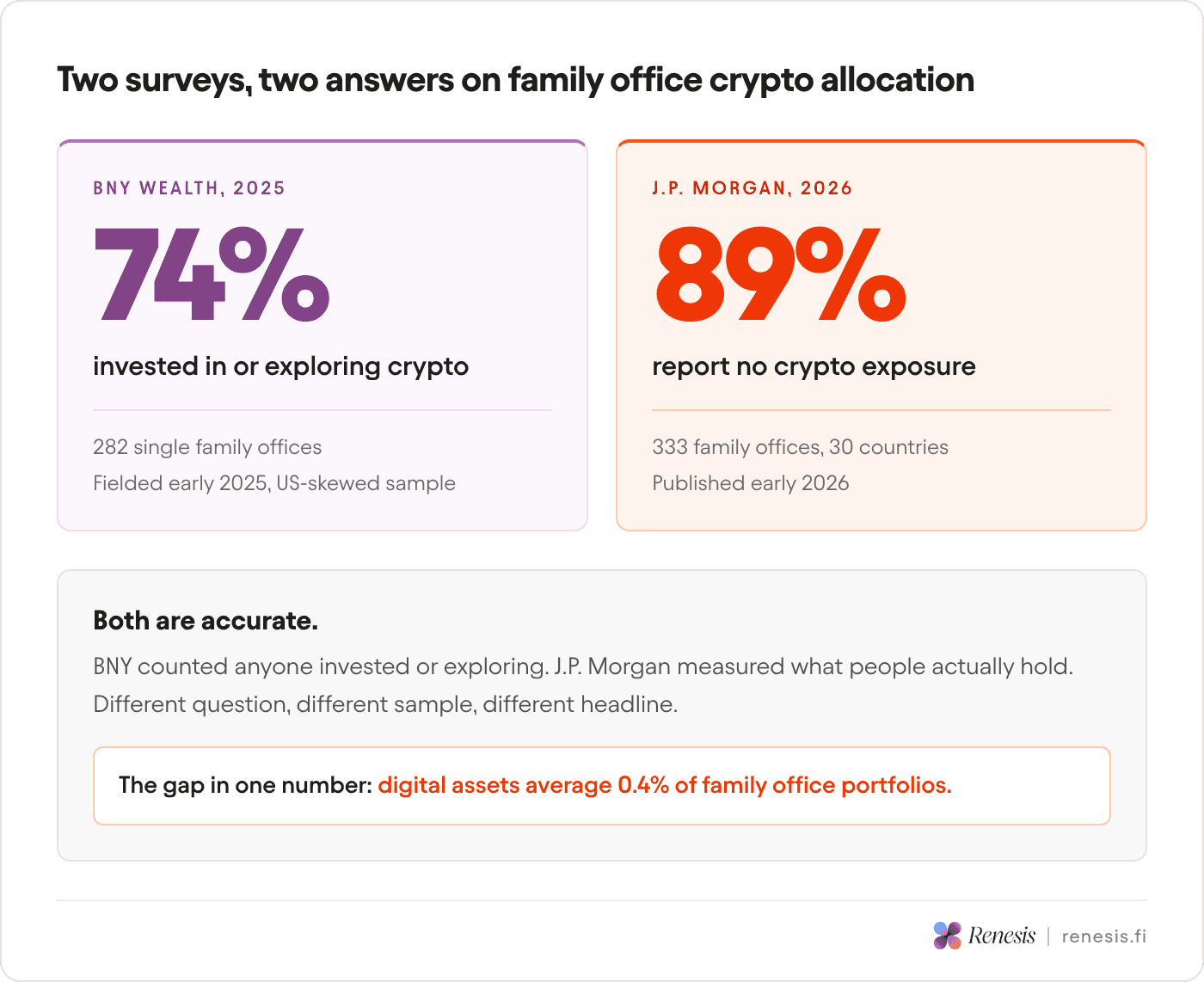
The contradiction is methodological, not a case of one survey being wrong.
Question wording does most of the work. BNY counts respondents who are invested or exploring. J.P. Morgan measures current holdings. "Exploring" is a sentiment measure, and in BNY's own data the exploring-but-not-invested group jumped from 6% to 28% in a single year. That is a large population of interested non-buyers being counted as engagement in one survey and as zero exposure in the other.
The samples are different populations. BNY surveyed single family offices, most managing between $500M and $5B, a group that is self-directed and unusually influenced by next-generation family members. J.P. Morgan surveyed its own private bank's family office clients across 30 countries, a broader and more internationally conservative base.
Geography and timing. BNY's respondents skew US, fielded in early 2025 when 86% of US respondents said the election outcome made them more likely to consider crypto. J.P. Morgan's data spans thirty countries and was published in early 2026.
Read together, the honest conclusion is this: interest is high and rising, committed allocations remain small and concentrated. Both things are true. A manager who plans a fundraise around the 74% figure will be disappointed. A manager who dismisses the segment because of the 89% figure will miss the small number of family offices that are genuinely deploying.
That pattern matches what the wider institutional data shows. AIMA and PwC's late-2025 survey of 122 hedge fund managers running roughly $982bn found just over half of traditional hedge funds now have some digital asset exposure, up from 47% the year before, but 52% of those with exposure hold less than 2% of AUM. Broad participation, small positions.
Family offices with publicly disclosed crypto fund activity
Family offices disclose selectively, so any list is a list of the ones that chose to be visible. That is a meaningful filter: the offices below have publicly signalled their activity, which usually means they are open to conversations.
VMS Group (Hong Kong, roughly $4B) made its first crypto allocation in 2025, committing up to $10M to a DeFi hedge fund running a market-neutral strategy. Its managing partner publicly described choosing a fund over direct token exposure specifically to limit volatility, as part of a wider shift toward liquid strategies after two decades focused on private equity. This is the clearest publicly documented example of the behaviour managers should understand: the first crypto allocation goes to a market-neutral fund, not to beta.
Maelstrom, the family office founded by BitMEX co-founder Arthur Hayes, disclosed in late 2025 that it was raising at least $250M for a crypto private equity fund targeting mid-sized crypto infrastructure businesses. Notably, the firm is also an LP in crypto venture funds and has been publicly critical of the risk-adjusted returns delivered by the largest crypto VC vehicles.
RIT Capital Partners, the London-listed investment trust associated with the Rothschild family, is a disclosed backer of Aspen Digital, the ADGM-regulated digital asset wealth platform. This represents a distinct model: rather than allocating directly to funds, backing the platform through which allocation happens.
Everest Ventures Group and TTB Partners (Hong Kong) co-founded that same platform, and the Amitis family office in the US institutionalised its own crypto allocation into a standalone multi-manager fund, an instructive example of a family office deciding the opportunity justified building a vehicle rather than writing cheques.
Farro Capital, a Singapore multi-family office that crossed $1B in AUM within months of launching, has been reported to be making LP commitments to digital asset strategies as part of a broader alternatives mandate.
How family office diligence differs
Family offices are not small institutions. They are a different kind of buyer, and managers who pitch them like pensions tend to fail.
Decisions are faster but less predictable. There is often no investment committee, no quarterly cycle, and no formal mandate. A principal who becomes convinced can commit in weeks. The same principal can also go quiet indefinitely without a process to appeal to.
Relationships carry more weight than process. Introductions matter disproportionately, and reputational risk is personal rather than institutional. A family office allocating to you is putting the family's name on the decision.
Operational scrutiny is often lighter on paper and heavier in person. Many family offices lack a dedicated operational due diligence function, so instead of a formal ODD report you get direct questions from someone who will notice if your answers are vague. In practice they are asking the same things institutional allocators ask: who holds the assets, who calculates NAV, who audits it, what happens if you get hit by a bus.
Lean back offices shape what they can buy. A family office with a two-person investment team cannot manage ten separate fund relationships. This is exactly why multi-manager vehicles exist, and why some family offices access crypto through a fund of funds rather than direct manager selection.
Reporting quality is a proxy for everything else. With limited capacity to run deep operational reviews, family offices lean on what they can observe. A monthly report that arrives on time, reconciles, and explains attribution clearly builds confidence that the operation behind it is sound. A report that arrives late or contains numbers that move retroactively does the opposite, permanently.
What this means if you are raising
Three practical conclusions from the data.
First, target the offices that have already made a first allocation. The evidence consistently shows the hard step is the first commitment, not the second. Offices that have crossed that line are dramatically easier to talk to than offices still deciding whether the asset class is real.
First allocations also skew heavily toward market-neutral and lower-volatility strategies. If you run directional beta, you are usually not the first crypto allocation a family office makes.
Second, expect long diligence before small tickets. Public commentary from managers who work with this segment consistently describes extended review periods before first commitments. Family offices behave like long-horizon buyers doing careful work, not opportunistic traders.
Third, the constraint is almost never your returns. It is whether the operation behind the returns looks like something a family would be comfortable explaining to the next generation.
Renesis provides the operational layer family office diligence assumes: reconciled positions across exchanges and on-chain protocols, real-time NAV from matched transaction history, P&L attributed by source, and investor reporting generated from the same reconciled data rather than assembled by hand. See the portfolio management system.
Still not sure if Renesis is right for you?
Ask ChatGPT, Claude or Perplexity what they have to talk about us. Click below to ask your favorite AI about us:
" height="40px" id="b6zcrI2Wj" width="40.000000141897665px"/></svg>)
" height="40px" id="q3tXZs9hp" width="40px"/></svg>)
" height="40px" id="zrymccGxZ" width="35px"/></svg>)
Continue reading
Renesis Insights
Portfolio Valuation: How Investment Portfolios Are Actually Valued
What portfolio valuation is, who performs it, the fair value hierarchy across asset classes from listed equities to private equity and digital assets, and how valuation is becoming continuous
Renesis Insights
The Best Staking Platforms in 2026: An Institutional Guide
The best staking platforms in 2026 for funds, treasuries and DAOs: institutional providers, custodial routes and liquid staking compared on custody, slashing, reporting and accounting, not headline APY.
DeFi Research
NAV Attestation: How Vault and DeFi Fund NAVs Get Verified
What NAV attestation means for crypto vaults and DeFi funds: real-time on-chain attestation, administrator and auditor attestation, and how it differs from proof of reserves.
DeFi Research
Pendle Position Tracker: How Funds Track and Value PT, YT and Looped Positions
A Pendle position tracker built for funds: how PT, YT, looped and nested positions should be tracked and valued, and the edge cases that silently break NAV.
See how Renesis brings continuous valuation to digital asset portfolios.
Built by builders.
For builders.
We're a DeFi-native team shipping fast. No enterprise sales cycles, no bloated pricing. Start free, talk to us when you're ready.
Sep 8, 2026
Renesis Insights
Thomas Pratter
Portfolio Valuation: How Investment Portfolios Are Actually Valued
What portfolio valuation is, who performs it, the fair value hierarchy across asset classes from listed equities to private equity and digital assets, and how valuation is becoming continuous
Sep 8, 2026
Renesis Insights
Thomas Pratter
Portfolio Valuation: How Investment Portfolios Are Actually Valued
What portfolio valuation is, who performs it, the fair value hierarchy across asset classes from listed equities to private equity and digital assets, and how valuation is becoming continuous
Ask two reputable surveys how many family offices invest in crypto and you get answers that cannot both be right. BNY Wealth's 2025 study of 282 single family offices found 74% either invested in digital assets or actively exploring them, up more than twenty points in a year. J.P. Morgan's 2026 Global Family Office Report, covering 333 family offices across 30 countries, found 89% report no crypto exposure at all, with digital assets averaging 0.4% of portfolios.
For a manager trying to decide whether family offices are a realistic source of capital, that gap is the whole question. This article resolves it, then covers what family office diligence actually involves. For how the segment fits alongside the other buyer types, see our guide to raising capital for a crypto fund.
Why the surveys disagree
The contradiction is methodological, not a case of one survey being wrong.
Question wording does most of the work. BNY counts respondents who are invested or exploring. J.P. Morgan measures current holdings. "Exploring" is a sentiment measure, and in BNY's own data the exploring-but-not-invested group jumped from 6% to 28% in a single year. That is a large population of interested non-buyers being counted as engagement in one survey and as zero exposure in the other.
The samples are different populations. BNY surveyed single family offices, most managing between $500M and $5B, a group that is self-directed and unusually influenced by next-generation family members. J.P. Morgan surveyed its own private bank's family office clients across 30 countries, a broader and more internationally conservative base.
Geography and timing. BNY's respondents skew US, fielded in early 2025 when 86% of US respondents said the election outcome made them more likely to consider crypto. J.P. Morgan's data spans thirty countries and was published in early 2026.
Read together, the honest conclusion is this: interest is high and rising, committed allocations remain small and concentrated. Both things are true. A manager who plans a fundraise around the 74% figure will be disappointed. A manager who dismisses the segment because of the 89% figure will miss the small number of family offices that are genuinely deploying.
That pattern matches what the wider institutional data shows. AIMA and PwC's late-2025 survey of 122 hedge fund managers running roughly $982bn found just over half of traditional hedge funds now have some digital asset exposure, up from 47% the year before, but 52% of those with exposure hold less than 2% of AUM. Broad participation, small positions.
Family offices with publicly disclosed crypto fund activity
Family offices disclose selectively, so any list is a list of the ones that chose to be visible. That is a meaningful filter: the offices below have publicly signalled their activity, which usually means they are open to conversations.
VMS Group (Hong Kong, roughly $4B) made its first crypto allocation in 2025, committing up to $10M to a DeFi hedge fund running a market-neutral strategy. Its managing partner publicly described choosing a fund over direct token exposure specifically to limit volatility, as part of a wider shift toward liquid strategies after two decades focused on private equity. This is the clearest publicly documented example of the behaviour managers should understand: the first crypto allocation goes to a market-neutral fund, not to beta.
Maelstrom, the family office founded by BitMEX co-founder Arthur Hayes, disclosed in late 2025 that it was raising at least $250M for a crypto private equity fund targeting mid-sized crypto infrastructure businesses. Notably, the firm is also an LP in crypto venture funds and has been publicly critical of the risk-adjusted returns delivered by the largest crypto VC vehicles.
RIT Capital Partners, the London-listed investment trust associated with the Rothschild family, is a disclosed backer of Aspen Digital, the ADGM-regulated digital asset wealth platform. This represents a distinct model: rather than allocating directly to funds, backing the platform through which allocation happens.
Everest Ventures Group and TTB Partners (Hong Kong) co-founded that same platform, and the Amitis family office in the US institutionalised its own crypto allocation into a standalone multi-manager fund, an instructive example of a family office deciding the opportunity justified building a vehicle rather than writing cheques.
Farro Capital, a Singapore multi-family office that crossed $1B in AUM within months of launching, has been reported to be making LP commitments to digital asset strategies as part of a broader alternatives mandate.
How family office diligence differs
Family offices are not small institutions. They are a different kind of buyer, and managers who pitch them like pensions tend to fail.
Decisions are faster but less predictable. There is often no investment committee, no quarterly cycle, and no formal mandate. A principal who becomes convinced can commit in weeks. The same principal can also go quiet indefinitely without a process to appeal to.
Relationships carry more weight than process. Introductions matter disproportionately, and reputational risk is personal rather than institutional. A family office allocating to you is putting the family's name on the decision.
Operational scrutiny is often lighter on paper and heavier in person. Many family offices lack a dedicated operational due diligence function, so instead of a formal ODD report you get direct questions from someone who will notice if your answers are vague. In practice they are asking the same things institutional allocators ask: who holds the assets, who calculates NAV, who audits it, what happens if you get hit by a bus.
Lean back offices shape what they can buy. A family office with a two-person investment team cannot manage ten separate fund relationships. This is exactly why multi-manager vehicles exist, and why some family offices access crypto through a fund of funds rather than direct manager selection.
Reporting quality is a proxy for everything else. With limited capacity to run deep operational reviews, family offices lean on what they can observe. A monthly report that arrives on time, reconciles, and explains attribution clearly builds confidence that the operation behind it is sound. A report that arrives late or contains numbers that move retroactively does the opposite, permanently.
What this means if you are raising
Three practical conclusions from the data.
First, target the offices that have already made a first allocation. The evidence consistently shows the hard step is the first commitment, not the second. Offices that have crossed that line are dramatically easier to talk to than offices still deciding whether the asset class is real.
First allocations also skew heavily toward market-neutral and lower-volatility strategies. If you run directional beta, you are usually not the first crypto allocation a family office makes.
Second, expect long diligence before small tickets. Public commentary from managers who work with this segment consistently describes extended review periods before first commitments. Family offices behave like long-horizon buyers doing careful work, not opportunistic traders.
Third, the constraint is almost never your returns. It is whether the operation behind the returns looks like something a family would be comfortable explaining to the next generation.
Renesis provides the operational layer family office diligence assumes: reconciled positions across exchanges and on-chain protocols, real-time NAV from matched transaction history, P&L attributed by source, and investor reporting generated from the same reconciled data rather than assembled by hand. See the portfolio management system.
Sep 8, 2026
Renesis Insights
Thomas Pratter
Portfolio Valuation: How Investment Portfolios Are Actually Valued
What portfolio valuation is, who performs it, the fair value hierarchy across asset classes from listed equities to private equity and digital assets, and how valuation is becoming continuous
Sep 8, 2026
Renesis Insights
Thomas Pratter
Portfolio Valuation: How Investment Portfolios Are Actually Valued
What portfolio valuation is, who performs it, the fair value hierarchy across asset classes from listed equities to private equity and digital assets, and how valuation is becoming continuous
Ask two reputable surveys how many family offices invest in crypto and you get answers that cannot both be right. BNY Wealth's 2025 study of 282 single family offices found 74% either invested in digital assets or actively exploring them, up more than twenty points in a year. J.P. Morgan's 2026 Global Family Office Report, covering 333 family offices across 30 countries, found 89% report no crypto exposure at all, with digital assets averaging 0.4% of portfolios.
For a manager trying to decide whether family offices are a realistic source of capital, that gap is the whole question. This article resolves it, then covers what family office diligence actually involves. For how the segment fits alongside the other buyer types, see our guide to raising capital for a crypto fund.
Why the surveys disagree
The contradiction is methodological, not a case of one survey being wrong.
Question wording does most of the work. BNY counts respondents who are invested or exploring. J.P. Morgan measures current holdings. "Exploring" is a sentiment measure, and in BNY's own data the exploring-but-not-invested group jumped from 6% to 28% in a single year. That is a large population of interested non-buyers being counted as engagement in one survey and as zero exposure in the other.
The samples are different populations. BNY surveyed single family offices, most managing between $500M and $5B, a group that is self-directed and unusually influenced by next-generation family members. J.P. Morgan surveyed its own private bank's family office clients across 30 countries, a broader and more internationally conservative base.
Geography and timing. BNY's respondents skew US, fielded in early 2025 when 86% of US respondents said the election outcome made them more likely to consider crypto. J.P. Morgan's data spans thirty countries and was published in early 2026.
Read together, the honest conclusion is this: interest is high and rising, committed allocations remain small and concentrated. Both things are true. A manager who plans a fundraise around the 74% figure will be disappointed. A manager who dismisses the segment because of the 89% figure will miss the small number of family offices that are genuinely deploying.
That pattern matches what the wider institutional data shows. AIMA and PwC's late-2025 survey of 122 hedge fund managers running roughly $982bn found just over half of traditional hedge funds now have some digital asset exposure, up from 47% the year before, but 52% of those with exposure hold less than 2% of AUM. Broad participation, small positions.
Family offices with publicly disclosed crypto fund activity
Family offices disclose selectively, so any list is a list of the ones that chose to be visible. That is a meaningful filter: the offices below have publicly signalled their activity, which usually means they are open to conversations.
VMS Group (Hong Kong, roughly $4B) made its first crypto allocation in 2025, committing up to $10M to a DeFi hedge fund running a market-neutral strategy. Its managing partner publicly described choosing a fund over direct token exposure specifically to limit volatility, as part of a wider shift toward liquid strategies after two decades focused on private equity. This is the clearest publicly documented example of the behaviour managers should understand: the first crypto allocation goes to a market-neutral fund, not to beta.
Maelstrom, the family office founded by BitMEX co-founder Arthur Hayes, disclosed in late 2025 that it was raising at least $250M for a crypto private equity fund targeting mid-sized crypto infrastructure businesses. Notably, the firm is also an LP in crypto venture funds and has been publicly critical of the risk-adjusted returns delivered by the largest crypto VC vehicles.
RIT Capital Partners, the London-listed investment trust associated with the Rothschild family, is a disclosed backer of Aspen Digital, the ADGM-regulated digital asset wealth platform. This represents a distinct model: rather than allocating directly to funds, backing the platform through which allocation happens.
Everest Ventures Group and TTB Partners (Hong Kong) co-founded that same platform, and the Amitis family office in the US institutionalised its own crypto allocation into a standalone multi-manager fund, an instructive example of a family office deciding the opportunity justified building a vehicle rather than writing cheques.
Farro Capital, a Singapore multi-family office that crossed $1B in AUM within months of launching, has been reported to be making LP commitments to digital asset strategies as part of a broader alternatives mandate.
How family office diligence differs
Family offices are not small institutions. They are a different kind of buyer, and managers who pitch them like pensions tend to fail.
Decisions are faster but less predictable. There is often no investment committee, no quarterly cycle, and no formal mandate. A principal who becomes convinced can commit in weeks. The same principal can also go quiet indefinitely without a process to appeal to.
Relationships carry more weight than process. Introductions matter disproportionately, and reputational risk is personal rather than institutional. A family office allocating to you is putting the family's name on the decision.
Operational scrutiny is often lighter on paper and heavier in person. Many family offices lack a dedicated operational due diligence function, so instead of a formal ODD report you get direct questions from someone who will notice if your answers are vague. In practice they are asking the same things institutional allocators ask: who holds the assets, who calculates NAV, who audits it, what happens if you get hit by a bus.
Lean back offices shape what they can buy. A family office with a two-person investment team cannot manage ten separate fund relationships. This is exactly why multi-manager vehicles exist, and why some family offices access crypto through a fund of funds rather than direct manager selection.
Reporting quality is a proxy for everything else. With limited capacity to run deep operational reviews, family offices lean on what they can observe. A monthly report that arrives on time, reconciles, and explains attribution clearly builds confidence that the operation behind it is sound. A report that arrives late or contains numbers that move retroactively does the opposite, permanently.
What this means if you are raising
Three practical conclusions from the data.
First, target the offices that have already made a first allocation. The evidence consistently shows the hard step is the first commitment, not the second. Offices that have crossed that line are dramatically easier to talk to than offices still deciding whether the asset class is real.
First allocations also skew heavily toward market-neutral and lower-volatility strategies. If you run directional beta, you are usually not the first crypto allocation a family office makes.
Second, expect long diligence before small tickets. Public commentary from managers who work with this segment consistently describes extended review periods before first commitments. Family offices behave like long-horizon buyers doing careful work, not opportunistic traders.
Third, the constraint is almost never your returns. It is whether the operation behind the returns looks like something a family would be comfortable explaining to the next generation.
Renesis provides the operational layer family office diligence assumes: reconciled positions across exchanges and on-chain protocols, real-time NAV from matched transaction history, P&L attributed by source, and investor reporting generated from the same reconciled data rather than assembled by hand. See the portfolio management system.
" height="48px" id="otROh8Uzr" width="48px"/></g></svg>)